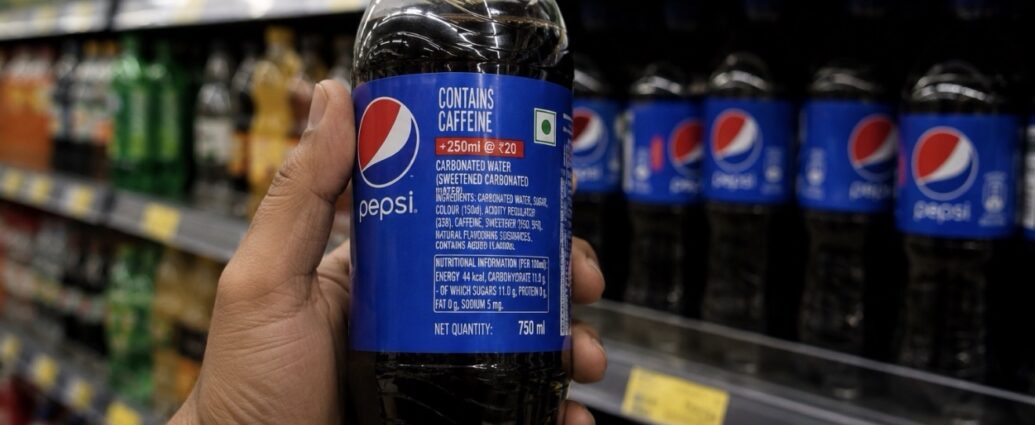
PepsiCo has a problem in the world’s fastest-growing major consumer economy — and it is not a competitor, a supply chain disruption, or a pricing challenge.
It is a smartphone camera pointed at an ingredient label, and the millions of Indian consumers now watching what it reveals.
One of the world’s largest packaged food and beverages companies, PepsiCo, is the latest global giant to respond to rapidly changing customer preferences in India.
“Today, more than 50% of our beverage portfolio in India comprises low- to no-sugar offerings,” said Nitin Bhandari, Vice President and General Manager of Beverages at PepsiCo India, adding that the company aims to “scale low- and no-sugar options to 90% of our beverage portfolio over time in India.”
PepsiCo gathers consumer insights through engagement forums, social media, and its WhatsApp-based consumer loyalty platform, PepGenie.
Reaching 90% low- or no-sugar beverages in India would represent one of the most sweeping product reformulations PepsiCo has undertaken in any major global market.
For a company whose core beverage business was built on full-sugar carbonated drinks, the shift is a direct response to a force that did not exist a decade ago:
Viral social media content that has turned label-reading into a mainstream consumer habit across a country of 1.4 billion people.
The Video That Changed Everything
The flashpoint that crystallized the new reality for global food brands came when a fitness influencer posted a viral video scrutinizing the sugar content in Bournvita — the chocolate malt drink owned by Mondelez and marketed to Indian families for decades as a nutritional supplement for children.
Following growing public backlash, Mondelez reduced the sugar content in its Bournvita offering, according to local media reports.
The influencer was pressured to take the original clip down — but the damage to Bournvita’s health halo was irreversible.
The Indian food safety regulator followed up by issuing notices barring malt-based beverages such as Bournvita from using “health drinks” branding and labeling.
Mondelez did not respond to requests for comment.
The reverberations extended well beyond Bournvita.
Every global brand selling packaged food or beverages in India suddenly faced the same uncomfortable question:
What happens when an influencer points a camera at the ingredient list and tens of millions of consumers watch?
Dabur — whose Real fruit juice brand also came under fire from label-reading social media creators — told CNBC it had been reducing sugar in its juice offerings since 2018 and had cut sugar content by 21% by 2023.
“We are currently working on sugar reduction to the tune of an additional 20% in the Real core beverage range,” a company spokesperson said, adding that the company is developing low-sugar and zero-sugar variants to serve a rapidly growing health-conscious consumer base.
Why India Is the Prize Every Global Brand Wants
The scale and urgency of these reformulations reflect the extraordinary economic opportunity India now represents for global consumer companies.
In the next five years, India’s income per capita is expected to grow at the highest rate among the top five emerging markets for consumer products — outpacing China, Brazil, Mexico, and Russia — according to Bain & Company, making it a priority for global consumer companies.
Global companies already dominate the world’s fastest-growing major consumer market across 20 product categories, from soft drinks and spirits to savory snacks, detergents, and diapers.
That dominance, however, is no longer guaranteed by brand recognition and distribution muscle alone — the two advantages global companies have historically used to lock in emerging market consumers.
A rising Indian middle class with smartphones, social media access, and growing health consciousness is demanding that products match their packaging claims.
When they do not, the consequences now spread at the speed of a share button.
India’s advertising expenditure is projected to reach ₹1,476 billion — roughly $15.9 billion — by 2026, with social media and online video accounting for the two largest slices of that spending.
Social advertising is projected to overtake television as the largest advertising format in India within the next five years — a fundamental shift in how brands reach Indian consumers.
Over 73% of internet subscribers in India now consume content in regional languages, with an estimated regional language user base of 540 million people — a $53 billion market opportunity for brands that can communicate in the languages their customers actually speak.
For global consumer brands accustomed to running English-language campaigns and relying on urban brand recognition, that number represents both a challenge and an enormous untapped growth opportunity.
The New Playbook — Digital First
PepsiCo’s response goes beyond reformulating its products.
Ankit Agarwal, Marketing Director for Doritos at PepsiCo India, described a structural shift in how the company approaches its Indian consumers.
“Over the last couple of years, we have become a digital-first brand. While traditional remains important for scale, digital allows us to have a more personal, two-way conversation with our audience,” he said.
The entire journey from product discovery to purchase can now happen in minutes on a smartphone — AI reduces friction in discovery, and quick-commerce delivery platforms complete the transaction.
That shift from a broadcast model to a pull model is significant.
Historically, global brands built awareness through television advertising and waited for consumers to recall them at the point of purchase.
In India today, consumers actively seek recommendations — often through social media creators or AI interfaces — and move directly to a purchase platform, bypassing traditional retail discovery entirely.
For American investors and companies tracking emerging market consumer growth, the India story carries a direct and practical message.
The brands that will win in India’s expanding middle class are not necessarily the ones with the largest advertising budgets or the most shelf space.
They are the ones that can listen — through social media, through data platforms, through direct consumer engagement — and then move fast enough to earn trust in a market where a single viral video can undo decades of brand equity overnight.
PepsiCo’s commitment to a 90% low- or no-sugar beverage portfolio in India is the most concrete illustration yet of how seriously the world’s largest consumer brands are taking that lesson.
The old playbook is being rewritten — one label-reading influencer at a time.
© JBizNews.com. All rights reserved. This article is original reporting by JBizNews Desk. Unauthorized reproduction or redistribution is strictly prohibited.