The past two and a half years have been challenging for the aviation industry in Israel. During the Swords of Iron War, virtually all international airlines—including the large American carriers—stopped flying to Israel. Many carriers were concerned that ballistic missiles hurtling through the air could strike an airliner or damage Ben Gurion Airport. Within a short time, only one airline continued to offer flights to New York, creating a severe shortage of seats and a dramatic spike in ticket prices that persisted throughout much of the war.
Responding to the shortage of flights, strong public demand, and an urgent request from the business sector—especially the Israeli high-tech industry, which needed to maintain mobility between Israel and the United States even during wartime—Arkia Airlines decided to offer New York-bound travelers an affordable solution. Minister of Transportation Miri Regev also approached Arkia and urged the company to enter this vital route. In just three months, the airline succeeded in leasing a widebody aircraft, navigating the complex American bureaucracy, establishing a complete operational infrastructure, training crews, and launching service to New York—a complex process executed rapidly under crisis conditions.
Arkia CEO Oz Berlowitz recalls, “The first flight was on February 8, 2025. It began as a kind of high-tech startup idea. At the time, only El Al was flying to New York, and an economy ticket cost around $6,000–$7,000.
“We began the service as a three-month startup, and now we’ve marked a full year of operations. Very quickly, we discovered extremely high demand. In fact, business class sold out before economy, indicating how strong the demand was. Last summer, we operated six weekly flights, and beginning this March, we returned to six weekly flights. We began with one widebody aircraft; today we operate three Airbus A330 aircraft.”
All of this was quite an accomplishment for Arkia, which, at its founding in 1949 as Israel Inland Airlines, flew DC-3s and De Havilland DH.89s to Eilat. Over the years, Arika upgraded its domestic routes, introduced modern aircraft, and became a major carrier to the Greek islands, other European destinations, and Asia.
The opening of the New York route marked a strategic leap for Arkia—from operating a regional network in nearby destinations and Europe to building an Israeli airline capable of operating long-haul flights on a significant scale. Arkia has continued this trend and has expanded to additional transatlantic destinations. It has also begun operating direct flights to Vietnam and Bangkok.
Although the security situation improved somewhat during the war, the shortage of flights and high prices persisted, and Arkia’s entry into the market sparked real competition, leading to a dramatic drop in prices across the entire sector.
Berlowitz sums up Arkia’s accomplishments over the past year: “This was an extraordinary year for Israeli aviation in general and for Arkia in particular. We operated in a complex security reality that included the continuation of the Gaza war and the 12-day conflict with Iran last June, yet we kept Israel’s skies open and significantly expanded the company’s activity. Throughout the year, we remained attentive to the Israeli public and to levels of demand. We doubled the size of our fleet, opened new routes to New York and Thailand, added flights to high-demand destinations, and at the same time invested in expanding our service center and improving service and operational punctuality.
Most recently, throughout “Operation Roaring Lion,” Arkia found creative solutions when Israel’s airspace was completely closed, ensuring the critical New York route continued to operate, albeit through complex and unconventional means. During this period, the airline operated under particularly challenging conditions, continuously adapting to an evolving security reality and exceptional operational constraints. At the same time, Arkia maintained essential flight activity, assisted in bringing Israelis back home, and worked to preserve air connectivity wherever possible. This period underscored Arkia’s commitment to the Israeli public during times of crisis, as well as its ability to act quickly, flexibly, and creatively.
“We are ending the year with nearly 70 percent growth in passenger numbers,” says Berlowitz. “Our entry into New York at the height of the war created real competition and lowered ticket prices, and the announcement of renewed flights to Thailand led to a significant price reduction in the market. We are proud of the momentum the company is experiencing and thank the Israeli public for their trust and for choosing to fly with us.”
Currently, Arkia continues to move forward with a clear long-term commitment — it is here to stay. The New York route operates regularly from Tel Aviv and serves as a central pillar of the company’s growth strategy and international expansion. Arkia continues to strengthen this route, with a strong focus on stability, reliability, and an advanced passenger experience.
The success of the New York route proved that there is room for an additional Israeli player in the international arena and strengthened management’s decision to continue expanding into East Asia. In November, Arkia began flying to Bangkok. In January, it began operating direct flights to Hanoi, a destination with no direct service from Israel, and this July, Arkia will launch a weekly flight to Phuket. Berlowitz adds that its flights to Hanoi will continue through May and will resume in September.
Since the introduction of direct flights to New York, Arkia now operates four widebody aircraft dedicated to long-haul routes, all featuring three service classes: Economy, Premium Economy, and Business Class—a scale of operation unprecedented in the airline’s history.
This development is not a one-off initiative but part of a multi-year growth plan aimed at transforming Arkia into a major player in long-haul destinations and creating real competition for the Israeli consumer. Berlowitz explains that within five years, Arkia will be operating 20 aircraft, including widebody jets, and will be offering service to at least two North American destinations, as well as continuing and possibly expanding its routes to the Far East.
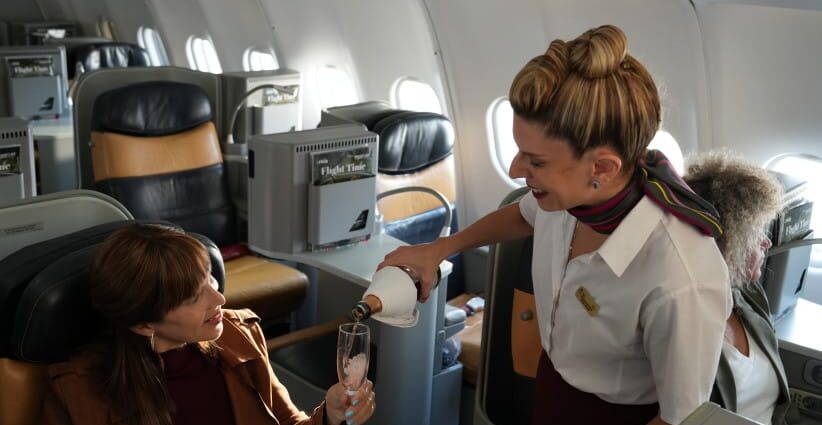
Flights to New York operate using leased Airbus A330 widebody aircraft, with an Israeli crew on every flight. The deluxe Business Class features spacious seats that open into fully flat 180-degree beds measuring 2 meters, expanded baggage allowances, personal amenity kits, full VIP service, and a premium dining menu, designed to offer passengers a highly upgraded, luxurious travel experience. Round-trip tickets to New York include two full kosher meals, one checked bag up to 23kg, and a carry-on weighing up to 8kg.
“Our level of service is excellent,” says Berlowitz. “The business-class seat is top tier, fully flat, with everything included. We invest heavily in service quality – in the meals, in the overall service, in the product itself and what the passenger receives, and in the training of the flight attendants.
“We were used to flying to European destinations, where the competition is mainly against low-cost carriers and local airlines, where the most important thing for passengers is to get there as quickly as possible and at the lowest price.
“With New York, we’ve discovered – and we’re constantly learning – that what matters just as much is the product itself: what you receive, at what time, how the service feels, what kind of food is offered, the level of kashrut, which movies are available, what entertainment programs, what blanket, what pillow – to that level of detail. It’s extremely important, and we have a dedicated team that handles this constantly.”
A valuable addition to Arkia’s flights to New York, explains Berlowitz, is its new interline agreement with JetBlue, enabling Arkia passengers to easily connect to numerous destinations across the United States, the Caribbean, and Latin America.
Berlowitz says that today’s airline passengers are always on top of what is happening in the industry, and airlines need to maintain a high level of service. “Today’s passenger looks at everything. They know everything — everything is accessible. They see all the competition, all the prices, the service levels, and the flight times. There are countless WhatsApp groups of agents and customers. To maintain standards in that environment, airlines have to work extremely hard. It’s an ongoing challenge, demanding excellence at every step.”
This article was written in collaboration with Arkia.