The core recommendation in a report released Thursday is simple enough to state in one line: New Jersey should not shut down a working power plant until the thing meant to replace it is built, connected, and proven to deliver on the hottest and coldest days of the year.
The Garden State Initiative, a nonpartisan research group based in Morristown, is calling on Trenton to replace the state’s current Energy Master Plan with what it describes as a more practical roadmap — one built on realistic timelines, proven technologies and measurable benchmarks rather than fixed mandates. The report, titled “Reliability Before Retirement,” was written by policy analyst Anurag Bhat.
The argument rests on a supply problem that has already shown up on bills. New Jersey imports close to a fifth of the electricity it uses, which leaves it leaning on neighboring states whenever demand spikes. More than two-thirds of the state’s summer generating capacity in 2024 came from natural gas. Battery storage, which the previous administration counted on to fill gaps when solar and wind are not producing, stands at roughly 5% of its target. Retiring firm generation before that gap closes, the report argues, means buying more power from the regional market at whatever it costs that day.
“New Jersey can pursue cleaner electricity while protecting affordability and reliability,” said Audrey Lane, the group’s president, who framed the fix as building new supply before dependable resources are retired.
The framework the report proposes has three parts. Preserve means keeping existing nuclear plants, gas plants and access to the regional PJM market. Build means adding resources that are cost-effective and actually deliverable, including the transmission lines needed to move the power. Prepare means evaluating the next generation of clean, firm technologies on a technology-neutral basis — judged on cost and performance rather than on which category they fall into. The report also reviews energy planning in California, New York, New England, Pennsylvania and Texas, concluding that none is a model to copy but each offers usable lessons.
The policy landscape it lands in has already shifted. Governor Phil Murphy released the 2024 Energy Master Plan last November, a roadmap developed over roughly 22 months. It calls for 100% clean electricity by 2035 and steep emissions cuts by midcentury. It arrived as PJM Interconnection, the grid operator serving New Jersey and a dozen other states, struggled with surging demand from artificial-intelligence data centers, and after capacity auctions added billions in costs across the region — showing up as a roughly 20% jump in summer electricity bills that became a central issue in the governor’s race.
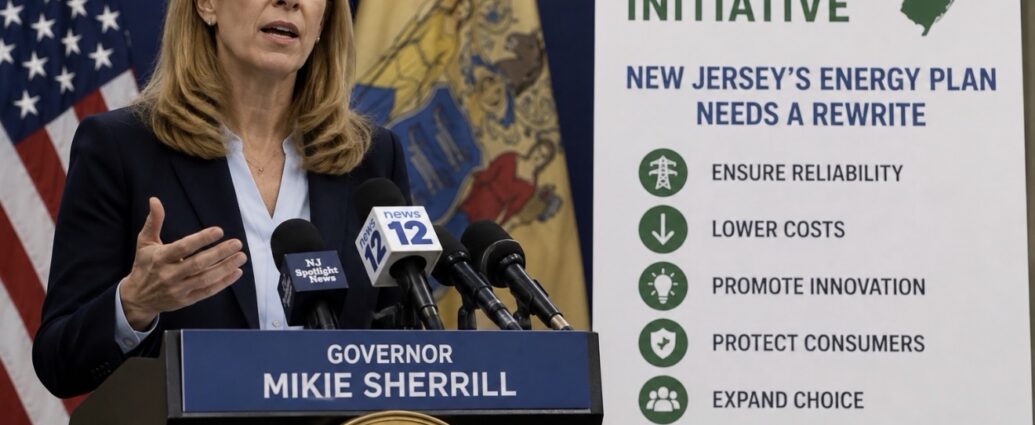
Governor Mikie Sherrill signed two executive orders on her first day in office in January, directing the Board of Public Utilities to expand ratepayer bill credits and pause proceedings that could approve new rate increases. A second set of orders aimed at supply expanded solar generation and battery storage, sought new natural gas capacity, and directed a study of new nuclear power. She has since signed legislation lifting a 40-year nuclear moratorium and launched a state nuclear task force. Nuclear currently produces about 42% of the state’s electricity and natural gas about 49%.
That overlap matters: on preserving nuclear and adding gas, the report and the governor are largely pointed the same direction. Where they differ is on pace and on whether the 2035 target should remain a mandate.
Not everyone accepts the premise. Alex Ambrose, a policy analyst at New Jersey Policy Perspective, welcomed the push to build renewables faster and cut permitting delays, arguing it lowers bills long-term, but rejected the case for new gas plants outright, saying there is no economic or other justification for building them in New Jersey. The disagreement is fundamentally about risk: whether the bigger danger is paying for gas capacity that later sits idle, or retiring capacity the state still needs.
For New Jersey employers, the number that matters is the one on the invoice. Electricity prices in the state remain well above the national average, with demand rising and supply tightening. Residents spend an average of $178 a month on energy and gas. The bill credits ordered in January are one-time relief — the previous round cost roughly $430 million and Sherrill’s is expected to run higher — which is precisely the distinction the report draws. Rebates lower this month’s bill. Supply lowers next decade’s.
JBizNews Desk | Trenton, N.J.
© JBizNews.com All Rights Reserved. Reproduction or distribution without written permission is prohibited.