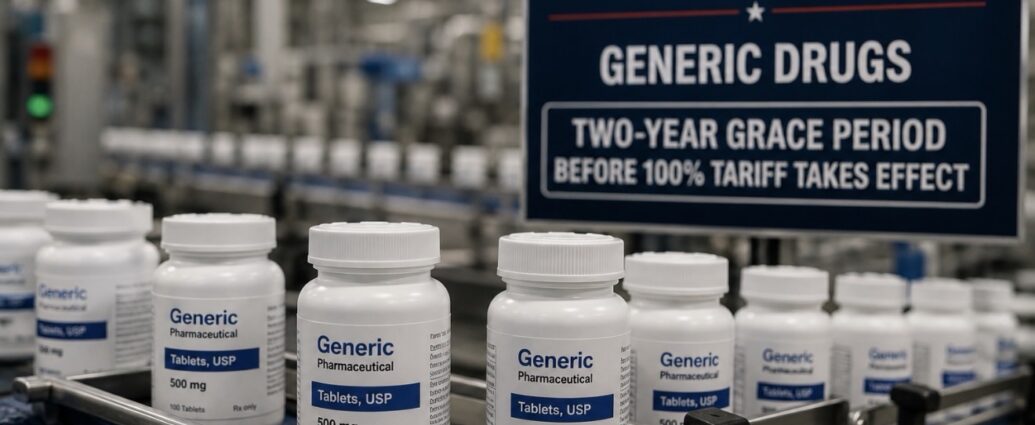
President Donald Trump announced on Truth Social Tuesday that imported generic drugs will carry a 0% tariff for two years beginning August 1, before the rate climbs to 100% for one year and then to 200% thereafter. The phased schedule pushes the first real cost onto importers in August 2028, giving manufacturers a runway the administration says is meant for one purpose: moving production onto American soil.
Trump framed the escalating duties as leverage rather than immediate policy. The goal, he wrote, is to reshore generic pharmaceutical production into America, with a penalty for companies that decline to build plants and equipment within the window they’ve been given. Branded and patented medicines are untouched by Tuesday’s move; that policy stays as it stands under the Section 232 order the White House issued in April.
The stakes are defined by scale. More than 90% of medicines sold in the United States are generics, according to the Food and Drug Administration — the low-cost, high-volume backbone of American pharmacies, hospital formularies, and Medicare Part D. A tariff of 100%, doubling to 200%, aimed at that segment is not a niche trade adjustment. It targets the exact category most Americans depend on to fill routine prescriptions, which is precisely why the administration built in a two-year delay before any charge takes effect.
Import geography sharpens the picture. India alone supplies close to half of the generic medicines used in the U.S. market, and Indian producers have long anchored the affordable end of the global drug supply chain. Industry figures there noted earlier this year that most large Indian manufacturers already run U.S. manufacturing or repackaging operations and have been exploring further acquisitions — a hedge that looks more valuable now that a concrete tariff date sits on the calendar. Companies with existing or planned domestic footprints are best positioned to sidestep the levy; those importing finished generics from abroad without a U.S. facility face the sharpest exposure.
The move fits a broader pressure campaign the administration has run on drugmakers throughout the year. Trump has leaned on his most-favored-nation pricing framework, which ties U.S. drug prices to the lower amounts paid in other wealthy countries. Under the April framework, companies that sign MFN pricing agreements with Health and Human Services and onshoring agreements with the Commerce Department qualify for a 0% tariff running through January 20, 2029. More than a dozen major drugmakers, including Eli Lilly, Pfizer, and Novo Nordisk, have already struck deals lowering prices on new and existing medicines in exchange for tariff relief.
For the generic sector specifically, the calculus is different than it is for branded pharma. Generic margins are thin by design — the entire business model runs on volume and price competition. A manufacturer weighing whether to build a U.S. plant has to measure the capital cost of new facilities against a tariff that, for now, is a 2028 problem rather than a 2026 one. That gap is the pressure point the administration is betting on: enough time to make a plant decision rational, enough penalty to make inaction expensive.
The supply-chain security argument underpins the whole effort. The administration has repeatedly cast domestic pharmaceutical capacity as a national-security matter, arguing that dependence on foreign production of essential medicines is a vulnerability in a period of strained global logistics. Whether tariffs are the right instrument to rebuild that capacity — or whether they mainly raise costs on the medicines Americans already struggle to afford — is the debate the next two years will settle.
For now, nothing changes at the pharmacy counter. Generic imports continue at zero tariff through August 2028. The signal to manufacturers, though, is unambiguous: the clock has started, and the cost of staying offshore has a number attached to it.
JBizNews Desk | Washington, D.C.
© JBizNews.com All Rights Reserved. Reproduction or distribution without written permission is prohibited.