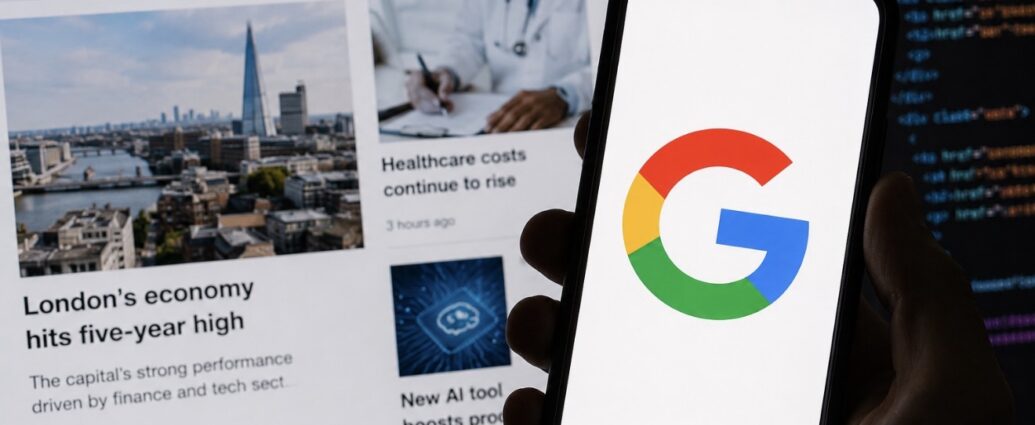
Make no mistake about what is happening here: Google is taking the business out from under the very people who built it. For twenty years the arrangement powered newsrooms, paid salaries, and floated entire media companies — publishers put their work on the web, Google sent the readers, everyone ate. Now Google has figured out it doesn’t need to send the reader anywhere. It can keep the audience, keep the ad money, and leave the publisher who did the actual work with an empty page. That’s not a partnership anymore. That’s a company using the people who feed it as unpaid raw material.
The mechanism is Google’s AI Overviews — the AI summaries now planted at the very top of search results that answer the question before a reader clicks a thing. The publisher paid the writer, ran the reporting, footed the bill. Google scrapes the answer, serves it up as its own, and pockets the visit. The reader never arrives. The traffic dies on Google’s page, and the business it used to feed dies with it.
And this should sound familiar, because a bigger company ran this exact play first. Amazon spent years inviting independent sellers onto its marketplace, watching which of their products caught fire — and then, according to a Wall Street Journal investigation built on interviews with more than 20 former employees, using those sellers’ own private sales data to launch competing Amazon-brand versions and undercut them. Employees had a name for slipping past the internal rules to get at individual seller numbers: “going over the fence.” One described the logic bluntly, saying they knew they shouldn’t, but they were building Amazon products and wanted them to sell. A small company’s bestselling car-trunk organizer became a template Amazon reportedly copied. Amazon denied using individual seller data, insisted its private label was a sliver of sales, and launched an internal investigation — but for the sellers who created those markets and then got buried by the house brand, the damage was done. Many simply closed shop.
That is the pattern now landing on publishers. Let the little guys prove what’s valuable, harvest the value, then compete against them with their own material. The platform that promised to be a lifeline turns out to have been studying you the whole time.
And the numbers say the harvest is well underway. Roughly 58% of Google searches now end with zero clicks to any outside site. Referrals to news sites fell about 33% over the course of 2025, tracked across more than 2,500 outlets. In the hardest-hit corners — travel, lifestyle, how-to — the drops run past 50% year over year, and DMG Media, owner of the Daily Mail, has documented click-through rates collapsing by nearly 90% on some searches the instant an AI summary appears above the links. That is not a slump. That is the floor giving way beneath a twenty-year-old business model.
So publishers are now weighing something that would have been unthinkable a few years ago: cutting Google off entirely. In a survey of more than 350 search professionals, roughly a third said they intend to block Google’s AI features the moment Google gives them a clean way to do it, with another quarter undecided. When a third of an industry is ready to walk away from its single biggest source of traffic, that’s not a complaint. That’s a revolt.
Here’s the trap, and it’s cruel by design. Publishers can’t yet block the AI summary without blocking themselves out of Google search altogether — the tools to separate the two barely exist. Google said in late January it was “exploring” opt-out controls, with no timeline and no promises. Until those arrive, refusing the AI Overview means vanishing from search completely, trading a slow bleed for instant death. Google knows it. That’s the leverage.
Which is why the fight has moved to the courts. Penske Media — behind Rolling Stone, Variety, Billboard, and The Hollywood Reporter — is pressing an antitrust suit accusing Google of abusing its search monopoly to force AI Overviews on publishers whether they consent or not. Chegg brought its own case after a 49% collapse in non-subscriber traffic. The European Publishers Council has filed in Brussels, and the UK’s competition regulator has been running a consultation on these exact questions. The pressure is coming from every direction, because the numbers finally got too big to explain away.
What makes this genuinely serious is where Google says it’s going: turning search from something that points you to the web into something that answers and acts for you directly — an engine designed to keep you on Google and off everyone else’s site. If that’s the destination, the traffic publishers built everything on isn’t down temporarily. It’s being engineered out of existence.
The lifeline is still tied around their waist. The question keeping publishers up at night is whether it’s holding them up — or dragging them under.
JBizNews Desk | New York
© JBizNews.com All Rights Reserved. Reproduction or distribution without written permission is prohibited.