
By JBizNews Desk
June 2, 2026
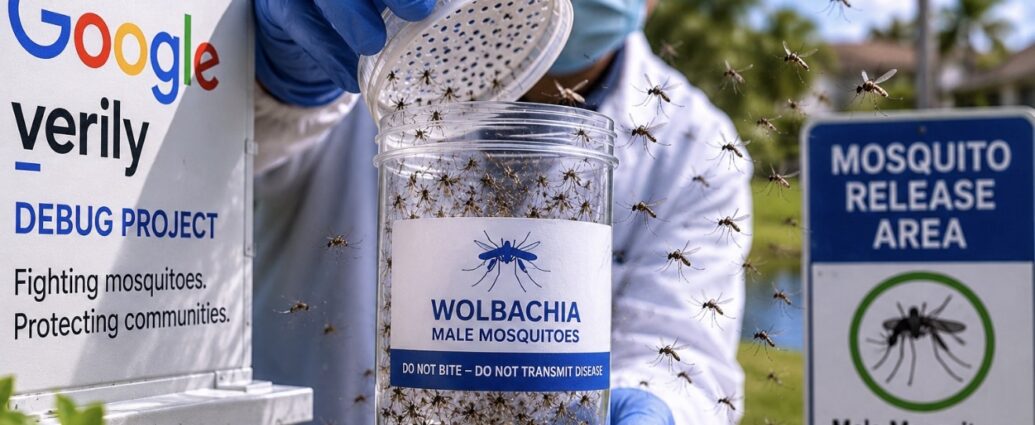
WASHINGTON — Alphabet Inc. is asking federal regulators for permission to release up to 32 million laboratory-bred mosquitoes across California and Florida over the next two years, a proposal that sounds alarming at first glance but is designed to do the opposite: reduce mosquito populations and limit the spread of disease.
The request, currently under review by the U.S. Environmental Protection Agency (EPA), was submitted by Verily, Alphabet’s life-sciences subsidiary, as part of its long-running Debug Project. The filing was published in the Federal Register on Monday, opening a public-comment period before regulators decide whether to approve the plan.
If approved, Verily would release approximately 16 million mosquitoes annually in each of the next two years at locations that have not yet been publicly identified.
The proposal may seem counterintuitive.
Why would a company fight mosquitoes by releasing millions more of them?
The answer lies in the type of mosquito being released.
Verily breeds male Aedes aegypti mosquitoes carrying a naturally occurring bacterium known as Wolbachia. When these males mate with wild female mosquitoes, the resulting eggs fail to hatch, reducing mosquito populations over time.
The males themselves do not bite humans and cannot transmit disease.
The approach is based on the Sterile Insect Technique, a method used for decades to combat agricultural pests including fruit flies and screwworms. What makes Verily’s effort different is the scale.
The company has spent years developing automated systems capable of breeding, sorting, and distributing mosquitoes in volumes large enough for widespread deployment.
According to Verily, automation and data-driven production techniques could dramatically reduce costs compared with traditional mosquito-control methods.
The public-health implications are significant.
The targeted mosquito species, Aedes aegypti, is responsible for spreading diseases including dengue fever, Zika virus, yellow fever, and chikungunya.
The Centers for Disease Control and Prevention has repeatedly identified mosquitoes as one of the world’s most dangerous disease vectors. Globally, mosquito-borne illnesses affect hundreds of millions of people annually and contribute to hundreds of thousands of deaths each year.
While the United States does not experience the same levels of mosquito-borne disease seen in tropical regions, outbreaks have increased in recent years.
Florida has periodically reported locally transmitted cases of dengue and Zika, while California has seen expanding populations of invasive mosquito species as temperatures rise and climate conditions change.
For state and local governments, mosquito control is big business.
Counties and municipalities spend millions of taxpayer dollars each year on spraying programs, public education campaigns, larvicide treatments, and monitoring operations designed to limit mosquito populations.
Verily argues that biological control methods could eventually reduce dependence on chemical pesticides.
That claim has attracted attention throughout the pest-control industry.
Traditional mosquito-management programs rely heavily on insecticides and field crews tasked with identifying breeding sites. If Verily’s approach proves effective and economically competitive, it could reshape portions of the mosquito-control market and create new competition for existing providers.
For Alphabet, the proposal represents something larger than a public-health initiative.
The project is part of the company’s broader effort to expand beyond its core advertising and search businesses.
Over the years, Alphabet has invested billions of dollars into “Other Bets” ventures ranging from autonomous vehicles and healthcare technologies to life sciences and environmental solutions.
Many of those projects have struggled to become profitable commercial businesses.
Verily’s mosquito program is viewed internally as one of the more promising opportunities to build a scalable service with measurable public-health outcomes.
A successful EPA approval could serve as an important validation of both the technology and the underlying business model.
The potential market is substantial.
Mosquito-control programs operate worldwide, particularly in regions where mosquito-borne diseases place significant burdens on healthcare systems and local economies.
Tourism-dependent destinations are especially vulnerable.
A disease outbreak can quickly discourage travel, reduce hotel occupancy, and impact local businesses. For states such as Florida, where tourism represents a major economic engine, mosquito management carries direct economic importance.
Environmental groups and community organizations are expected to closely examine the proposal during the EPA review process.
Questions remain regarding release locations, long-term monitoring requirements, ecological impacts, and overall program costs.
Verily maintains that the released mosquitoes pose minimal environmental risk because only male insects are used and the Wolbachia-based approach does not involve genetic modification.
Still, any proposal involving the release of millions of insects is likely to generate public scrutiny.
For now, the decision rests with federal regulators.
What appears on the surface to be an unusual science experiment is, in reality, a test of whether a major technology company can transform a public-health intervention into a scalable commercial business.
If the EPA grants approval, California and Florida could become the first major proving grounds for a strategy that Alphabet hopes can be deployed around the world.
Washington — JBizNews Desk
© JBizNews.com All Rights Reserved. Reproduction or distribution without written permission is prohibited.





