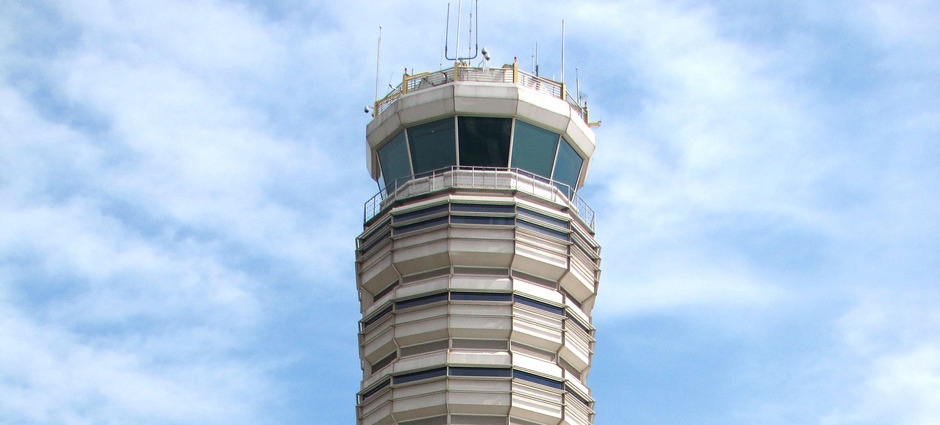
Reagan National Airport control tower, Arlington, Va., April 2012 file photo. redlegsfan21/Wikimedia Commons; cropped, CC BY-SA 2.0.
House and Senate transportation committee leaders reached an agreement in principle Tuesday on a requirement for aircraft to receive nearby traffic signals, moving a civil aviation safety bill closer to a final deal after the deadly 2025 collision near Washington’s Reagan National Airport.
The agreement covers civil aviation provisions, not the entire bill. Details involving the House and Senate Armed Services committees remain unresolved, and lawmakers have not announced that a final comprehensive measure has become law.
Receiving traffic signals, not only broadcasting them
Under the framework, aircraft already required to broadcast their location using ADS-B Out would also be required to receive those signals through ADS-B In, Senate Commerce Committee Chairman Ted Cruz said in a November 17 joint committee announcement.
The distinction matters for aircraft operators: broadcasting an aircraft’s position and receiving information about other aircraft are different functions. The proposed requirement would add the receiving capability for the group of aircraft described in the agreement. The announcement does not say that every aircraft, without exception, would fall under a new mandate.
House Transportation and Infrastructure Committee Chairman Sam Graves and ranking Democrat Rick Larsen joined Cruz and Senate Commerce Committee ranking Democrat Maria Cantwell in announcing the bipartisan framework.
Military-related details remain open
Cruz said details were still being worked out with the Armed Services committees. Cantwell said lawmakers still needed a comprehensive bill that holds everyone to the same standards and would continue working with military partners and the Federal Aviation Administration.
The leaders called for a final House-Senate bill to be signed into law before the end of the current Congress. That is their stated goal, not a guaranteed passage date or an installation deadline for aircraft owners.
The announcement gives no final retrofit schedule, equipment cost or compliance process. Operators should not read the agreement in principle as a newly effective equipment rule.
Reconciling two aviation safety bills
The talks seek to resolve differences between the House’s Airspace Location and Enhanced Risk Transparency Act of 2026, or ALERT Act, H.R. 7613, and the Senate’s Rotorcraft Operations Transparency and Oversight Reform Act, or ROTOR Act, S. 2503. The joint announcement says the House measure previously passed its chamber and the Senate measure previously advanced through the Senate.
The legislation responds to National Transportation Safety Board recommendations after the January 2025 collision between American Airlines Flight 5342 and an Army UH-60 Black Hawk helicopter near Reagan National. The collision killed 67 people, according to the committee announcement.
Tuesday’s development is a congressional agreement on part of a safety bill. It is separate from the investigation of the FAA’s recent telecommunications failure and does not establish a cause of that outage.
JBizNews Desk | Washington
© JBizNews.com. All rights reserved. Unauthorized reproduction or redistribution is strictly prohibited.