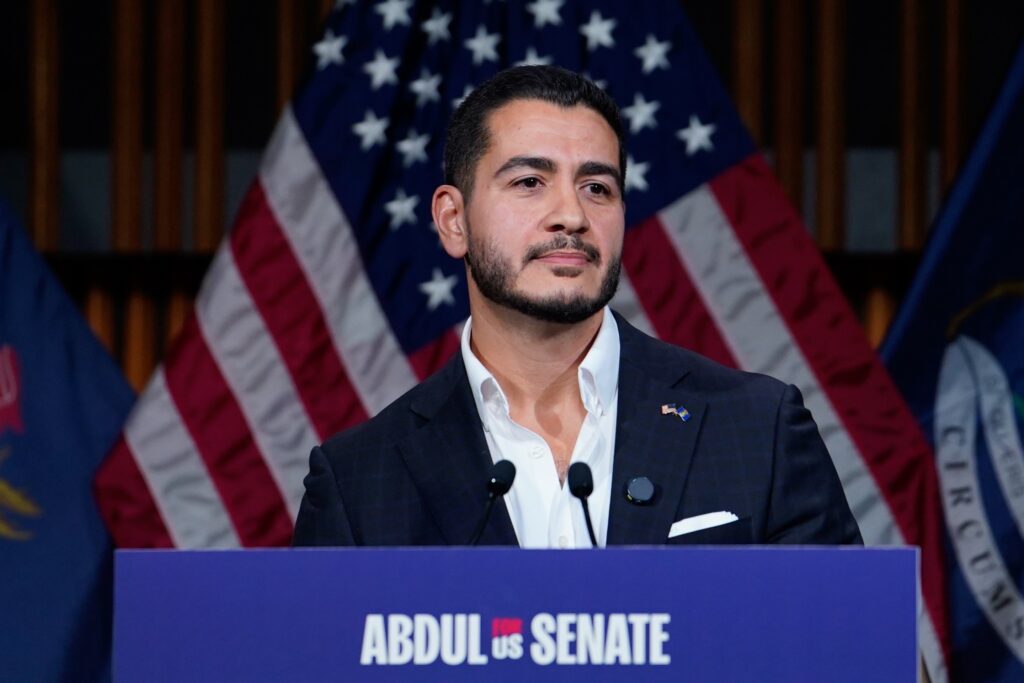
Near the end of his victory speech in Detroit early Wednesday, Senator-elect Abdul El-Sayed returned to the line that carried his campaign: “It shouldn’t be this hard to see a doctor in the richest, most powerful country in the world.”
El-Sayed defeated Republican Mike Rogers in Michigan’s open Senate race on a night when Democrats captured both chambers of Congress. He arrives in Washington as one of the country’s most prominent advocates of Medicare for All, a public, universal, single-payer system, and as the co-author of a detailed plan for how it would work.
The issue resonated with voters in both parties. In the NBC News Exit Poll, which surveyed more than 79,000 voters, 85% said they were very or somewhat concerned about healthcare costs. Sixty-one percent said the federal government should play a bigger role in helping Americans get it.
Democrats campaigned on healthcare costs across the country, but the party is split on the fix. Many moderates want to strengthen the Affordable Care Act, which expanded coverage through Medicaid and subsidized private marketplaces. For El-Sayed and other progressives, Medicare for All remains the gold standard, and a single public payer would replace much of the private insurance business that sustains some of America’s largest companies.
UnitedHealth Group is No. 3 on the 2026 Fortune 500 and the biggest healthcare company on the list. CVS Health, which owns Aetna, ranks No. 6, and Elevance Health ranks No. 18. El-Sayed has singled out the industry before: in 2022, in written testimony to the Senate Budget Committee, he noted that UnitedHealth’s second-quarter profit in 2020 nearly doubled from a year earlier.
El-Sayed, 42, holds a medical degree and a doctorate, ran Detroit’s health department from 2015 to 2017, and later directed Wayne County’s Department of Health, Human and Veterans Services. He and co-author Micah Johnson laid out their vision in the 2021 book Medicare for All: A Citizen’s Guide, which offers the clearest picture of how the policy could take shape as progressives grow in Congress.
What El-Sayed’s version of Medicare for All would cover
In the book, El-Sayed and Johnson describe Medicare for All as “an enhanced version of the traditional Medicare program that tens of millions of seniors rely on today,” one that would insure every American for life.
A “core tenet” of the policy, they write, is comprehensive coverage: physician visits, prescription drugs, and emergency services, potentially extending to long-term care, vision, and dental. Patients could see any participating provider, eliminating out-of-network charges.
El-Sayed has also pitched the system as more durable than employer-based coverage. “Turn 26, get a job, lose a job, get married, get divorced: none of these would cost you your health insurance under Medicare for All,” he wrote in the same Senate testimony.
One element has shifted. In a 2020 podcast, El-Sayed said Medicare for All “does away with the private insurance market,” Bridge Michigan reported. During this campaign, he said his version would not ban private plans offered through unions or employers, though his campaign website says Medicare for All “should make those choices redundant and unnecessary.”
He has also sketched how the system would be run. At a July roundtable with Michigan voters hosted by More Perfect Union, El-Sayed said its governance should sit “under, but separate from, the executive branch,” similar to the Federal Reserve, so the program couldn’t “change on a dime” with each new president. He added that Medicare would negotiate prescription drug prices as the buyer for the entire country.
How he would pay for it
El-Sayed and Johnson argue that individual Americans already fund the U.S. healthcare system through taxes, premiums, deductibles, and copayments. Under Medicare for All, they contend, money would flow through the public sector rather than private insurers.
Their financing plan has two parts. The first would “combine existing federal spending on Medicare, Medicaid, and private insurance subsidies into a single stream to be used for Medicare for All.” The authors also float administering the program at the state level, which would free up state money now spent on Medicaid and private insurance.
The second is progressive taxation: a “wealth tax on the richest Americans,” a new corporate tax code, and higher taxes on investment income. The authors also count on savings from lower administrative costs and lower prices for drugs and services, which they attribute to a single payer’s negotiating power.
The middle-class question is unresolved. El-Sayed has said he would “hope” to avoid raising taxes on most Michigan families, including those earning around $100,000 a year, according to Bridge Michigan. Experts told the outlet that middle-class tax increases would likely be necessary, though some households could come out ahead overall.
Why it still faces long odds in Congress
El-Sayed has been blunt about the obstacle. “The biggest challenge is not making the math work. The biggest challenge is not architecting the system. The biggest challenge is creating the political will to get there,” he told the More Perfect Union panel, which included several voters who had backed President Trump.
Public opinion is moving in his direction. In an Axios-Ipsos poll released in October, 43% of Americans supported Medicare for All and 24% opposed it, with 32% unsure.
The policy still has vocal critics, from pharmaceutical companies to the American Hospital Association. They argue that dismantling private insurance would eliminate jobs in healthcare administration and that middle-class families would bear the brunt of higher taxes. They also point to the price tag. A 2018 analysis by Charles Blahous, a former public trustee for Medicare and Social Security, estimated that Bernie Sanders’ Medicare for All proposal would add $32.6 trillion in federal spending over 10 years. Blahous has described that figure as a lower bound that assumes the bill’s cost controls deliver their full savings.
The votes are another hurdle. Democrats will control both chambers in January, but Republicans and many moderate Democrats oppose single-payer. Retiring Kentucky Sen. Mitch McConnell called it an “untested government takeover” in 2019. Any bill would likely need 60 votes to clear a Senate filibuster, plus President Trump’s signature.
Still, El-Sayed won’t be alone. In Maine, Democrat Troy Jackson unseated Republican Sen. Susan Collins after campaigning on Medicare for All and told the American Prospect he would be a “dog with a bone” on the issue. The next test is whether the new progressive senators rally behind a single bill, and whether El-Sayed’s room for private plans becomes a compromise or a fault line.
“Winning a single U.S. Senate seat was never the goal,” El-Sayed told supporters early Wednesday. “The goal is to use that seat to transform our politics.”
This story was originally featured on Fortune.com