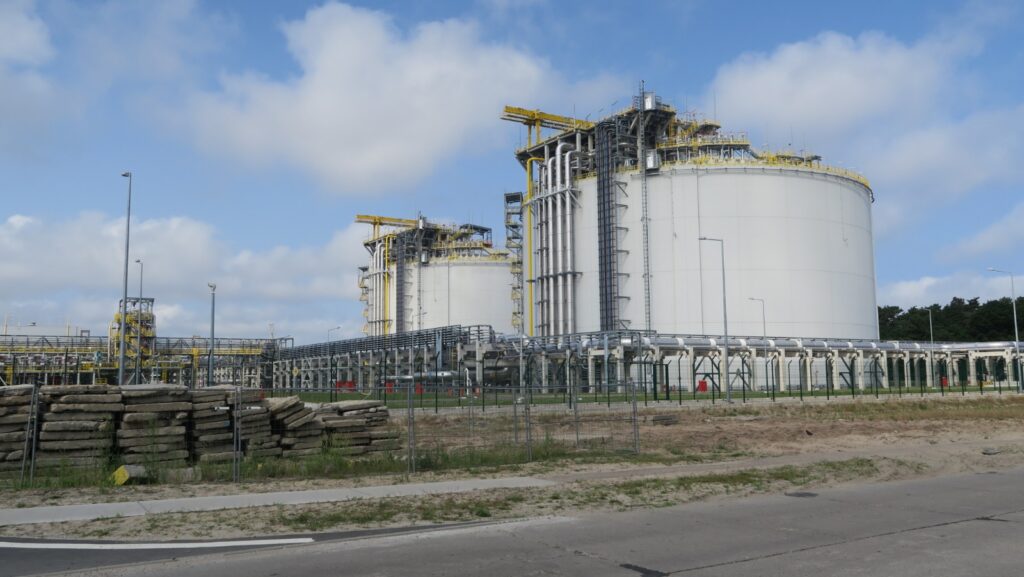
Photo: Maciek Kwiatkowski / Wikimedia Commons (archive)
Europe is entering its winter heating season with its lowest natural gas inventories since 2013, leaving a smaller safety cushion that could keep global gas markets tight well into 2027, the International Energy Agency warned in a report released Tuesday.
The agency’s Global Gas Security Review 2026 says the European Union will rely more heavily on imported liquefied natural gas, or LNG, to meet winter demand as disruption to shipments through the Strait of Hormuz constrains global supplies.
The risk extends beyond the cold months. If Europe draws heavily on storage this winter, it will need to buy more gas to rebuild those reserves through summer 2027, competing with other importers for available cargoes.
A winter stress test, not a prediction
In a severe scenario combining colder-than-average weather with continued disruption to LNG flows through Hormuz, EU storage could fall below 10% of working capacity by the end of March 2027, according to the IEA’s simulations.
That is a conditional stress scenario, not a forecast that storage will reach that level. Both the weather assumption and the continued shipping disruption are part of the calculation.
The agency says gas can generally be withdrawn from storage less quickly once inventories fall below 30% of working capacity. Low stocks would therefore leave Europe more exposed to a late cold snap, a technical outage or another supply interruption, even before sites were empty.
Less LNG despite new production
The IEA projects global LNG supply will decline by 3%, or almost 20 billion cubic metres, in 2026, assuming trade flows through Hormuz remain largely disrupted at least through the end of the year.
Loadings from Qatar and the United Arab Emirates fell by more than 60 billion cubic metres from March through October compared with a year earlier. Higher output outside the Gulf, including new projects in North America and Africa, offset about two-thirds of that loss over the same period, the agency said.
Global gas demand is expected to fall by about 1.5%, or close to 65 billion cubic metres, for the full year. The IEA attributes the decline to disrupted activity in the Middle East, weaker industrial consumption in Europe and a shift from gas to coal in parts of Asia’s power sector.
More flexible trade, but a smaller buffer
The review says more flexible LNG contracts have helped buyers redirect supplies during the disruption. Contracts that allow cargoes to change destination accounted for more than half of the market in 2025, up from 29% in 2016, with expanding U.S. LNG supplies a major contributor.
But flexible trading cannot fully replace lost supply or stored fuel. Limited storage in several Asian and South American importing countries, alongside Europe’s smaller reserves, could intensify competition for cargoes when seasonal demand rises, the IEA said.
The featured photograph shows LNG-terminal tanks in Poland in 2016. It is an archive image, not a current view of European inventory levels.
JBizNews Desk | Paris
© JBizNews.com. All rights reserved. Unauthorized reproduction or redistribution is strictly prohibited.