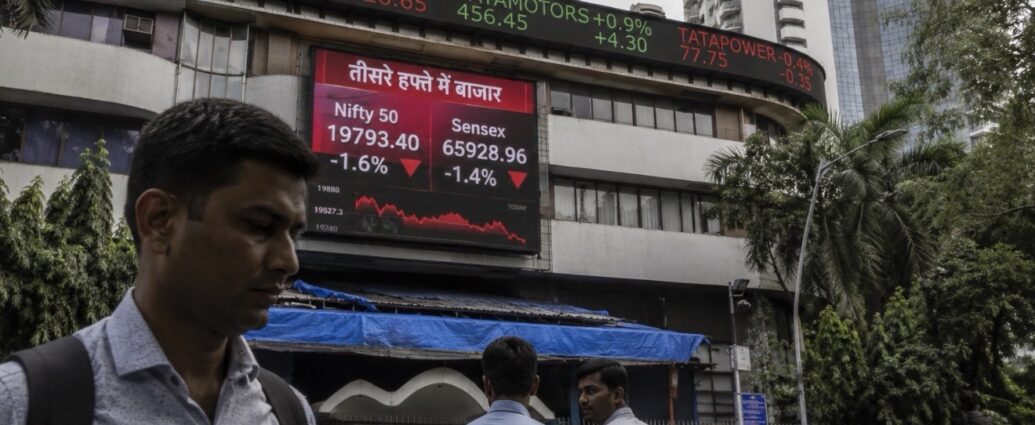
For years, India sold global investors on one of the most compelling economic stories of the century: a nation of 1.4 billion people poised to become the world’s next manufacturing powerhouse, the democratic counterweight to China, and eventually the planet’s third-largest economy. Global CEOs embraced the narrative. Wall Street poured money into Indian equities. Prime Minister Narendra Modi built much of his economic diplomacy around the promise that India’s rise was not merely coming — it had already begun.
Then the numbers changed.
On February 27, India’s Ministry of Statistics and Programme Implementation (MoSPI) quietly released a revised GDP series that effectively reduced the size of the Indian economy by hundreds of billions of dollars. Under the new methodology, nominal GDP for fiscal year 2025-26 was recalculated downward to approximately ₹345 lakh crore, compared with roughly ₹357 lakh crore under the previous series.
In dollar terms, India’s economy was effectively reduced from around $4.2 trillion to closer to $3.9 trillion.
The downgrade immediately carried symbolic and financial consequences. India, which had celebrated overtaking Japan as the world’s fourth-largest economy in 2025, slipped back behind Tokyo under the revised calculations. Estimated per-capita GDP also fell sharply, dropping from prior estimates near $2,900 to roughly $2,600.
While the government simultaneously revised headline growth rates slightly higher — lifting fiscal 2025-26 real GDP growth to 7.6% — economists quickly focused on the larger implication: India’s economy may not be as large or as structurally strong as global markets had assumed.
The timing could hardly be worse.
As investors digested the revision, nearly every major economic pressure point surrounding India began deteriorating simultaneously.
The Indian rupee fell this week to a historic low near 95.73 against the U.S. dollar, making it Asia’s weakest-performing major currency of 2026. Foreign portfolio investors have already withdrawn more than $20 billion from Indian equities during the first four months of the year, according to data from the National Securities Depository Ltd. (NSDL) — already exceeding last year’s record pace of outflows.
Meanwhile, India’s dependence on imported energy is becoming increasingly exposed amid tightening global oil markets and disruptions surrounding the Strait of Hormuz. India imports approximately 85% of its crude oil needs, leaving the economy highly vulnerable to sustained increases in global energy prices and supply disruptions tied to the ongoing U.S.-Iran conflict.
State-run oil marketing companies are reportedly losing as much as ₹1,000 crore per day as the government limits domestic fuel-price increases to contain inflation pressure on consumers.
Reserve Bank of India Governor Sanjay Malhotra warned this week that policymakers may need to intervene more aggressively if currency and inflation pressures continue intensifying.
But the growing concern among economists extends far beyond oil prices or short-term market volatility.
For years, analysts have questioned whether India’s official GDP data accurately reflects underlying economic reality.
Former Indian Chief Economic Adviser Arvind Subramanian has repeatedly argued that India’s growth figures likely overstate actual expansion because of structural distortions in measurement methodology. In March, Nicholas Lardy, senior fellow at the Peterson Institute for International Economics, published research arguing that India’s economic trajectory has been materially less stable than headline data suggested. Mumbai-based economist Dhananjay Sinha recalculated India’s post-pandemic growth under the revised methodology and concluded that true growth may be closer to 4.8%, well below earlier estimates.
The pressure intensified after the International Monetary Fund assigned India a “C” grade in late 2025 for the quality and coverage of its national accounts — the second-lowest rating possible — citing outdated methodologies and gaps in real-time economic measurement.
The deeper issue now confronting investors is whether India’s structural transformation is progressing fast enough to justify the enormous expectations embedded into global capital flows and market valuations.
Despite years of flagship initiatives including “Make in India”, production-linked incentive programs, and “Atmanirbhar Bharat” self-reliance campaigns, manufacturing still represents only about 16% to 17% of India’s GDP — far below the levels historically associated with export-driven industrial powers such as China, South Korea, or Vietnam during their rapid expansion phases.
Large segments of advanced manufacturing remain heavily dependent on imported components, machinery, semiconductors, and battery technology.
In a sharply worded note to Prime Minister Modi earlier this year, analysts at Bernstein warned that India faces a narrowing window to restructure its economy before demographic advantages begin fading. The report highlighted India’s continued dependence on imported industrial inputs, the vulnerability of the country’s massive IT outsourcing sector to generative AI disruption, and the continued concentration of labor in low-productivity informal work.
Other forecasters are already turning more cautious. BMI, part of Fitch Solutions, recently cut its fiscal 2026-27 GDP growth forecast for India to 6.7% from 7.7%, citing external pressures, energy-market disruptions, and weakening global conditions.
None of this means India’s economy is collapsing. By almost any global standard, it remains one of the fastest-growing major economies in the world. The country still possesses one of the largest consumer markets on earth, a rapidly expanding digital infrastructure, and an increasingly important role in global supply-chain diversification efforts as companies seek alternatives to China.
But investors are increasingly asking a more uncomfortable question: whether the gap between India’s global economic narrative and its underlying economic fundamentals has become too large to ignore.
The next critical moment arrives May 29, when MoSPI releases provisional annual GDP estimates under the revised methodology. Investors, economists, and policymakers will be watching closely not simply for another growth number, but for evidence of whether the economy behind the headlines is truly becoming the global economic superpower markets have spent years anticipating.
For much of the past decade, belief in India’s future helped drive investment. Increasingly, global markets are demanding harder proof.
JBizNews Desk
© JBizNews.com. All rights reserved. This article is original reporting by JBizNews Desk. Unauthorized reproduction or redistribution is strictly prohibited.