By JBizNews Desk— May 5, 2026
Markets opened cautiously higher Tuesday morning as a record earnings report from Palantir Technologies provided a floor against a sharply escalating global crisis — with Iran striking a South Korean-operated cargo ship, launching a massive missile and drone barrage at the United Arab Emirates, and the U.S. and Israel openly coordinating potential new military strikes.
The S&P 500 rose 0.7% to trade around 7,250, the Dow Jones Industrial Average gained 0.55%, adding roughly 270 points from Monday’s close of 48,941, and the Nasdaq Composite advanced 0.9%. The Russell 2000 was the lone decliner, slipping 0.6%.
Those gains came directly off Monday’s steep selloff, when the Dow shed 557 points, the S&P 500 slid 0.41% to 7,200.75 and the Nasdaq fell 0.19% to 25,067.80 — all driven by the same Middle East escalation now being partially priced out.
Oil: Still the Dominant Story
West Texas Intermediate crude futures fell below $104 per barrel Tuesday but held most of Monday’s gains as Middle East tensions intensified, with the U.S. and Iran exchanging fire in the Strait of Hormuz. Brent crude declined about 1.4% to around $112.90, easing from Monday’s spike when WTI surged over 4% and Brent jumped nearly 6%.
Both benchmarks remain well above pre-war levels — and crude continues to be the single largest driver of global inflation risk.
The consumer is already absorbing the shock. The national average for gasoline hit a record near $4.45 per gallon on May 2, with analysts warning of $5 gasoline by Memorial Day. U.S. gasoline inventories have fallen for eleven consecutive weeks, tightening supply ahead of peak summer demand.
The U.S. Energy Information Administration estimates that Iraq, Saudi Arabia, Kuwait, UAE, Qatar, and Bahrain collectively shut in over 9 million barrels per day of production in April — a disruption with virtually no modern precedent.
UBS analyst Giovanni Staunovo said the outlook remains clear: “The path for prices remains skewed to the upside as long as flows through the strait remain restricted.”
Goldman Sachs has also raised its 2026 oil forecasts, signaling elevated energy costs even under a partial resolution scenario.
Energy Sector Leads
Energy continues to outperform across markets.
It was the only S&P 500 sector to gain Monday, and remains the top-performing sector year-to-date. Companies including Occidental Petroleum, APA Corporation, and Diamondback Energy all moved higher as oil prices surged.
Diamondback Energy reinforced that trend Tuesday, reporting strong first-quarter results, raising production guidance, and increasing its base dividend.
The Geopolitical Backdrop
Markets are being shaped directly by events in the Strait of Hormuz.
The UAE Ministry of Defence said its air defenses intercepted 12 ballistic missiles, three cruise missiles, and four drones launched from Iran. The UAE’s foreign ministry condemned the strikes as “renewed terrorist, unprovoked Iranian attacks targeting civilian sites.”
An Iranian drone struck the Fujairah Petroleum Industries Zone, sparking a large fire and injuring three Indian nationals. Schools across the UAE shifted to remote learning through Friday.
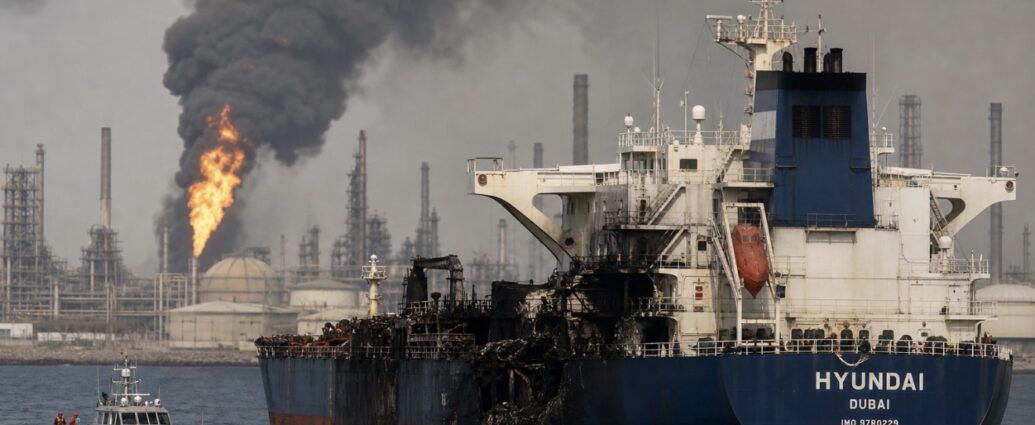
President Donald Trump confirmed that Iran had struck “unrelated nations,” including a South Korean-operated cargo ship, urging Seoul to “join the mission.”
South Korea’s foreign ministry said the vessel caught fire after an explosion in the Strait of Hormuz. The ship, carrying 24 crew members including six South Koreans, reported no casualties and is being towed to Dubai.
At the same time, U.S. and Israeli officials are coordinating potential new strikes on Iran.
Joint Chiefs Chairman General Dan Caine said Iran has attacked commercial shipping nine times and seized two vessels since the ceasefire, while also targeting U.S. forces more than ten times — though still “below the threshold” for full-scale war.
Defense Secretary Pete Hegseth warned: “Iran will face overwhelming firepower if it attacks commercial shipping,” while emphasizing the ceasefire is “not over.”
Palantir and Market Movers
Against that backdrop, Palantir Technologies delivered the session’s strongest corporate signal.
The company reported $1.63 billion in revenue, up 85% year-over-year, beating expectations of $1.54 billion. Adjusted EPS came in at 33 cents, above the 28-cent estimate.
CEO Alex Karp raised full-year guidance to $7.65–$7.66 billion, pointing to sustained high growth.
Despite the beat, shares fell roughly 3–4% in early trading, reflecting valuation concerns.
Other notable movers:
- Pinterest surged on strong revenue guidance
- Duolingo dropped ~13% on weaker user growth
- Tyson Foods rose on strong earnings
- UPS edged higher after Monday’s decline
- GameStop slipped following its eBay acquisition proposal
- Nvidia ticked up ahead of May 20 earnings
- Bitcoin rose over 2% to ~$80,740
What Comes Next
Tuesday’s market is balancing two opposing forces: record corporate earnings driven by AI and a rapidly escalating geopolitical conflict.
With gasoline at record highs, the Strait of Hormuz still largely restricted, and major powers signaling readiness for further military action, energy prices and inflation remain the single biggest risk to the market’s rally.
Last week’s record highs are now being tested by a much larger question: how long global markets can absorb escalating conflict before it fully resets pricing across the economy.
JBizNews Desk