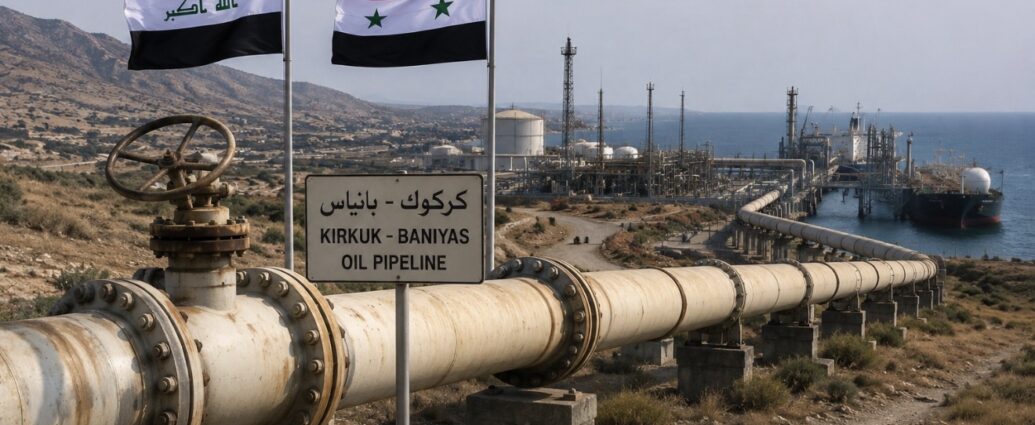
Iraq and Syria signed a memorandum of understanding Friday to rehabilitate the Kirkuk–Baniyas crude oil pipeline, reviving a long-dormant route that could carry Iraqi oil to Syria’s Mediterranean coast and reduce Baghdad’s dependence on exports through the Strait of Hormuz, according to an official announcement from the Syrian Petroleum Company published Saturday.
The agreement was signed in Washington by Youssef Qablawi, chief executive of the Syrian Petroleum Company, and Basim Abdul Karim Nasser, chief executive of Iraq’s Basra Oil Company, during meetings attended by the Iraqi prime minister, the U.S. energy secretary and other senior officials.
A second memorandum was signed between the Syrian Petroleum Company and an international consortium comprising Chevron, UCC Holding and TI Capital. The companies are expected to prepare technical and financial studies, assess the condition of the existing pipeline and related facilities, and establish a framework for implementing the reconstruction project.
The agreements move the project beyond months of preliminary discussions and into a formal planning stage, though no final construction contract, project cost or completion date has been announced.
The revived route would connect Iraqi oil production with the Syrian port of Baniyas, giving Iraq access to the Mediterranean and allowing crude shipments to avoid the Persian Gulf and the Strait of Hormuz. The waterway between Iran and Oman has long served as one of the world’s most important energy chokepoints.
Roughly one-fifth of global oil and gas shipments passed through Hormuz before the latest regional conflict sharply reduced traffic through the strait. Iraq has been especially exposed because most of its crude exports traditionally leave through southern terminals near Basra.
Before the current disruption, Iraq exported approximately 3.4 million barrels per day through its southern Gulf facilities. When shipments through Hormuz were interrupted, storage began filling and Baghdad was forced to accelerate efforts to move crude and refined products through alternative routes.
Iraq has already begun transporting fuel oil across Syria by truck for export from Baniyas. That emergency arrangement demonstrated that the Mediterranean route could function, but trucking is more expensive, slower and capable of moving far less oil than a pipeline.
The proposed pipeline network is intended to provide a permanent, higher-capacity alternative.
Iraqi officials have described a broader export system connecting Basra, Haditha, Kirkuk, Syria’s Baniyas port and Turkey’s Ceyhan terminal. The wider network has been projected to carry as much as 2 million barrels of oil per day, although the final capacity will depend on which sections are constructed or restored.
The original Kirkuk–Baniyas pipeline was built during the 1950s to transport crude from northern Iraq to the Mediterranean. Operations were repeatedly interrupted by disputes between Iraq and Syria, regional conflicts and infrastructure damage. Much of the system has remained unusable since the 2003 war in Iraq, while years of conflict in Syria damaged pumping stations and other facilities along the route.
Restoring the system will therefore require more than repairing a single pipe. Engineers must evaluate pumping stations, storage facilities, metering systems, terminals and security conditions across both countries before construction can begin.
The involvement of international companies provides technical and financial backing that earlier revival efforts lacked. Chevron’s participation also places a major U.S. energy company inside a project that Washington views as strategically important to global energy security.
The United States welcomed the Iraqi-Syrian agreement and the participation of a U.S.-led international consortium, describing the pipeline as a priority infrastructure project. Washington has been encouraging regional oil producers to build export routes that cannot be disrupted by the closure of a single maritime passage.
For Iraq, the project is both an economic and national-security priority.
The country is one of the world’s largest oil producers, but its export infrastructure remains heavily concentrated in the south. A functioning Mediterranean pipeline would allow Baghdad to continue selling oil even during Gulf shipping disruptions, while also giving the government greater flexibility in negotiating export and transportation agreements.
For Syria, the pipeline could generate transit fees, attract foreign investment and restore Baniyas as a regional energy terminal. Syrian officials are seeking to position the country as a corridor connecting Iraqi and Gulf energy resources with Mediterranean markets.
The project could also strengthen commercial ties between Iraq and Syria after years of war, sanctions and disrupted cross-border trade. Energy cooperation has expanded since the reopening of a major northern border crossing earlier this year, allowing additional movement of fuel, goods and equipment between the two countries.
The agreement does not provide an immediate solution to the current shortage of secure export capacity. Major pipelines crossing several countries generally require years of engineering, financing, regulatory approvals and construction before oil begins flowing.
Still, the signing represents one of the clearest steps yet toward restructuring how Iraqi oil reaches global markets.
If completed, the Kirkuk–Baniyas route would not eliminate the importance of the Strait of Hormuz. It would, however, give Iraq a second major direction for exports and reduce the ability of any future conflict or blockade to shut down nearly all of the country’s seaborne oil trade.
JBizNews Desk | Washington
© JBizNews.com All Rights Reserved. Reproduction or distribution without written permission is prohibited.