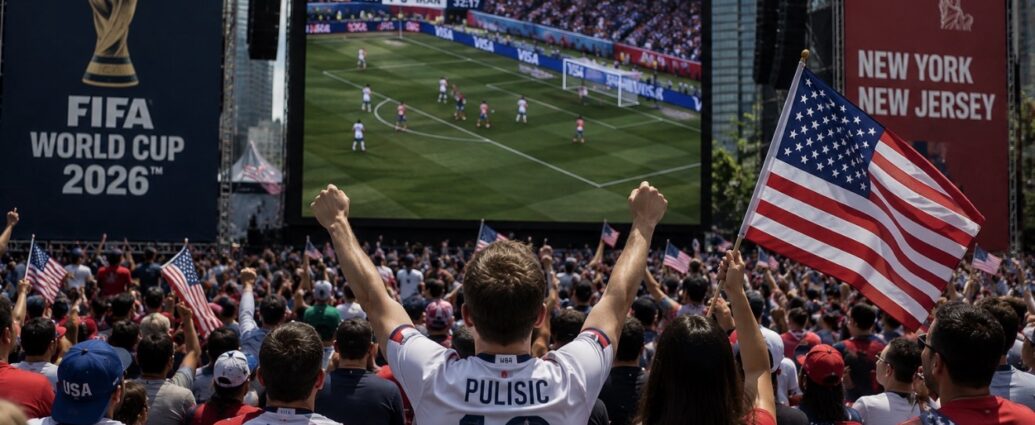
Nearly half of registered voters watched the tournament, with income and education influencing audience participation more than political affiliation.
NEW YORK — The latest CNBC All-America Economic Survey found that nearly half of registered voters watched the 2026 FIFA World Cup, with Democrats and Republicans tuning in at broadly similar levels despite President Donald Trump’s prominent public role throughout the tournament.
The nationwide survey of 1,000 registered voters, conducted with a margin of error of plus or minus 3.1 percentage points, found that political affiliation was not the strongest predictor of who followed the competition. Viewership varied more noticeably by household income and education, suggesting that access, media habits and consumer demographics mattered more than partisan identity.
The findings provide an important signal for broadcasters, advertisers and corporate sponsors that invested heavily in the largest World Cup ever staged.
The tournament was hosted across the United States, Canada and Mexico, with most games played in U.S. cities. The expanded competition featured 48 national teams and 104 matches, creating more broadcast inventory, advertising opportunities and consumer engagement than any previous edition.
Trump maintained a highly visible presence around the event, appearing alongside FIFA President Gianni Infantino, attending official functions and publicly discussing teams, players and tournament decisions. He also confirmed plans to attend the final at MetLife Stadium in East Rutherford, New Jersey.
Despite the president’s involvement and the intensely partisan political environment surrounding his administration, the survey found no major party-driven separation in World Cup viewing.
That distinction matters for media companies because audiences for political programming are often sharply divided. Conservative and liberal viewers frequently choose different television networks, digital platforms and news sources, making it difficult for advertisers to reach a broad national audience through one property.
The World Cup appears to have operated differently.
The tournament attracted viewers across party lines and offered advertisers access to a national audience that was diverse not only politically, but also by age, ethnicity, language and geography. That broad reach strengthens the commercial value of major international sporting events at a time when traditional television audiences remain increasingly fragmented.
Higher-income and college-educated voters were more likely to report watching the tournament than lower-income and less-educated respondents. The pattern may reflect differences in access to streaming subscriptions, cable packages, flexible work schedules and familiarity with international soccer.
It also highlights a continuing challenge for sports broadcasters seeking to expand soccer’s American audience beyond younger, urban and higher-income consumers.
English-language coverage was carried primarily by Fox Sports, while Telemundo and Peacock provided Spanish-language broadcasts and streaming access. The availability of coverage across traditional television, cable and digital platforms allowed viewers to follow games through a wider range of services than during earlier tournaments.
Spanish-language coverage became a particularly significant part of the U.S. audience, drawing both Spanish-speaking households and some English-speaking viewers seeking a different broadcast experience.
The commercial impact extended beyond television ratings.
Restaurants, bars, streaming platforms, sports-betting companies, apparel sellers and sponsors benefited from a tournament played largely during U.S. daytime and evening hours. Host cities also experienced increased demand for hotel rooms, transportation, dining and entertainment connected to visiting supporters and public watch parties.
FIFA said tournament attendance reached approximately 6.7 million spectators, reflecting the scale of the event across the three host countries. Strong attendance and television engagement helped reinforce the organization’s claim that the expanded format produced one of the most commercially successful World Cups in history.
For sponsors, bipartisan viewership reduces the risk that involvement with the tournament will be interpreted primarily through a political lens. Companies can market around national teams, individual players and the shared experience of major matches without limiting their message to one ideological segment of the country.
That does not mean politics disappeared from the tournament.
Immigration policy, travel restrictions, ticket costs, security, presidential appearances and Trump’s relationship with FIFA remained part of the public conversation. Several decisions involving players and participating nations also generated political scrutiny.
The survey indicates, however, that those controversies did not prevent Americans from both major political parties from watching.
The broader business conclusion is that live sports remain one of the few forms of mass media capable of bringing politically divided audiences together at the same time. That scarcity gives major sporting rights increasing value as entertainment companies compete for programming that viewers are less likely to record, delay or ignore.
The World Cup’s ability to maintain a politically balanced audience may influence how broadcasters and advertisers value future soccer rights in the United States, particularly as the sport seeks to build on the tournament’s momentum.
For media companies, the result is straightforward: Americans may disagree sharply about politics, but millions still chose to watch the same matches.
JBizNews Desk | New York
© JBizNews.com All Rights Reserved. Reproduction or distribution without written permission is prohibited.