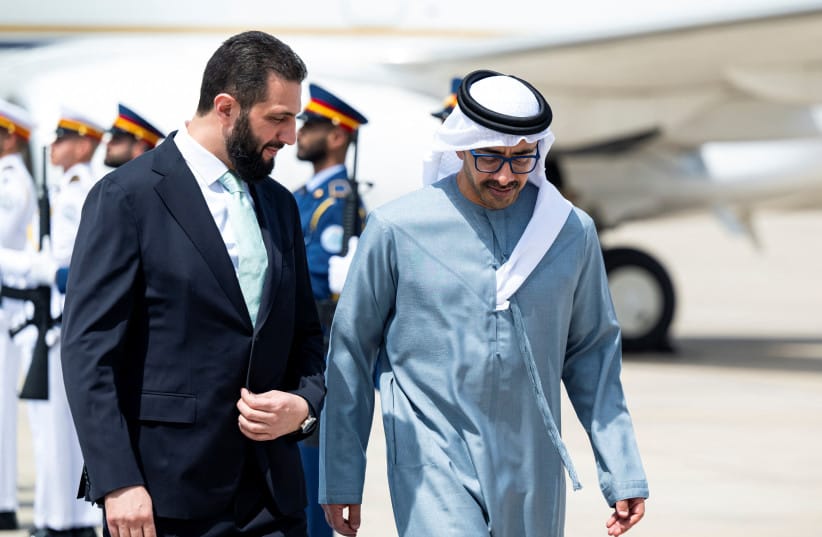
Iraq’s Prime Minister Ali al-Zaidi left Baghdad on October 28 for a trip to Syria. He arrived just before noon on Wednesday. This matters because it is the first such trip since the fall of the Assad regime in 2024. This could mark a major turning point for these countries. Iraq and Syria are historically linked.
Iraq’s state media said that Zaidi is heading a high-level delegation to Syria. Iraq is not providing many details to the media about the visit. However, security and counter-terrorism efforts were expected to be addressed during talks.
On Tuesday, Syrian President Ahmed al-Sharaa said the border between the countries is “completely” secure. However, recent tensions between Syria and Jordan over a Jordanian airstrike on ISIS in Syria show that there could be issues. Syria says Jordan killed several civilians.
Syrian President Ahmad al-Sharaa is seeking to strengthen ties with Iraq, highlighting another important dimension of Damascus’s regional diplomacy. In an interview with Iraq’s Dijlah TV, reported by the Syrian state news agency SANA on October 28, Sharaa said Syria and Iraq have a historic opportunity to deepen economic cooperation, strengthen state institutions, and coordinate regional security.
Syria’s Sharaa said that Syria’s role as a trade corridor for Iraq is important. He stressed the example of the connections between Iraq’s Faw Port and Syria’s Mediterranean port of Tartous. He also called for rebuilding oil pipelines connecting Iraq to Syria’s Baniyas port. Iraqi oil has been flowing to Syria due to the crisis with Iran.
Commerce between nations increases significantly
According to SANA, Sharaa said commercial traffic between the countries had increased significantly over the previous six or seven months, including more than 100,000 transit trucks and 40,000 import and export trucks. SANA also noted that the Syrian president addressed Iraq’s internal security challenges, expressing support for Prime Minister Ali al-Zaidi’s efforts to combat corruption and bring armed groups under state authority.
Sharaa said that the “decision of war and peace must remain in the hands of the state,” according to SANA, arguing that competing military organizations undermine national institutions.
The Syrian leader also said he traveled to Iraq in 2003. SANA notes “the president spoke of his experience in Iraq, explaining he went there in 2003 out of solidarity and duty to defend Iraqis and confront the American occupation, without organizational, political, military or security affiliations. He said he entered prison around 2005, did not participate in the sectarian conflicts Iraq witnessed, and returned to Syria in 2011 after his release.”
This is particularly interesting because Iraq views this controversially. Iraq views the groups that Sharaa worked with as terrorist groups.
The developments involving Syria, Jordan and Iraq show Damascus’s attempt to rebuild regional ties through trade and security cooperation. There are many challenges. This matters for the wider region, including Israel. Iraq is home to Iranian-backed militias that threaten Israel.
They were also active in Syria before the fall of the Assad regime. As such, a secure Syria and Iraq, where militias cannot roam at will, helps Israel, Saudi Arabia, and Jordan.
Some history here is instructive. Syria and Iraq share a history that stretches from the Ottoman Empire to the rise of modern Arab nationalism, the Ba’ath Party, and the conflicts that followed the US invasion of Iraq in 2003. Their long border has repeatedly served as a corridor for trade, insurgencies, and regional power struggles.
Both territories were part of the Ottoman Empire before its collapse during World War I.
The Arab Revolt, led by Sharif Hussein of Mecca and his sons, helped lay the foundations for Hashemite ambitions in the region. King Faisal briefly ruled an Arab kingdom in Damascus before becoming king of Iraq in 1921. His brother Abdullah established the Hashemite monarchy in Transjordan. The family of Abdullah continues to rule Jordan.
Syria and Iraq subsequently developed rival branches of the Ba’ath Party, which came to power in Damascus in 1963 and Baghdad in 1968. Although both regimes espoused Arab nationalism, their leaders became bitter rivals.
The Hashemite rule ended brutally in Iraq due to these changes in power. During the era of the Arab-Israeli wars from 1948-1973, both Iraq and Syria opposed Israel and sent forces to fight Israel.
Sharaa’s rise to power changes the landscape
After the US invasion of Iraq in 2003, insurgents crossed from Syria into Iraq, using routes through the Middle Euphrates River Valley (MERV), particularly around al-Bukamal and al-Qaim.
These same routes later became central to ISIS, which expanded across eastern Syria and western Iraq in 2013–2014, erasing the practical significance of the border as it seized territory. It appears Sharaa was one of those who crossed into Iraq via this route and was then detained in Iraq and sent to Camp Bucca after 2003.
The flow along the river valley subsequently reversed as Iraqi Shi’ite militias entered Syria to support the Assad regime. The al-Qaim–al-Bukamal crossing became a key part of Iran’s regional supply network. Militias moved into Al-Bukamal and moved weapons to Hezbollah.
That all changed when Assad’s regime fell, and Sharaa rose to power.
Today, reports of oil moving by truck through the Syrian desert near al-Tanf illustrate the continuing importance of these corridors. The routes that once carried insurgents, ISIS fighters and militias also connect economies and communities. Geography remains central to Syria and Iraq’s security, commerce, and political future.
In some ways, they are essentially the same country, linked by the desert and the river. On the other hand, part of Iraq is heavily Shi’ite and looks to Iran for influence, while part of Syria, in the hill country from Damascus to Homs, Hama, and Aleppo, has historically looked toward the Mediterranean.