
Photo: Leeloo The First / Pexels
Step 1: What is changing?
The IRS is raising the income limits for the 0% tax rate on most long-term investment profits in 2027. For single filers, the limit rises to $51,050 of total taxable income. This is an annual inflation adjustment, not a new 0% tax rate on salaries.
Step 2: Is this for profits or salary?
It is for qualifying capital gains: profit from selling stock or other investments held for more than a year. It is not a 0% tax rate on your salary. Wages still follow the regular income-tax brackets.
Step 3: Why does my salary matter?
Think of the income limit as a bucket. Your other taxable income, including wages, goes in first. Investment profits go in after that. Only the profits that fit under the limit get the 0% rate.
Step 4: A simple example
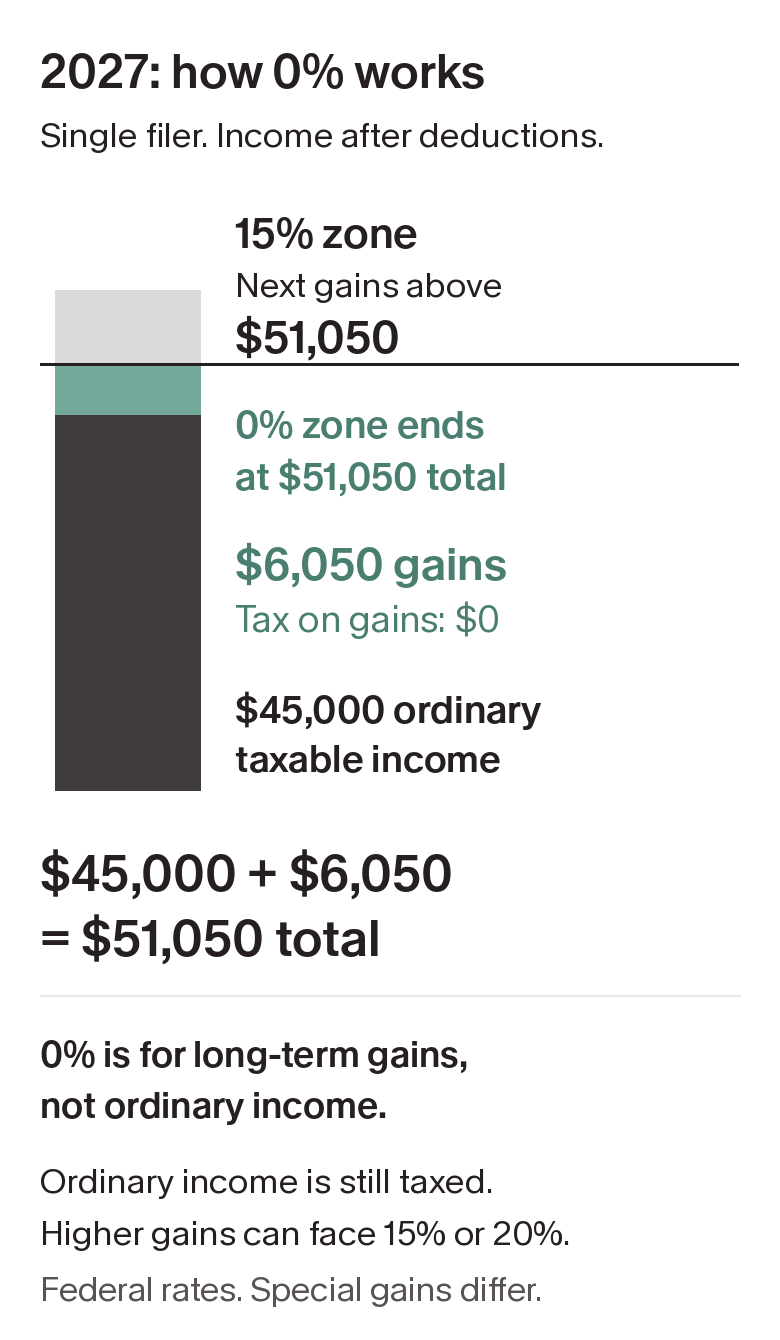
Single and selling stock? If your income after deductions is $45,000 and you make a $6,050 long-term profit, you would pay $0 in federal capital-gains tax on that profit in 2027.
Why? Add the two amounts: $45,000 + $6,050 = $51,050. That is the new top of the 0% band for a single filer. Your other income still faces the usual income-tax rules.
The key is taxable income: income left after deductions. A $45,000 gross salary is different. First subtract the deductions you qualify for, then work out how much room is left for gains.
This chart shows how other taxable income fills the band first, with investment profit stacked on top.
Who gets the 0% rate?
The IRS’s 2027 limits depend on how you file your return. Count your other taxable income and your gains together. This is not a separate allowance for tax-free stock profits.
For most long-term gains, the part that fits below the first limit gets the 0% rate. The next part gets 15%, up to the second limit. The part above that generally gets 20%.
Long-term usually means you owned the investment for more than one year before selling it, as the IRS explains.
| Filing status | Maximum 0% amount | Maximum 15% amount |
|---|---|---|
| Single and other individuals | $51,050 | $563,200 |
| Married filing jointly and surviving spouses | $102,100 | $633,600 |
| Head of household | $68,350 | $598,400 |
| Married filing separately | $51,050 | $316,800 |
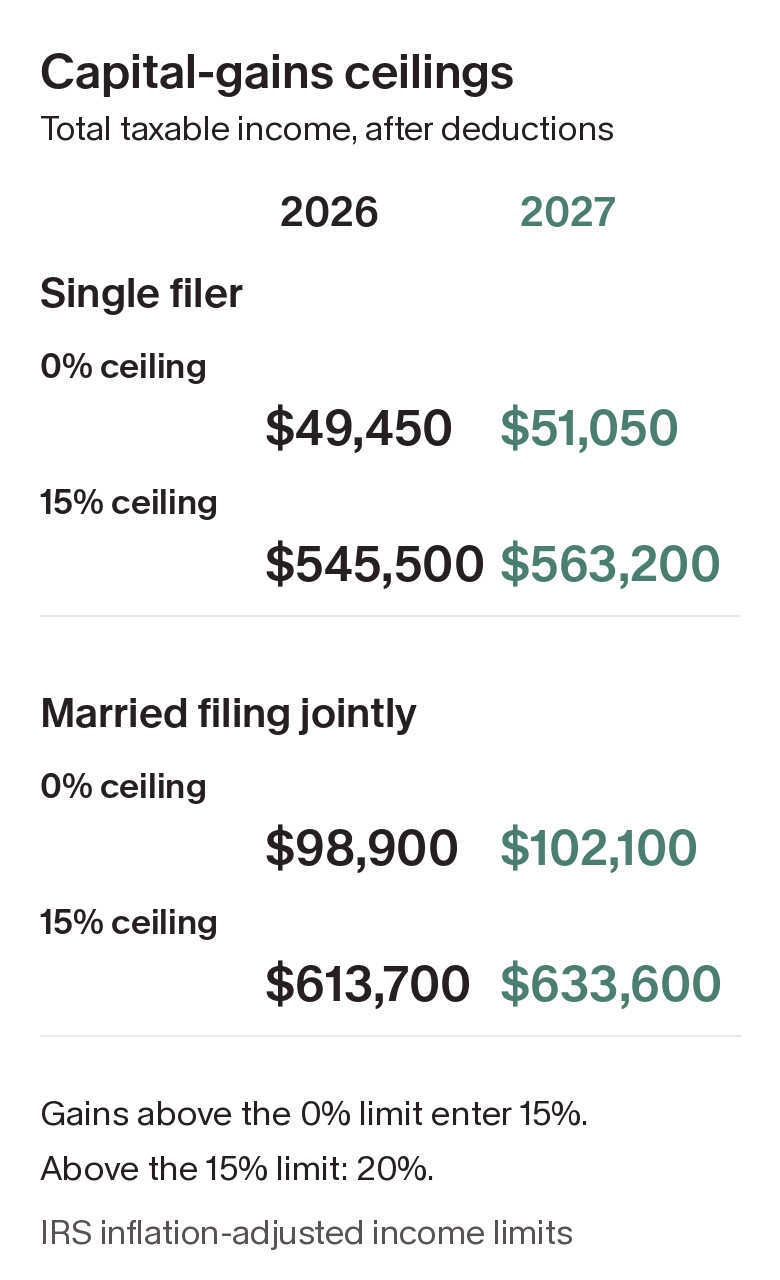
These are the old and new income limits for single filers and married couples filing jointly.
What changed from 2026?
A single filer’s 0% limit rises from $49,450 in 2026 to $51,050 in 2027. For a married couple filing jointly, it rises from $98,900 to $102,100. The IRS’s 2026 limits show the starting point.
These are annual inflation adjustments, not new tax rates. The usual rates stay 0%, 15% and 20%. The higher limits give some investors more room to sell at a profit before a higher rate applies.
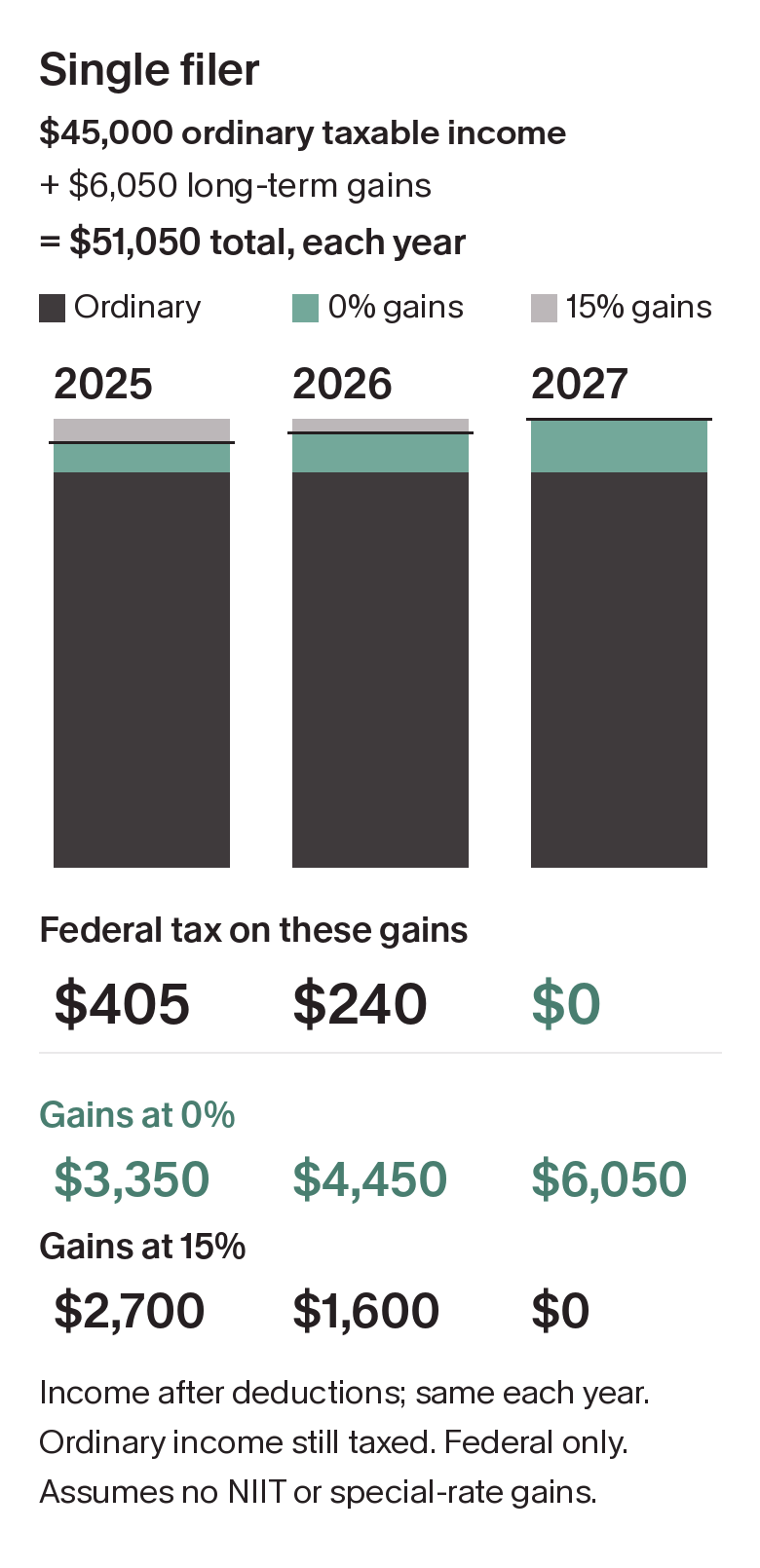
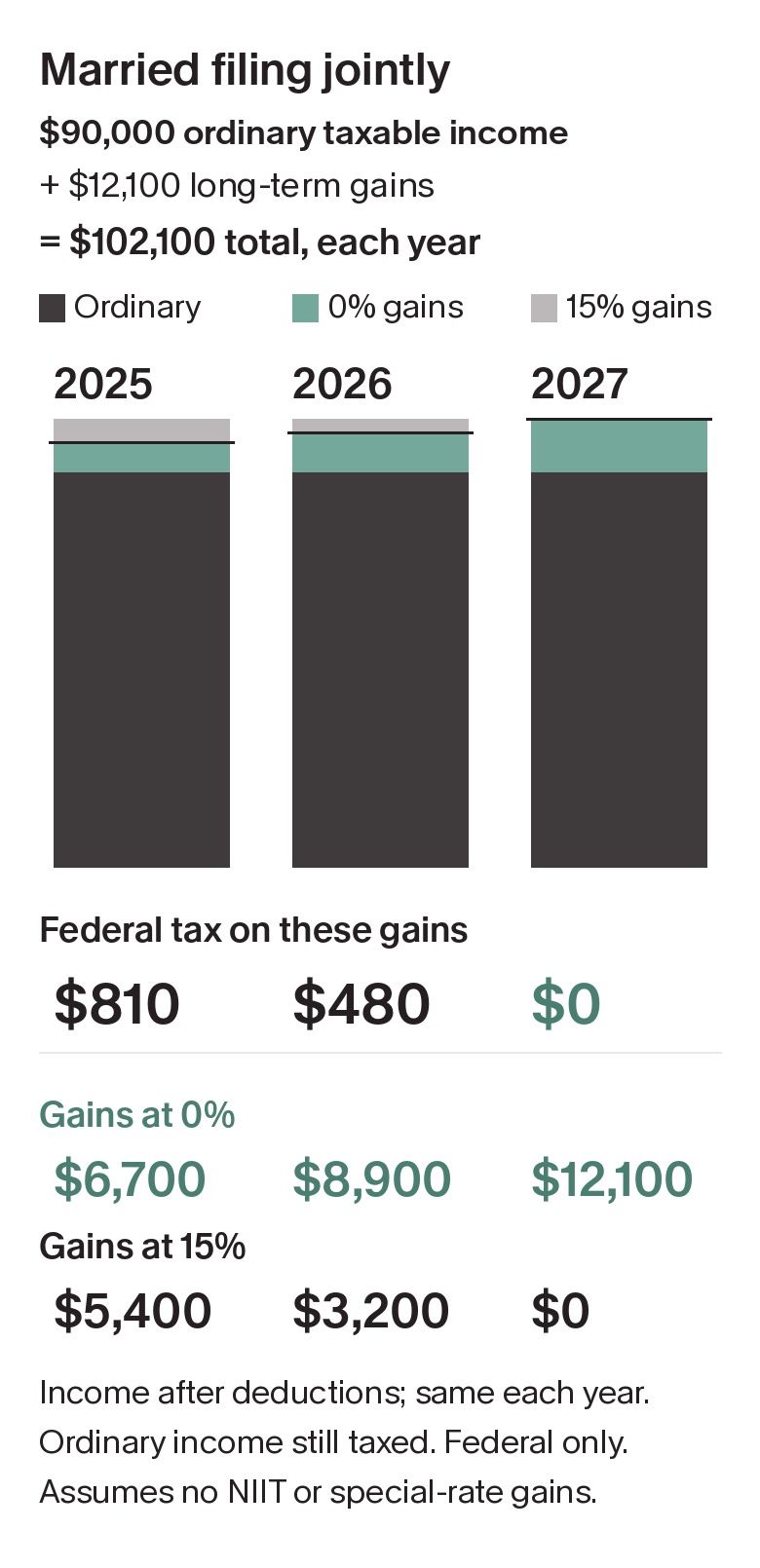
The next chart keeps income and profits the same in each year. It shows how the bigger 0% band can mean less federal tax on the profit. The IRS’s 2025 limits provide the first year’s figures.
For a single filer with the same income and profit each year, the federal tax on the profit falls from $405 to $240 to $0.
For a married couple filing jointly with the same income and profit each year, the tax on the profit falls from $810 to $480 to $0.
Higher income? An extra tax may apply
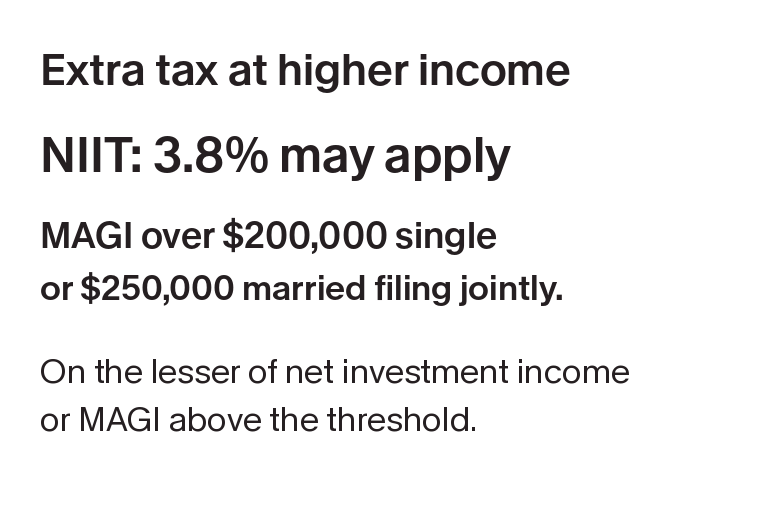
Some investors also pay the Net Investment Income Tax, or NIIT. It is an extra 3.8% tax on certain investment income, including some capital gains.
It can apply when modified adjusted gross income, called MAGI, is above these amounts:
- $200,000 for a single filer or head of household.
- $250,000 for a married couple filing jointly or a qualifying surviving spouse.
- $125,000 for a married person filing separately.
MAGI is an income figure calculated before the standard or itemized deduction, with certain adjustments. It is different from the taxable income used in the capital-gains table.
The extra tax is 3.8% of whichever amount is smaller: your net investment income, or the amount your MAGI is above the limit. It does not automatically apply to all your income.
This extra tax is separate from the capital-gains rates above.
The standard deduction rises, too
A deduction lowers the income you pay tax on. For 2027, the standard deduction rises to $16,600 for single filers and $33,200 for married couples filing jointly, the IRS announced.
The 2027 rules generally apply to tax returns filed in 2028. If you are planning an investment sale, check the year of the sale, your filing status, deductions and other income.
JBizNews Desk | Taxes & Investing
© JBizNews.com. All rights reserved. Unauthorized reproduction or redistribution is strictly prohibited.