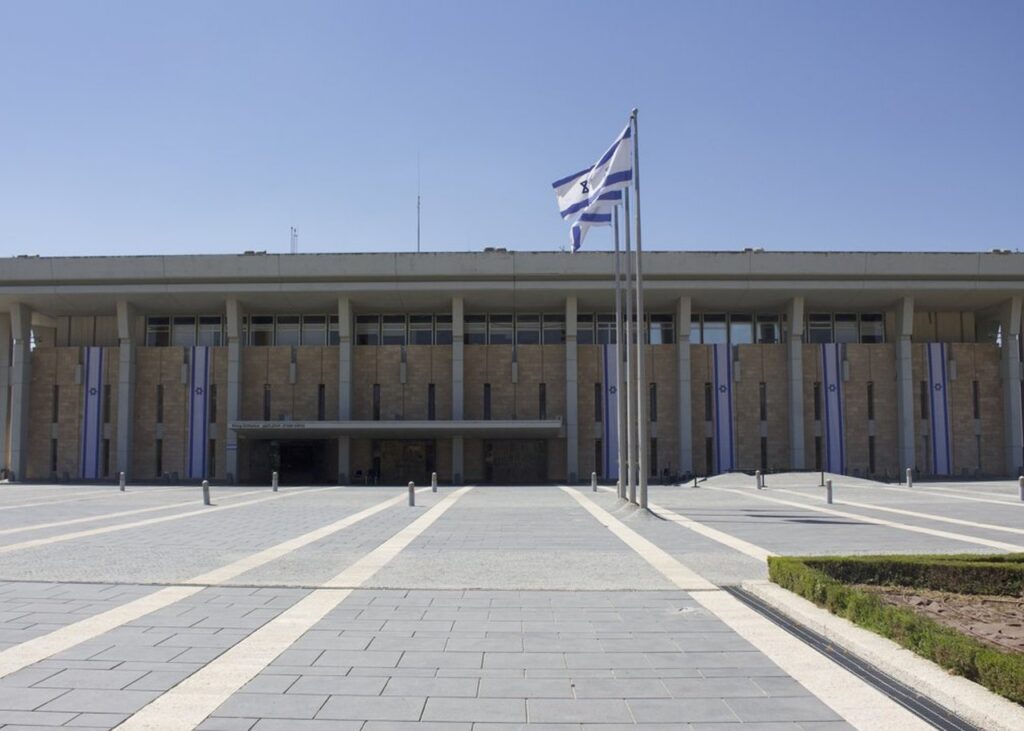
The Knesset in Jerusalem. Photo: Clema12/Wikimedia Commons, CC BY-SA 4.0
Benjamin Netanyahu’s Likud leads Israel’s unfinished party vote count, but that does not decide the next prime minister. His outgoing government continues until a new government wins the Knesset’s confidence, a legal process that can run for months if successive attempts fail.
The Central Elections Committee’s national tally, checked Wednesday at 3:17 p.m. Eastern Time, showed Likud with 1,040,170 votes, or 20.70% of valid ballots, ahead of Gadi Eisenkot’s Yashar with 814,385, or 16.21%. The displayed update was October 28 at 9:01 p.m. Israel time (3:01 p.m. Eastern). The partial tally recorded 5,047,241 ballots from 11,542 polling stations, including 5,024,919 valid votes.
Those figures answer who is ahead in the partial party count. They do not establish a winning coalition, a final seat allocation or a winner of the premiership. Israel is electing a parliament, not choosing its prime minister in a separate head-to-head ballot.
Who can become prime minister?
Under Basic Law: The Government, the president consults the parliamentary groups and assigns a consenting Knesset member the task of forming a government. The largest party’s leader is not automatically appointed prime minister. The candidate must assemble a government that wins confidence in the Knesset.
That route is open to Netanyahu, Eisenkot or another eligible member who receives the task. The unfinished count does not establish who will secure the necessary parliamentary support.
Who runs the country meanwhile?
Section 30 says the outgoing government continues to perform its functions until a new government is formed. That keeps Netanyahu’s government in office in a caretaker capacity during the formation process. Section 13 says the replacement takes office when the Knesset expresses confidence in it.
Staying in office during that interval is not the same as winning a new mandate. Nor does the prime minister personally control every stage: assignments and extensions involve the president, and confidence depends on parliament.
The legal calendar
The CEC says final results will be published in the official gazette by November 4. It has not said they will necessarily be published on that date. The first seven-day clock runs from actual publication.
- First assignment: Within seven days of publication, the president assigns a consenting Knesset member to form a government.
- First candidate: 28 days, with presidential extensions totaling no more than 14 additional days.
- Next decision: If the candidate fails, returns the task or loses a confidence vote, the president has three days to choose another willing member or tell the Knesset speaker that no formation appears possible.
- Second candidate, if assigned: 28 days. Section 9 does not give this candidate the first candidate’s additional 14-day extension.
- Parliament’s route: A 21-day window allows a majority of Knesset members, at least 61, to request a specified consenting member. The president must assign that member within two days; the candidate then has 14 days.
- Confidence: When a candidate reports forming a government, the speaker notifies the Knesset and sets the formation sitting within seven days of that parliamentary notification. A government takes office only upon confidence.
- Failure: Section 11 provides for dissolution after failure of the final route and a repeat election on the last Tuesday before the end of 90 days from the relevant presidential announcement or rejected confidence vote.
A worked calendar, not an election forecast
If results are published November 4, the first assignment is due by November 11. An assignment on that last day would give the first candidate until December 9, or December 23 if the full 14-day extension is granted.
A simple calendar-day sum would put the next three-day endpoint on Saturday, December 26. The Interpretation Law’s Section 10 includes rest days in a period but excludes them when they fall at its end. With that ordinary endpoint adjustment, an unsuccessful route using all the following periods would look like this:
| Stage in this example | Date |
|---|---|
| Gazette publication assumed | Wednesday, November 4, 2026 |
| First assignment at seven-day limit | Wednesday, November 11 |
| First 28 days end | Wednesday, December 9 |
| Full first-candidate extension ends | Wednesday, December 23 |
| Second assignment after full next-decision interval, with Saturday endpoint adjustment | Sunday, December 27 |
| Second candidate’s 28 days end unsuccessfully | Sunday, January 24, 2027 |
| 21-day majority-request window ends | Sunday, February 14 |
| Requested candidate assigned after full two days | Tuesday, February 16 |
| Final candidate’s 14 days end unsuccessfully | Tuesday, March 2 |
| Repeat election if the relevant Section 11 announcement is made March 2 | Tuesday, May 25 |
This example assumes candidates fail at the end of their mandate periods without a later confidence sitting, the majority request is filed on the last available day and the presidential failure announcement is made March 2. It is not an announced schedule or an absolute latest timetable. Earlier assignments, early returns of a mandate, a successful agreement or a dissolution law can shorten the process. A government presented at the end of a mandate can instead trigger a confidence sitting and, if rejected, move the next-stage starting point.
Section 43 adds a limited exception for a repeat vote close to a holiday, festival or memorial day. A majority of Knesset members can decide within five days of the grounds for the election arising to move it to a date no later than 100 days from those grounds. With a March 2 trigger in this example, that 100th day is June 10. No such postponement has been decided.
Could caretaker service reach mid-2027?
Yes, conditionally. A failed formation process followed by a late-spring repeat election would not itself install a new prime minister. Formation proceedings would follow that election, and the outgoing government would continue until a successor wins confidence.
But the law does not guarantee Netanyahu office until mid-2027 or set mid-2027 as an absolute end date. There is no minimum 28-day wait if a candidate can form a government sooner, and there is no fixed calendar date on which caretaker service automatically ends. The endpoint is a new government taking office, subject to the law’s other rules for a prime minister leaving office.
JBizNews Desk | Jerusalem
© JBizNews.com. All rights reserved. Unauthorized reproduction or redistribution is strictly prohibited.