In the Middle East, a state that desires peace cannot assume it will live in peace, and a state that avoids war cannot assume war will avoid it.
Alliances in this region change rapidly. Stable states sit beside fragile states, militias, and ideological groups. The interests of major powers tangle with the conflicts of regional powers. A state may find itself pulled into a confrontation it did not choose, or watch its territory, economy, and infrastructure become a tool for one party to pressure another.
The question of national security therefore goes beyond preventing a war. It concerns stopping danger before it fully forms, discouraging an adversary from exploiting it, and ensuring the state can still function if all safeguards fail and the blow lands.
Israel offers the clearest example of this dynamic, given its location, geography, and the history of conflict around it.
Since its founding, the country has contended with limited strategic depth. The history of confrontation on its borders means a major security failure carries different consequences than the same failure would in states with more territory and greater distance from front lines.
Israel’s security doctrine has historically rested on deterrence, warning, decisiveness, and defense. Prevention later gained a larger role.
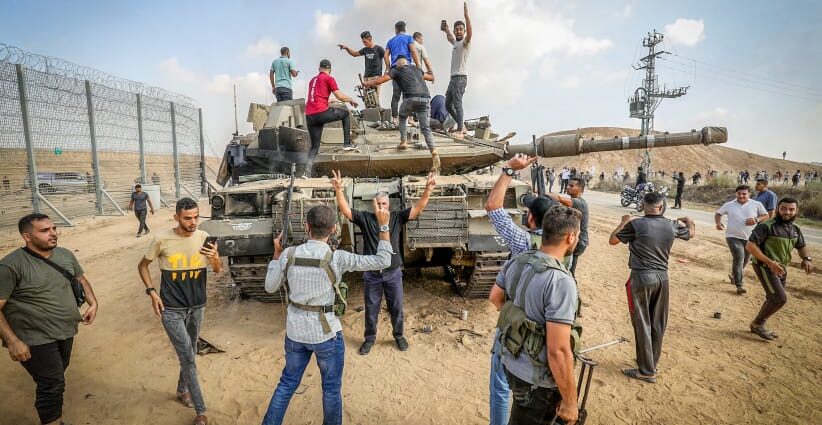
The October 7, 2023, Hamas-led massacre did more than add a new element to that doctrine. It exposed the danger of trusting an adversary to remain deterred, and the danger of treating an assessment of intentions as a security guarantee.
It revived an old truth in Israeli thinking: the latitude you grant your enemy today may become tomorrow the danger that catches your state unprepared.
Permanent preparedness or repeated failure
After that day, the entire cost calculus changed. For Israel, the question was no longer a simple tradeoff between high military readiness and a calm period that allows lower spending. It became a choice between the cost of permanent preparedness and the risk of repeating a failure whose consequences could far outweigh the money saved during quiet years.
Deterrence stays essential, intelligence more so, and military readiness cannot drop to a level that would require months to rebuild when a crisis starts. This carries a heavy economic, social, and political price. It has come to be seen as the cost of lowering the chance of surprise, rather than a burden that can be put off indefinitely.
Prevention by definition does not begin after danger strikes or a breach occurs. At that point, the state has already moved from stopping danger to managing its aftermath.
Prevention begins much earlier, before rockets launch and before fighters cross borders. It begins when capability takes shape in weapons stockpiles, smuggling routes, command and funding structures, training sites and positioning areas, and in rocket and drone systems that build up under cover of waiting.
Prevention, in this sense, does not mean unlimited use of force. It means targeting a specific capability that poses an operational danger before it matures into a full threat.
The lessons from Israel’s experience apply elsewhere. The same geopolitical conditions, in varying degrees, impose a similar logic on other states in the region.
The recent Gulf war demonstrated that location, wealth, international ties, and balanced policies offer no complete immunity when the region erupts. Iran targeted Gulf states and their vital economic infrastructure as part of a broader confrontation with the United States and Israel.
The Gulf, in one aspect of this strategy, became an area that could be hurt so that political and economic pain would reach Washington, the West, and global markets.
The lesson is stark. A state can declare it wants no confrontation, open channels for mediation, and maintain relations with opposing parties. That does not force its adversary to read the situation the same way.
If the adversary believes striking it will pressure a larger power or raise the cost of war for others, the state may become a target despite having no role in starting the conflict.
Iran has specifically shown its calculations change when the cost of action becomes tangible, and when it believes the other side can reach its centers of gravity and inflict damage hard to absorb. Deterrence here does not come from good intentions. It comes from a capability the adversary knows exists and must account for in its planning.
Even so, deterrence offers no complete protection. What happens if one rocket gets through defenses and hits a major power station? What if a desalination plant, data center, or port central to trade movement goes offline?
At that moment, another test appears that aircraft and missiles alone cannot settle: the state’s ability to continue after receiving the blow.
Here, the meaning of strength also changes. What matters is not only keeping the adversary from reaching its target, but making the adversary know that hitting the target will not produce the desired result. The more alternatives and backup capacity a state has, the less effective any single blow becomes.
Inflicting damage differs from paralyzing a state. Real preparation starts years before a crisis, with sufficient stockpiles, repair capacity, and institutions that know how to operate when basic services fail.
No matter how strong domestic capacity grows, international alliances remain an important part of the security equation.
Alliances carry weight. They cannot replace domestic capacity, however. An ally may supply weapons and intelligence. It cannot manage a state’s internal crises or restart systems that have broken down inside it.
In this sense, Israel’s experience amounts to more than a special case. It serves as an early testing ground for questions that states across the region have begun to face in their own ways.
The requirement is not to copy Israel. Differences in geography, society, and politics make that pointless. The requirement is to grasp the lesson that its environment forced on it decades ago, and that October 7 brought forcefully back to attention.
Security costs money. Intelligence costs money. Ready armies cost money. Creating alternatives, stockpiles, and redundant vital structures also costs money. Discovering the need for these things after war begins, however, usually proves the costliest option of all.
The Middle East grants its states no permanent guarantees. This is not a call for militarization of the region or for treating war as unavoidable fate. It is a call for understanding the region as it is, not as we wish it were.
The most durable peace requires a state that resists blackmail and paralysis, and whose adversary knows that striking one of its assets will neither break its will nor disable its ability to continue.
This is the doctrine of the survivable state. In a region like ours, a state may not get to choose when the next crisis arrives.
It can decide today, however, whether to enter that crisis counting on it never happening, or prepared for it to happen and able to endure afterward without the adversary robbing it of its capacity to carry on.
The writer is a UAE political analyst and former Federal National Council candidate.