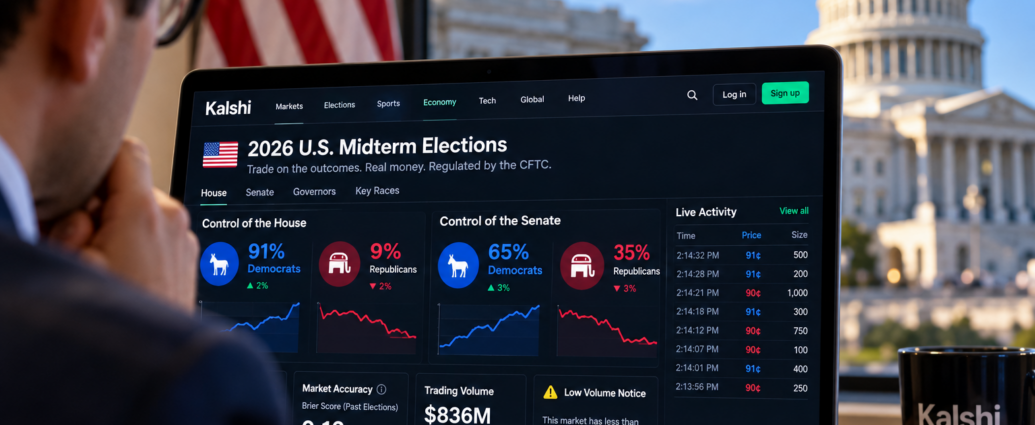
NEW YORK — Kalshi is adding accuracy scores, low-volume warnings and live trading information to its election markets, giving Americans a clearer look at how much confidence they should put in prediction-market odds ahead of the Nov. 3 midterm elections.
The federally regulated prediction-market exchange announced Tuesday that the new transparency features are now available across its midterm election markets.
The changes come as prediction markets increasingly move from a niche trading product into mainstream political coverage, where percentages displayed beside candidates and parties can easily be interpreted as forecasts of who will win.
Kalshi wants users to see more of what is behind those numbers.
What Does a 70% Chance Actually Mean?
Kalshi allows traders to buy contracts tied to real-world outcomes.
In a simple election contract, a winning position ultimately pays $1 while the losing side pays nothing.
That means market prices can be interpreted as probabilities.
If a candidate is trading around 70 cents, for example, the market is effectively pricing that candidate at roughly a 70% chance of winning.
But 70% does not mean certainty.
If a forecast is properly calibrated, events given a 70% probability should still fail roughly three times out of every 10.
That distinction becomes particularly important as prediction-market percentages appear more frequently in political coverage.
Kalshi Adds an Accuracy Score
The first new feature is a Brier score, a statistical measurement used to evaluate probability forecasts.
Lower scores indicate better forecasting performance.
Rather than simply showing visitors the current price of an election contract, Kalshi will now provide additional information about how accurately comparable market probabilities have performed historically.
The company says its scores are calculated using millions of historical data points and are weighted according to trading volume and how far a market was from its final resolution.
The concept is important because a prediction market should not be judged simply by whether its favorite wins.
A market consistently assigning 80% probabilities would be well calibrated if those outcomes ultimately occurred about four times out of five.
Warning for Thin Markets
Kalshi is also highlighting markets with relatively little trading activity.
Markets below $10,000 in volume can now be identified through low-volume information.
Why does that matter?
A heavily traded market incorporates the decisions of more participants and generally has more money available to absorb individual orders.
A thin market can potentially move much more sharply when someone places a large trade.
Kalshi itself says its research shows forecasting performance improves as participation and trading volume increase, although the company says even markets around the $10,000 level have produced useful forecasts.
The label gives casual observers something they previously might have missed: a 70% probability backed by substantial trading activity is not necessarily equivalent to a 70% number produced by a lightly traded race.
Watch the Trades Happen
The third change makes individual trades easier to see.
Kalshi is putting its real-time activity feed more prominently on midterm market pages, allowing visitors to watch trades occur and see how market probabilities move.
The activity information already existed on Kalshi, but moving it closer to the main market chart makes it easier for casual users to understand what is driving changes.
A sudden jump in a candidate’s probability, for example, can be viewed alongside the trading activity behind the move.
Election Markets Are Going Mainstream
The changes arrive as election trading becomes a much larger part of Kalshi’s business and public profile.
Kalshi says election trading volume in 2026 is already higher than during the 2024 presidential election cycle and that its election markets have grown six times faster than its football markets this year compared with last year.
The audience is also much larger than the number of people actually placing trades.
According to Kalshi, five people view its midterm markets for every one person who trades them.
That means the probabilities increasingly function not only as financial prices but also as public information.
Kalshi’s Midterms Hub had accumulated more than $836 million in trading volume as of Tuesday.
Markets Are Not Polls
There is another distinction consumers need to understand.
Prediction markets are not opinion polls.
A political poll asks a sample of voters which candidate they support or intend to vote for.
A prediction market asks something different through financial incentives: what outcome do traders believe will actually occur?
A trader can personally support one candidate while buying a contract predicting that candidate’s opponent will win.
That difference is why polls and prediction markets can sometimes produce very different pictures of the same election.
Neither should be treated as a guarantee.
A Test on Election Night
The Nov. 3 midterms will provide a major public test for prediction markets as Americans decide control of Congress and elect governors and other officials across the country.
Kalshi’s own live markets Tuesday put Democrats at roughly a 91% probability of winning the House, while its Senate market placed Democrats around the mid-60% range.
Those numbers will continue changing as traders react to polling, campaign developments, economic news and eventually election results.
The difference now is that someone looking at a Kalshi percentage will have more information available to judge it.
Instead of seeing only the probability, users can examine trading volume, historical forecasting accuracy and the transactions moving the market.
For a platform whose numbers are increasingly being treated as political forecasts, that context may become almost as important as the odds themselves.
JBizNews Desk | New York
© JBizNews.com All Rights Reserved. Reproduction or distribution without written permission is prohibited.