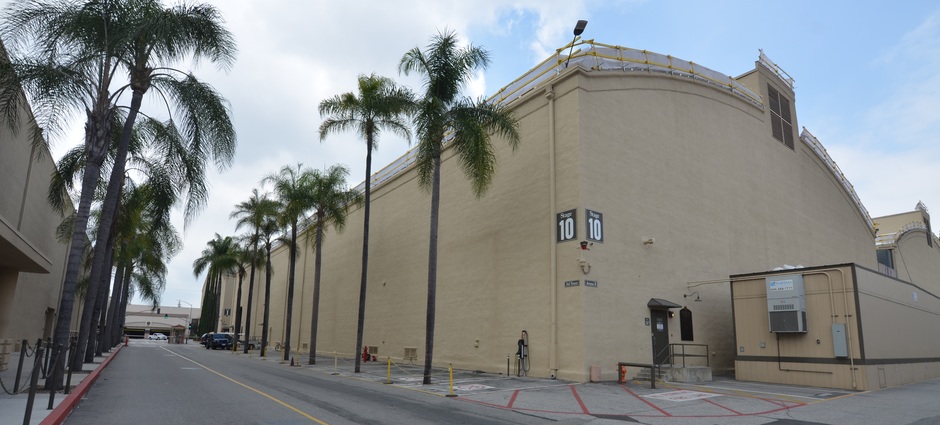
Soundstage 10 at Warner Bros. Studios in Burbank, archive photograph (June 2019). Steven Lek / Wikimedia Commons, CC BY-SA 4.0. Cropped. Illustrates the regional production industry.
Los Angeles County’s motion-picture and video industry averaged 92,454 private payroll jobs in 2025, down 36.3% from its 2022 peak, according to a county report released Monday, November 16, that recommends making filming cheaper and easier to keep work in the region.
The decline reaches beyond studio employees to the network of businesses that keeps productions running, including prop suppliers, post-production facilities, soundstages and caterers. Industry establishments fell 17.2% between 2021 and 2025, the county’s Department of Economic Opportunity said in its release announcing the findings.
The Screen Sectors Landscape Analysis, prepared by CVL Economics for the county Film Office, describes two problems operating together: a smaller market for some kinds of film and television, and productions choosing competing locations even when work remains available.
A smaller workforce, not a new round of layoffs
The employment figures measure annual average private payroll jobs in the motion-picture and video industries, using the Bureau of Labor Statistics’ Quarterly Census of Employment and Wages. They describe the workforce in 2025, not layoffs announced this week or a count of unemployed entertainment workers.
Employment was 21.3% below its 2019 level, compared with a 17.6% decline nationally. The county’s share of U.S. employment in those industries fell to 27% in 2025 from 28.3% in 2019, after reaching 34.7% in 2021 and 2022, according to the full report.
Theatrical film production in the county fell 52% between 2019 and 2025. The analysis attributes more than three-quarters of that decline to lost competitive market share, rather than simply fewer films being made overall.
Streaming shows tell a similar story about competition. National streaming-series production rose from 260 in 2019 to 539 in 2022, then fell to 414 in 2025. The county’s share nevertheless dropped from 34.6% to 23.6% between 2019 and 2025. A growing national market did not preserve Los Angeles County’s earlier share of the work.
Lower costs and simpler permits are proposed
The county report says competing U.S. and overseas production centers offer lower operating and labor costs, alongside attractive tax incentives. It argues that California’s expanded film tax-credit program addresses only part of the problem, leaving local costs and administrative delays for county officials to tackle.
Its recommendations include simplifying and reducing filming fees, improving coordination among departments and nearby cities, modernizing filming regulations, and speeding permits for film ranches and standing sets.
The report also calls for capitalizing an Evergreen Fund to support productions, exploring filming uses for underused county properties, and creating searchable directories of county locations. These are recommendations, not an announcement that new funding or fee reductions have been approved.
For businesses already serving the industry, the proposed response includes better access to county contracts, recruitment assistance and layoff-aversion services. The aim is to preserve the crews, facilities and suppliers that productions need, rather than treat each departing project as an isolated loss.
Smaller films and digital producers offer openings
Not every part of the industry is losing ground. The county’s share of U.S.-origin wide-release films with budgets below $20 million rose from 8.3% in 2019-2021 to 12.3% in 2022-2025, the only budget category to gain local share.
Los Angeles County also housed 67 of the 114 creator, podcast and digital-media companies examined in the report. That is a finding about the companies studied, not a census of the entire creator economy.
The report recommends training workers for emerging formats, including short, portrait-oriented dramas made for mobile viewing. The county says it has already invested approximately $6.24 million across five creative-economy training partnerships, separate from the report’s proposed next steps.
Those newer formats use many of the same crews, stages and suppliers as traditional productions. Keeping those businesses operating while connecting experienced workers with different kinds of projects is part of the county’s proposed route to rebuilding its production base.
JBizNews Desk | Los Angeles
© JBizNews.com. All rights reserved. Unauthorized reproduction or redistribution is strictly prohibited.