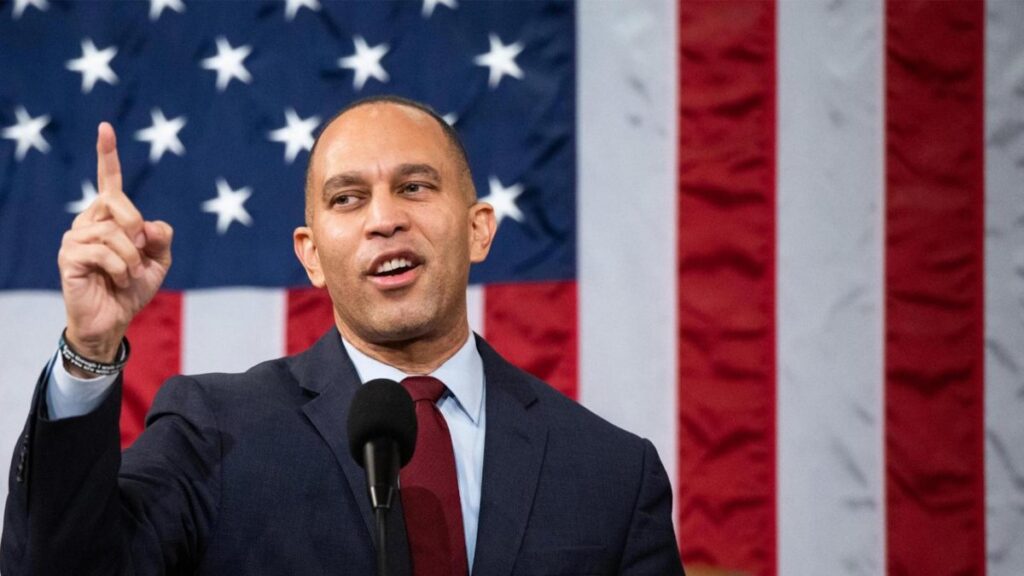
Hakeem Jeffries in January 2023 at the opening of the 118th Congress. File photo: U.S. government / Wikimedia Commons, public domain. Not from Tuesday’s briefing demand.
Update, November 18, 2026, 12:39 p.m. EST: Clayton gives current assessment at House hearing
Director of National Intelligence Jay Clayton told the House Homeland Security Committee on Wednesday that officials had no indication the recent service outages were related, coordinated or the result of a state-sponsored malicious actor, according to a published account of his testimony and answers to lawmakers. He said that assessment followed review within the government and with private-sector cybersecurity specialists. Based on what officials knew at the time, he described separate outages associated with maintenance and technical changes.
The committee’s November 18 worldwide-threats hearing is a separate development from the briefing demands described below; it does not establish that all those requested briefings have occurred. Clayton’s statements describe the current intelligence assessment, not a published final technical explanation for every affected system or a guarantee against future cyberattacks. His broader warning about faster AI-enabled cyber threats does not establish that AI or a foreign government caused these outages.
Democratic and Republican lawmakers called Tuesday for the Trump administration to brief Congress on a succession of technology outages affecting air travel, banking and communications, seeking answers about the causes and whether any of the incidents are connected.
The demands are calls for information, not findings that a coordinated cyberattack occurred. The public accounts reviewed for this report do not establish a common cause linking the failures.
Jeffries and Hawley seek answers
House Minority Leader Hakeem Jeffries said Congress needed both a high-level briefing for senior leaders and briefings for members of both chambers and parties. Speaking at a November 17 Capitol news conference, he said it was too early to determine whether the problems reflected infrastructure failures or malicious activity, according to reporting from the briefing.
Jeffries said he had spoken with Transportation Secretary Sean Duffy but still wanted answers about what happened, why it happened and how a recurrence could be prevented.
Sen. Josh Hawley, a Missouri Republican, separately called for the full Senate to be briefed. He questioned the explanation for the Federal Aviation Administration’s November 13 ground stop and the succession of disruptions, telling reporters Tuesday that lawmakers and the public deserved a fuller account. His skepticism does not establish a technical cause.
Rep. Mike Lawler, a New York Republican, also urged an immediate briefing and a coordinated government response. In comments reported Tuesday, he said some incidents might be coincidental while arguing that cybersecurity and malicious uses of artificial intelligence required attention.
November 17 update: Paul describes separate meeting on FAA failure
Sen. Rand Paul, a Kentucky Republican, said officials still appeared uncertain about the FAA router failure after a closed-door discussion with senators. In a November 17 interview on Fox News’ “The Story”, he said he did not think officials yet fully understood the technical problem and wanted it examined before Congress approved more spending.
Asked about a possible foreign actor, Paul said he had no evidence of a foreign actor or cyberattack, but supported continuing to look. That is his assessment of the evidence available to him, not a completed forensic finding. The senators’ meeting he described is separate from Jeffries’ demand for broader, bipartisan congressional briefings and does not establish that those requested briefings have taken place.
In a November 17 Transportation Department account of his remarks, Transportation Secretary Sean Duffy said investigators had recreated what happened in El Dorado but still lacked clarity about the root cause. He said national-security agencies had told him the FAA was not hacked and that he had asked the FBI to assist with examining the router as a precaution. Those attributed assessments do not establish a common cause for disruptions at other organizations.
November 17 update: Warner sees no indication of a coordinated attack
Sen. Mark Warner, the Senate Intelligence Committee’s vice chairman and a co-chair of the Senate Cybersecurity Caucus, said in a November 17 statement that he saw no indication at that point that the recent outages resulted from a cyberattack, foreign interference or a coordinated effort.
Warner said AI tools’ faster discovery of vulnerabilities was putting pressure on companies and agencies to install security patches quickly, potentially straining older systems. He described legitimate work to secure systems as the explanation the evidence appeared to support so far, while saying the incidents still needed to be fully understood.
That is Warner’s preliminary assessment, not a published technical finding establishing one cause for every outage. His statement did not identify individual affected systems or disclose a forensic report. He said he would keep examining the incidents and pressing for answers.
What officials have established about the FAA failure
The FAA’s November 15 account said its legacy telecommunications equipment became unstable amid excessive data traffic. Its initial investigation identified sites in El Dorado, Arkansas, and Amarillo, Texas, as potential sources of that traffic.
The agency said it had no indication, based on the available evidence, of a cyberattack or an outside malicious actor. It also said the FAA and contractor L3Harris were continuing to investigate the root cause. A preliminary account of network instability is not a completed forensic explanation.
The FAA lifted the nationwide ground stop at 8:15 p.m. Eastern on November 13. The briefing demands do not announce another nationwide flight restriction or establish the current status of any individual flight.
Questions are not evidence of a coordinated attack
In the November 17 account that drew renewed attention to the dispute, White House spokeswoman Lauren Bis said officials saw no evidence of a cyberattack. That statement addresses the administration’s assessment; it does not substitute for a final explanation of every separate failure.
Lawmakers’ broader request goes beyond the FAA’s equipment investigation to seek an account of disruptions across different organizations. The available reporting establishes that members want briefings, not that a briefing has been scheduled, a joint investigation launched or investigators have linked the incidents.
For businesses and customers, a cluster of outages can expose reliance on essential digital services without proving that the systems failed for the same reason. The separate FBI and Google warnings about malicious AI use likewise do not establish that those tools caused the recent aviation, banking or communications disruptions.
JBizNews Desk | Washington
© JBizNews.com. All rights reserved. Unauthorized reproduction or redistribution is strictly prohibited.