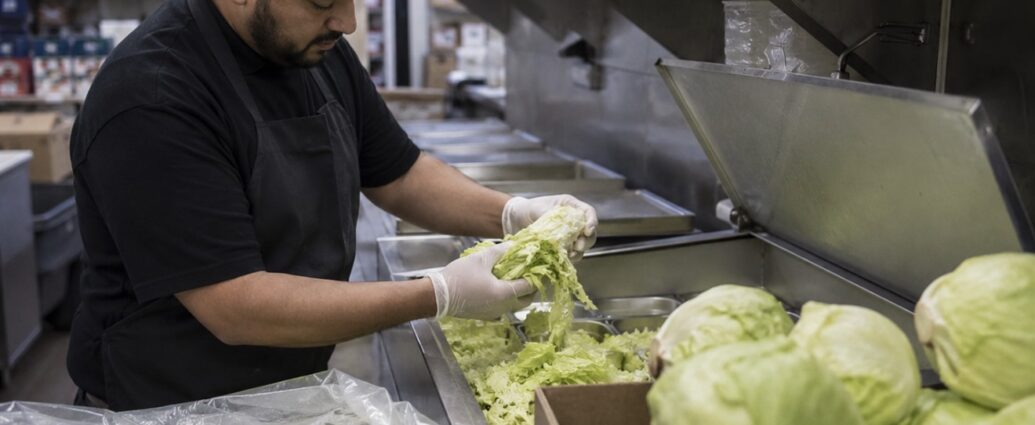
A nationwide Cyclospora surge is beginning to produce measurable financial damage across the restaurant industry, with Taco Bell reporting weaker July sales and other chains warning that customers are avoiding lettuce even when their own supplies were not connected to the outbreak.
Yum Brands executives said Thursday that Taco Bell’s U.S. same-store sales declined approximately 2% during the current quarter through late July as publicity surrounding contaminated iceberg lettuce reduced customer traffic. Sales have begun recovering, but the disruption interrupted momentum at a chain that had posted 7% same-store sales growth during the second quarter.
Federal health officials are investigating a nine-state outbreak linked to iceberg lettuce supplied by Taylor Farms de Mexico. Taco Bell stopped using the affected lettuce July 17, while Taylor Farms removed iceberg lettuce sourced from central Mexico from the U.S. market and initiated a broader recall.
The recall reached beyond restaurants. Products identified by the Food and Drug Administration included shredded lettuce and iceberg salad sold under several food-service and retail labels, including certain Marketside products available at Walmart.
More than 1,900 confirmed illnesses have been connected to the specific nine-state iceberg-lettuce outbreak, including at least 98 hospitalizations and no reported deaths. Illinois, Indiana, Kansas, Kentucky, Michigan, Ohio, Oklahoma, Pennsylvania and West Virginia have reported cases.
That outbreak is part of a much larger seasonal increase in Cyclospora infections. The Centers for Disease Control and Prevention reported 6,707 laboratory-confirmed domestically acquired cases across 45 states from May 1 through July 27, along with 423 hospitalizations and no deaths.
CDC officials are also reviewing more than 11,500 additional cases that have not yet been laboratory confirmed or require further investigation. Not all of those illnesses have been connected to lettuce, Taylor Farms or Taco Bell, and health authorities are investigating multiple possible sources.
Cyclospora is a microscopic parasite that can contaminate food or water. Infection commonly causes prolonged diarrhea, appetite loss, stomach cramps, nausea, fatigue and weight loss. Unlike some foodborne illnesses, symptoms can continue for weeks or return after appearing to improve.
For restaurants, the commercial threat extends beyond locations that received recalled products.
Chipotle said publicity surrounding the outbreak hurt July sales even though its California-grown romaine lettuce was not implicated. Chopt also experienced weaker customer traffic as consumers became more cautious about leafy greens generally.
That spillover demonstrates how quickly a supplier problem can become an industrywide demand problem. Customers rarely distinguish between iceberg and romaine lettuce, specific growing regions or individual distributors when an outbreak dominates headlines. Instead, many temporarily avoid an entire food category or the restaurants most closely associated with it.
Operators must then decide whether to remove ingredients, change suppliers, absorb higher purchasing costs or offer promotions to restore traffic. Taco Bell has used discounted menu offers, including lettuce-free products, as it works to rebuild customer confidence.
The disruption arrives as restaurants are already confronting elevated food, labor and transportation costs. Lettuce prices had increased before the outbreak because of difficult growing conditions, while the need for refrigeration makes leafy-greens distribution particularly sensitive to fuel and freight expenses.
Large restaurant chains generally have enough purchasing power to replace suppliers and launch national marketing campaigns. Smaller operators may face a harder adjustment, particularly when they lack multiple approved vendors or cannot afford to discard inventory and discount meals simultaneously.
Produce suppliers also face greater pressure to strengthen tracing systems. A recall that reaches restaurants, grocery stores and institutional food-service customers can require identifying farms, processing plants, shipping dates and individual product codes across a highly fragmented distribution network.
For consumers, the immediate instruction remains product-specific: recalled Taylor Farms de Mexico iceberg lettuce should not be eaten and should be discarded or returned. Other lettuce is not automatically unsafe, although federal investigators have warned that additional products or locations could still be identified.
Taco Bell’s early recovery suggests that the financial impact could prove temporary. Yet the broader lesson for the restaurant industry is more lasting: a food-safety event involving one supplier can rapidly reduce sales at unrelated businesses, disrupt an entire produce category and force companies to spend heavily rebuilding trust.
JBizNews Desk | Louisville, Kentucky
© JBizNews.com All Rights Reserved. Reproduction or distribution without written permission is prohibited.