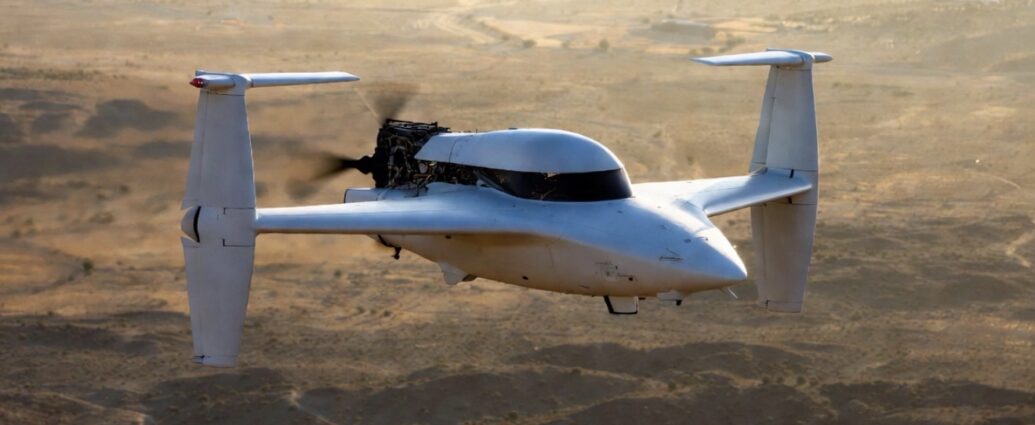
Lockheed Martin has introduced MORFIUS X-Rotor, an airborne high-power microwave platform designed to disable large numbers of hostile drones in a single mission, announced at the Farnborough International Airshow. The company says the reusable system can neutralize more than 50 enemy drones in one flight before being recovered and prepared for reuse.
The pitch is as much financial as it is tactical. Counter-drone economics have been upside down for years: defenders have been spending interceptors worth hundreds of thousands of dollars to knock down attack drones that cost a few thousand to build. MORFIUS is designed for field recovery and reuse, keeping cost per kill low and easing pressure on defense budgets while sustaining firepower.
“MORFIUS sets a new benchmark for counter-drone capability, delivering a high kill rate while keeping the cost per kill low,” said Randy Crites, vice president and general manager of Lockheed Martin Missiles and Fire Control Advanced Programs. Crites added that the lightweight, field-reusable microwave architecture gives the company “the most effective, low-cost solution on the market today.”
How it works
Unlike missiles or lasers, which engage targets one at a time, high-power microwave systems emit bursts of electromagnetic energy that can knock out the electronics of multiple drones at once — a fit for swarm tactics because it delivers rapid, wide-area neutralization without burning through expensive interceptors. Lockheed describes the platform as a “one-to-many” system that disrupts the internal electronics and guidance of unmanned aircraft using directed beams of electromagnetic energy.
MORFIUS is ground-launched, sensor-agnostic, and compatible with existing command-and-control systems without requiring dedicated fire-control radars. That last point matters commercially. Systems that demand their own bespoke radar and control architecture force a customer into a full-stack purchase; a system that plugs into whatever the customer already fields is far easier to sell into allied militaries with mixed inventories and tight procurement calendars.
The company says MORFIUS is the only ground-launched, field-reusable airborne high-power microwave system capable of delivering more than 50 drone defeats per flight while operating with any command-and-control system and without relying on fire control radars.
Not a clean-sheet program
The X-Rotor builds on earlier MORFIUS variants that have been flying since 2017 and draws on the same family of high-power microwave effectors. That lineage is part of the commercial argument — the company is presenting a maturing line rather than a concept looking for funding.
Lockheed is accelerating prototype production of both the platform and its microwave payload while preparing additional flight testing. Recent demonstrations were conducted in Arizona, California and Oklahoma, and the earlier testing campaign covered flight, intercept and lethality evaluations.
Where the demand is coming from
Lockheed says the program aligns with the U.S. Department of War’s 2025-2028 Rapid Response Counter-UAS Roadmap, an effort aimed at inexpensive systems that can be put in the field quickly. The announcement also lands amid rising interest in counter-drone systems worldwide.
For contractors, counter-UAS has become one of the few defense segments where budget authority moves at commercial speed. Procurement offices that once measured programs in decades are now writing requirements around threats that evolve in months, and commercial off-the-shelf quadcopters modified into attack platforms have compressed that cycle further. Lockheed says commercial drone swarms have become a growing threat to allied forces in modern combat environments.
The unresolved question is durability of performance. Whether the X-Rotor lives up to its stated numbers will depend on continued testing and operational deployment — and microwave effects against hardened or shielded airframes remain harder to guarantee than against consumer-grade electronics. Buyers will want repeatable results across weather, range and target mix before committing at scale.
For the tri-state defense supply base — the machine shops, RF component makers and electronics subcontractors that feed programs like this one — an accelerating prototype line is the practical takeaway. Directed-energy payloads pull in specialized power electronics, antenna assemblies and thermal management work, categories where regional suppliers already hold qualified positions on other Lockheed programs.
JBizNews Desk | Farnborough, England
© JBizNews.com All Rights Reserved. Reproduction or distribution without written permission is prohibited.