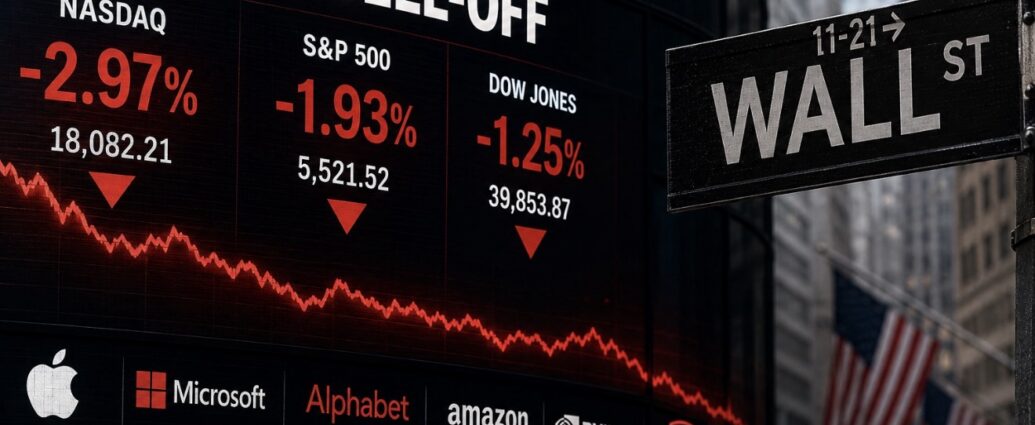
For nearly two years, the market had one overriding message for Big Tech: spend whatever it takes to win the artificial intelligence race. On Thursday, that message changed.
Investors punished some of the market’s biggest technology companies despite solid revenue growth, signaling that Wall Street is becoming less willing to reward soaring AI investment without clear evidence those dollars will translate into stronger cash flow and shareholder returns. The shift sent technology shares sharply lower and dragged the broader market to multi-week lows.
The change in sentiment was led by Alphabet and Tesla, the first members of the so-called “Magnificent Seven” to report quarterly results this earnings season. Alphabet delivered another strong quarter fueled by rapid cloud growth tied to artificial intelligence demand, but investors focused instead on the company’s expanding capital spending plans and its first reported quarterly cash burn. Tesla, meanwhile, reported negative free cash flow for the first time in more than two years, reinforcing concerns that even the industry’s largest companies are spending faster than cash is being generated.
The market reaction was swift. Technology shares led losses across Wall Street as traders reassessed how much they are willing to pay today for profits that may not materialize for years. The Nasdaq fell to its lowest level in more than two months, while the S&P 500 and Dow Jones Industrial Average also retreated as selling spread well beyond the technology sector.
The earnings themselves were not the story.
The price of staying in the AI race was.
Alphabet’s latest spending plans underscored how dramatically the economics of artificial intelligence have changed. Data centers, specialized chips, networking equipment and power infrastructure are demanding unprecedented levels of capital. Industry analysts now expect hyperscale technology companies to collectively invest hundreds of billions of dollars this year as competition intensifies. Until now, investors largely embraced those expenditures as necessary to secure long-term leadership. Thursday suggested that patience may be wearing thinner.
The pressure extended beyond individual companies because investors increasingly view AI spending as a sector-wide issue rather than a company-specific one. Every major cloud provider faces similar decisions over infrastructure investment, while chipmakers, software developers and enterprise technology companies all depend on sustained demand from those projects. As a result, weakness in Alphabet and Tesla quickly rippled across the broader technology complex.
The selloff was amplified by another factor weighing on financial markets: energy prices. Brent crude climbed above $100 a barrel as geopolitical tensions disrupted shipping routes, reviving concerns that higher fuel costs could slow progress on inflation and complicate the Federal Reserve’s policy outlook. Rising Treasury yields added further pressure to high-growth technology stocks whose valuations are particularly sensitive to interest-rate expectations.
None of this means investors have abandoned artificial intelligence. Demand for AI computing, cloud services and advanced semiconductors continues to expand rapidly, and executives across the industry remain committed to aggressive investment.
What changed Thursday was the standard by which Wall Street is measuring success.
Growth alone is no longer enough. Investors increasingly want proof that record AI spending can generate durable profits, stronger free cash flow and meaningful returns for shareholders. As more of the technology industry’s largest companies report earnings over the coming weeks, that question is likely to shape not only stock prices but the broader direction of the market for the rest of the year.
JBizNews Desk | Wall Street
© JBizNews.com All Rights Reserved. Reproduction or distribution without written permission is prohibited.