A majority of voters for Israel’s four main change-bloc parties support a government led by Gadi Eisenkot that includes the Arab Ra’am party, according to a survey conducted by the Hebrew University’s Accord Center on Tuesday evening, as polls were closing in the Knesset election.
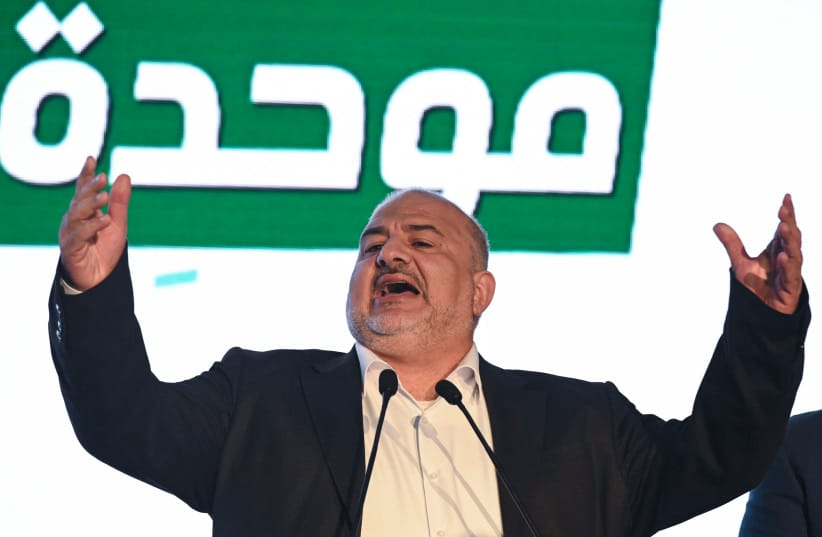
The survey found that 61% of voters for Eisnekot’s Yashar, Naftali Bennett’s B’Yachad, Yair Golan’s Democrats, and Avigdor Liberman’s Yisrael Beytenu favored forming a government with Mansour Abbas’ Ra’am, making it the most popular option among supporters of the parties seeking to replace Prime Minister Benjamin Netanyahu.
Another 20% preferred holding new elections, while 12% supported a rotation government with Netanyahu. Just 7% favored forming a coalition with the ultra-Orthodox parties.
The poll was conducted on October 27, between 9:15 p.m. and 10:27 p.m., among 467 respondents who had already voted for one of the four parties. The results were weighted according to party size.
The findings come amid uncertainty over the formation of Israel’s next government, after Tuesday’s election left neither Netanyahu’s bloc nor the change bloc with the 61 Knesset seats required for a parliamentary majority without support from Arab parties.
The possibility of cooperation with Ra’am, led by Mansour Abbas, has become a central issue in coalition discussions. While the survey indicates substantial support for such an arrangement among change-bloc voters, the bloc’s leaders have expressed differing positions on cooperation with Arab parties.
*רוב מצביעי גוש השינוי, כולל מצביעי ליברמן, בעד ממשלה עם רע”מ ובהימנעות של הרשימה המשותפת* מרכז אקורד מהאוניברסיטה העברית ערך היום (29.10) סקר בזק שבדק את עמדות מצביעי גוש השינוי לממשלה הנשענת מבחוץ על תמיכת רע”מ ובהימנעות הרשימה המשותפת. הממצאים חד-משמעיים: *59% ממצביעי גוש השינוי מעדיפים שאיזנקוט ירכיב ממשלה עם רע”מ ובהימנעות המשותפת על פני כל אופציה אחרת.* רק 26% מעדיפים ממשלת רוטציה עם נתניהו, 10% מעדיפים בחירות נוספות ו-5% מעדיפים ממשלה בשיתוף המפלגות החרדיות. הממצא עקבי עם הסקר שנערך בסיומו של יום הבחירות, שבו 61% ממצביעי האופוזיציה תמכו בממשלה בתמיכת רע”מ. תוצאות האמת ותרחיש הכולל את הרשימה המשותפת לא שינו את רמת התמיכה. מפילוח התשובות עפ”י מפלגות עולה שממשלה עם רע”מ ובהימנעות המשותפת היא האופציה המועדפת על מצביעי כל אחת מארבע מפלגות הגוש. תומכים בה 93% ממצביעי הדמוקרטים, 59% ממצביעי ישר!, 47% ממצביעי ביחד וכן 42% ממצביעי ישראל ביתנו. (הסקר נערך ב-29 באוקטובר 2026 בקרב 935 משיבים שהצביעו לישר!, ביחד, הדמוקרטים וישראל ביתנו. התוצאות משוקללות לגודל המפלגות בתוצאות הבחירות).
— Eran Halperin (@eranh75_eran) October 29, 2026
Golan pushes for majority coalition with Arab parties
Golan has argued that the opposition could secure a majority with Arab parties, while Eisenkot, Naftali Bennett, and Avigdor Liberman have opposed bringing Arab parties into a governing coalition.
The four opposition parties had agreed to coordinate their election efforts ahead of the vote, although questions remained over the composition of a future government and the selection of its leader.
An earlier Israel Democracy Institute survey, published before the election, found that Eisenkot was the most broadly acceptable candidate for prime minister among both Jewish and Arab respondents. That survey also examined public preferences for new elections and alternative government arrangements in the event of a political deadlock.