President Donald Trump has long had an antagonistic relationship with the press. He famously popularized the phrase “fake news” and has called reporters “the enemy of the people.” Yet the president is also more accessible to reporters than his recent predecessors, making media appearances on roughly 80% of his days in office during stretches of his second term and taking far more shouted questions and interviews than Obama or Biden ever took.
It’s a contradiction that defined Monday: a president who grants extraordinary access on his own terms, and revokes it entirely when the coverage displeases him. And at New York’s Gracie Mansion on Monday, New York City Mayor Zohran Mamdani made sure to portray a different scene to the press.
“I told the president that we’re going to have all of the members of the press here on the lawn, and that is something that I believe in,” Mamdani said.
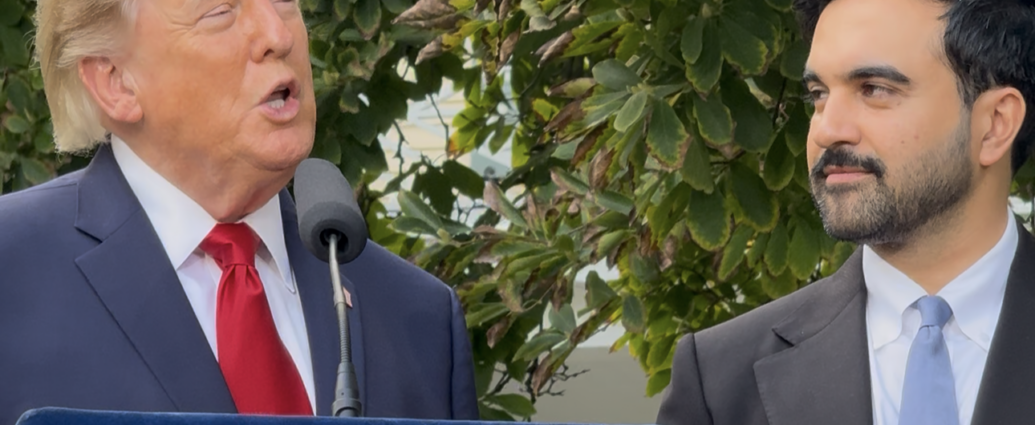
Standing next to him on the lawn of the famed city house was Trump, who on Friday announced he was banning CNN, MS NOW and Politico from White House grounds over the “constant ‘reporting’ [of] FAKE NEWS.”
By Monday morning, the three banned outlets had filed a joint First Amendment lawsuit in federal court in Washington D.C., arguing the ban amounted to viewpoint discrimination and violated their due-process rights. Other networks refused to provide White House pool coverage that day in solidarity, since CNN normally handles that rotation.
Friday’s action isn’t Trump’s first attempt to ban the press. In 2018, the White House revoked the press pass of then-CNN reporter Jim Acosta, until a federal judge ordered it be restored. More recently, in February 2025, he barred the Associated Press from the Oval Office and other small-pool events over the news agency’s refusal to adopt “Gulf of America,” instead of the widely-accepted “Gulf of Mexico.” (A judge initially ordered the access restored, only to be overruled by the the D.C. Circuit in June 2025.)
Asked by reporters about his closed-door conversation with Trump, Mamdani said he made sure the president knew the press would be present at Gracie Mansion.
Trump, in response, joked that the press would never boycott him, and again called the three outlets fake news. “If you look at CNN, it’s fake news. If you look at MS NOW, I don’t even know what MS NOW is,” he went on.
“I really think I have an obligation not to allow them into another very special house. This is a special house, Gracie Mansion. Well, the White House is the most special of all houses,” Trump said of the ban.
Temporary Protected Status
When The City reporter Katie Honan asked Trump about Temporary Protected Status, Mamdani said he and the president spoke about possibly restoring that status for Haitian immigrants, explaining it in economic terms and citing concern from “pastors, developers, executives in healthcare and hospitality.” He added that Trump, by controlling who gets TPS status, “can either deliver or deny stability” for people who’ve built lives in New York.
TPS status is granted to nationals of a designated country who are already living in the U.S., regardless of how they arrived, so long as the DHS determines that war, natural disaster or other extraordinary conditions make it unsafe for them to return. Recipients of TPS status are able to live and work in the U.S., but have no pathway to permanent residency.
Haiti has held TPS status since the 2010 earthquake, but upon removing TPS status for Haitians, then-Department of Homeland Security Secretary Kristi Noem argued that the administration was “returning TPS to its original status: temporary.”
Trump’s history with the Haitian community has swung wildly during his time in politics. As a candidate in 2016, he called himself Haitians’ “biggest champion” during a visit to Miami’s Little Haiti. Yet in his first administration, he tried to end TPS for Haitian immigrants in 2017, with the DHS arguing Haiti had recovered from the earthquake. Haitian TPS holders sued in Brooklyn, arguing the decision was motivated by political bias, and a federal judge agreed in April 2019.
Trump again tried to revoke TPS status in 2025, only for his ban to again be challenged int he courts; the Supreme Court ruled in June 2026 that DHS could proceed with cutting off protections for an estimated 330,000 to 350,000 Haitians. A new lawsuit alleges that Trump’s decision was racially motivated, though the termination remains in effect.
The end of TPS status cuts off work authorization for hundreds of thousands of Haitians as of July 24, and New York City Hall was forced to let go of Haitian employees with no other legal path to work.
“The mayor feels very strongly about [TPS],” Trump said Monday before leaving Gracie Mansion. “I feel strongly about a lot of things. I feel strongly about taking care of people, and that’s what we do. We’re doing a good job of it.”
New York has the country’s second-largest Haitian population after Miami, more than 160,000 people, concentrated in Brooklyn’s Flatbush and East Flatbush. Many work in healthcare: New York State alone has roughly 7,000 Haitian TPS holders working as nursing assistants and home caregivers, in a citywide healthcare workforce that’s 57% immigrant and nearly three-quarters immigrant among home health aides, according to the Center for Migration Studies.
After Trump left, Mamdani disclosed that he had personally invited Trump to the mayor’s residence, after the two discussed Trump’s own fond memories of Gracie Mansion.
This story was originally featured on Fortune.com