By JBizNews Desk
New York — May 25, 2026 — Manhattan’s commercial real estate market opened 2026 with strengthening demand for premium office space, declining vacancies in top-tier buildings and rising leasing activity across finance and technology corridors, directly challenging predictions that New York City would suffer a major corporate exodus following Mayor Zohran Mamdani’s election victory.
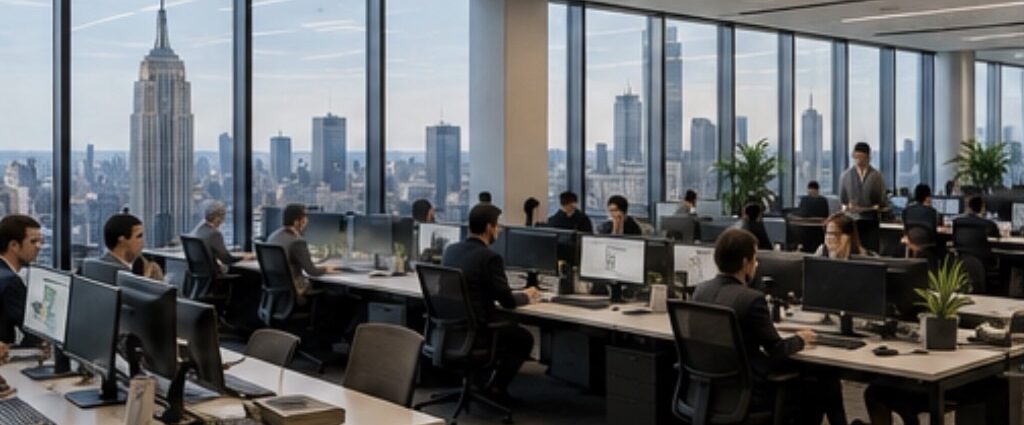
New first-quarter data compiled by JLL show leasing momentum accelerating in trophy Class A office product across Midtown Manhattan, Hudson Yards and parts of Downtown, with institutional landlords reporting tightening availability in the city’s strongest submarkets.
Separate market analysis published by Cushman & Wakefield this spring tracked similar trends, identifying rising absorption across premier Manhattan office assets while industrial demand continued strengthening throughout northern New Jersey’s logistics corridor tied to the Port of New York and New Jersey.
The data sharply undercut widespread predictions from segments of the financial press and political commentators who forecast that high-income residents, major employers and institutional capital would rapidly flee New York after Mamdani’s November election.
To date, the broad corporate retreat has not materialized in the leasing numbers, migration data or tax-revenue forecasts released so far in 2026.
The New York City Council’s December economic outlook projected fiscal-year 2026 and 2027 tax revenues above earlier Office of Management and Budget expectations, while the New York City Economic Development Corporation continues describing Manhattan as a magnet for younger educated workers and high-value employers.
The office market, however, is increasingly splitting into two entirely different realities.
Top-tier Class A buildings near major transit hubs are outperforming aggressively, with some premier towers effectively becoming waitlisted as financial firms, law firms and technology tenants compete for limited premium inventory.
Meanwhile, aging Class C office buildings continue deteriorating as viable commercial assets.
Industry executives now openly describe much of the older office inventory across Manhattan and the broader metropolitan area as functionally obsolete.
Executives surveyed earlier this year by New Jersey Business Magazine predicted large portions of the Class C market could disappear entirely within the next two years as properties migrate into residential conversion pipelines, light-industrial redevelopment projects or demolition plans.
That bifurcation is spreading across the region.
In New Jersey, Class A demand remains strongest in Newark, Jersey City, New Brunswick and the broader HELIX innovation corridor, where life-science, healthcare and institutional developments continue attracting tenants and capital.
South Jersey office inventory remains the weakest segment of the state’s office market, while Central Jersey is seeing more measured Class A expansion tied to pharmaceutical, logistics and technology employers.
Industrial real estate continues leading institutional investment flows across both sides of the Hudson River.
The Port Newark-Elizabeth Marine Terminal complex, Meadowlands logistics corridor and last-mile distribution hubs in Edison, Carteret and Linden remain among the strongest-performing industrial markets on the East Coast as e-commerce growth and reshoring strategies continue supporting warehouse demand.
Major institutional investors including Blackstone, Prologis, KKR and Brookfield Asset Management remain active buyers throughout the region’s industrial and multifamily sectors.
The macroeconomic backdrop has also become more supportive for commercial real estate than many analysts anticipated late last year.
Interest rates have moderated during the first half of 2026, while major financial institutions including JPMorgan Chase, Goldman Sachs, Morgan Stanley and Citigroup have tightened return-to-office mandates, increasing demand for high-quality office space close to transportation infrastructure and corporate amenities.
Capital markets have also stabilized.
Acquisition activity, refinancing volume and development financing have all improved materially year over year for institutional-quality projects, particularly in multifamily, logistics and top-tier office product.
The political risk premium that briefly entered New York commercial real estate pricing immediately after the mayoral election has therefore compressed substantially.
That does not mean concerns have disappeared.
Investors, landlords and corporate tenants remain closely focused on how the Mamdani administration handles fiscal policy, commercial taxation, the ongoing PTET credit debate and broader business regulation heading into the city’s fiscal 2027 budget cycle.
But for now, the leasing data tell a much different story than the one many expected six months ago.
Rather than empty towers and fleeing corporations, Manhattan’s strongest buildings are seeing rising competition for space.
The exodus narrative, at least so far, has run into a stubborn obstacle: the actual market.
JBizNews Desk
© 2026 JBizNews. All Rights Reserved. Reproduction or distribution without written permission is prohibited.