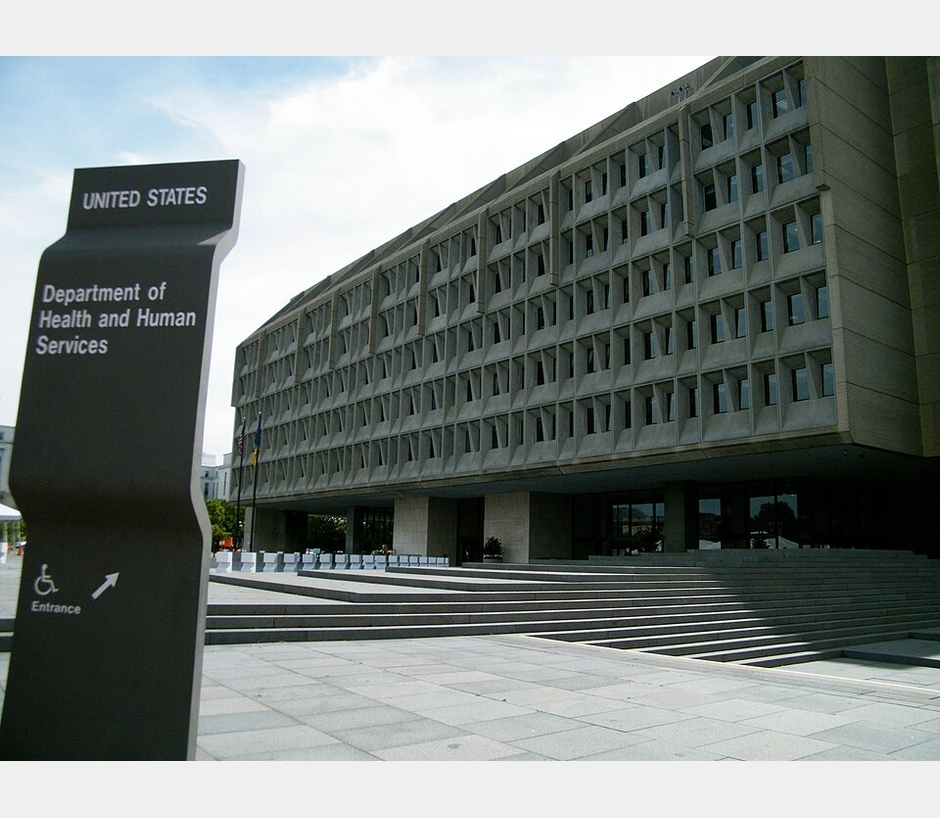
File photo: A Department of Health and Human Services sign outside the department’s Washington building, photographed in 2011. Sarah Stierch / Wikimedia Commons / CC0; resized and fitted.
Medicare is keeping its nationwide freeze on new hospice and home health agency enrollments for another six months, while reopening a path for providers already in the program to add locations.
The Centers for Medicare & Medicaid Services announced the extension on Nov. 12, saying fraud risks in both sectors remain high. The restrictions began May 13. They limit which businesses can enter Medicare, not whether patients can continue receiving services from providers already enrolled.
The change matters for agencies planning to expand. Under the extension, an enrolled home health agency can add branches to its existing enrollment, and an enrolled hospice can add practice locations. CMS said it is more concerned about entirely new operators, with whom it may have no experience, than about existing providers adding a location. The agency cautioned that those expansions still warrant scrutiny.
New applications for initial Medicare enrollment remain covered by the freeze. So do certain changes in majority ownership that require a provider to enroll as a new business. The extension does not stop currently enrolled providers from continuing to deliver care, CMS said in its announcement.
Fraud concerns keep the nationwide restrictions in place
CMS said the initial pause gave it time to investigate suspected fraud, use data analysis to identify risky providers and remove operators from Medicare. The agency concluded that the conditions behind the original restrictions have not gone away.
Its hospice notice describes schemes in which patients were enrolled without their knowledge or despite not having a terminal illness, and providers billed for care that was unnecessary or never delivered. The home health notice cites cases involving kickbacks, stolen patient information and claims for services that were not provided.
CMS considered limiting the extensions to Southern California, a focus of its enforcement efforts. It rejected that option because it said the risks are national, rather than confined to one region. Keeping the restrictions nationwide also prevents operators from avoiding them simply by moving across state lines, the agency said.
In its announcement, CMS said a two-day California site-visit operation in October resulted in 145 provider revocations involving providers associated with more than $703 million in Medicare and Medicaid payments. That figure describes payments associated with those providers; CMS did not identify it as a tally of proven fraud losses.
Effective now, with access still under review
Both the home health notice and the hospice notice make the extensions and location changes effective Nov. 12. The documents were filed for public inspection that day and are scheduled for Federal Register publication Nov. 16.
CMS said it has seen no evidence that the original restrictions materially reduced access to either type of care nationwide or at the state level. It plans to keep monitoring access, particularly in rural areas. The agency expects savings from restricting new enrollments but said it does not yet have data to estimate the amount.
© JBizNews.com. All rights reserved. Unauthorized reproduction or redistribution is strictly prohibited.