By JBizNews Desk
June 3, 2026
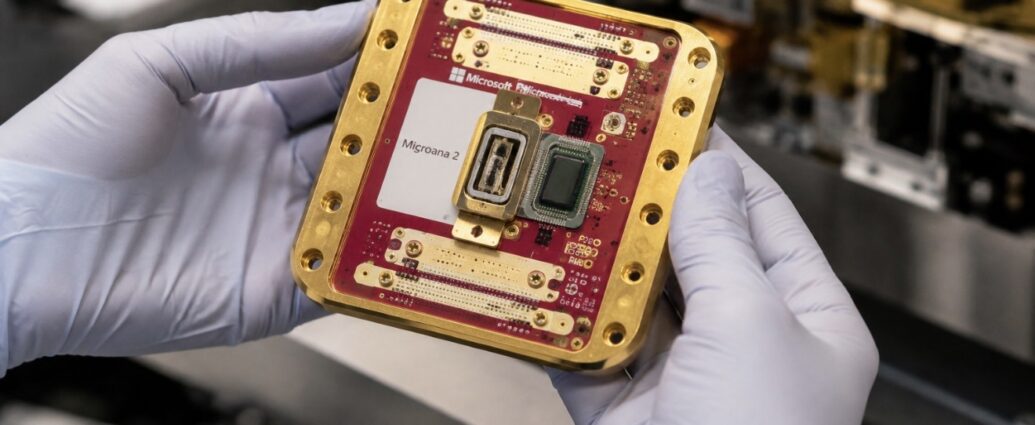
Microsoft unveiled its next-generation quantum computing chip, Majorana 2, on Tuesday at its Build developer conference in San Francisco and said the breakthrough could cut its timeline for a practical quantum computer in half — potentially bringing one to market as soon as 2029.
The company says the new chip delivers qubits that are 1,000 times more stable than those in the previous generation, a leap that Chetan Nayak, Microsoft’s Technical Fellow and Corporate Vice President of Quantum Hardware, described as a critical step toward building a commercially useful quantum computer.
If Microsoft is right, the announcement could represent one of the most important advances in computing since the birth of artificial intelligence. If critics are right, it may be another promising quantum milestone that remains years away from proving itself in the real world.
The Problem Quantum Computing Has Always Faced
Quantum computers operate using qubits, the quantum equivalent of the 1s and 0s used in traditional computers.
Unlike ordinary bits, qubits can exist in multiple states simultaneously, giving quantum systems the potential to solve certain problems dramatically faster than today’s most powerful supercomputers.
The challenge is stability.
Qubits are notoriously fragile and can lose their quantum state in fractions of a second, creating errors that must be constantly corrected.
Microsoft says Majorana 2 dramatically improves that problem.
According to the company, the new chip maintains qubit stability for an average of approximately 20 seconds, with some lasting nearly a full minute. Microsoft’s earlier generation reportedly held stability for less than 12 milliseconds.
To illustrate the difference, company researchers compared the improvement to a smartphone battery that lasts nearly three years on a single charge instead of dying after one day.
A New Material Formula
The breakthrough comes from a redesign of the chip’s physical structure.
Microsoft replaced the aluminum used in earlier versions with lead and redesigned the semiconductor layer using specialized indium arsenide compounds.
According to the company, the new materials better protect qubits from environmental interference, including cosmic radiation and microscopic disturbances that can destroy quantum states.
The new chip contains 12 qubits, up from eight in the previous generation, and performs operations in approximately one microsecond on hardware measuring roughly one-hundredth of a millimeter.
AI Helped Build the Chip
Perhaps the most notable aspect of the announcement is how Microsoft says the chip was developed.
The company revealed that its own artificial intelligence systems played a major role in designing the materials used inside Majorana 2.
Using Microsoft Discovery, an AI-driven scientific research platform, autonomous software agents helped researchers evaluate materials and accelerate development.
“Agentic AI has permeated almost everything we do,” Nayak said during the presentation.
Microsoft simultaneously announced that Discovery is becoming broadly available through Azure and GitHub Copilot, signaling that the company sees AI-assisted scientific discovery as a major business opportunity beyond its internal research efforts.
The Business Opportunity Is Enormous
The convergence of AI and quantum computing represents one of the largest long-term technology bets being made anywhere in the world.
Microsoft’s vision is straightforward:
Better AI helps build better quantum computers.
Better quantum computers eventually help build better AI.
The potential applications stretch across industries:
- Drug discovery
- New materials development
- Energy optimization
- Financial modeling
- Cybersecurity
- Advanced manufacturing
A practical quantum computer could potentially model molecular interactions impossible for today’s computers, dramatically accelerating pharmaceutical research and materials science.
It could also eventually challenge many of today’s encryption systems, a possibility that has governments, banks, and intelligence agencies investing heavily in quantum research.
Not Everyone Is Convinced
Despite Microsoft’s confidence, the announcement was met with substantial skepticism from portions of the scientific community.
The company’s approach relies on a highly specialized quantum architecture known as topological quantum computing, built around elusive particles called Majorana modes.
The field has a complicated history.
Previous claims involving Majorana-based systems have faced criticism, and some high-profile research papers in the field were later retracted.
Several physicists say Microsoft’s latest announcement does not fully resolve long-standing questions.
“Nothing in this preprint resolves the fundamental issues,” said Henry Legg, a physicist at the University of St Andrews in Scotland.
Other researchers have argued that Microsoft has yet to conclusively demonstrate that its underlying device operates exactly as claimed.
The debate highlights one of the persistent challenges in quantum computing: outside researchers often struggle to independently verify breakthrough claims.
The Race Is Intensifying
Regardless of the controversy, the broader quantum race is accelerating.
Microsoft is competing against:
- IBM
- Numerous quantum startups
- State-backed research efforts in China and Europe
All are pursuing different technical approaches toward the same goal: a practical, fault-tolerant quantum computer.
The financial stakes are immense.
Microsoft currently carries a market value of roughly $3.28 trillion, while industry analysts increasingly view quantum computing as a future market potentially worth hundreds of billions—or even trillions—of dollars.
What Happens Next
The significance of Majorana 2 ultimately depends on whether Microsoft’s approach scales beyond the laboratory.
If the company can continue improving stability and dramatically increase qubit counts, a commercially useful quantum machine by the end of the decade becomes more plausible.
If the underlying physics proves less robust than Microsoft believes, the timeline could slip years beyond the company’s current projections.
For now, one thing is clear:
The race to build the world’s first practical quantum computer has entered a new phase, and Microsoft is betting that artificial intelligence can help it get there first.
San Francisco — JBizNews Desk
© JBizNews.com All Rights Reserved. Reproduction or distribution without written permission is prohibited.