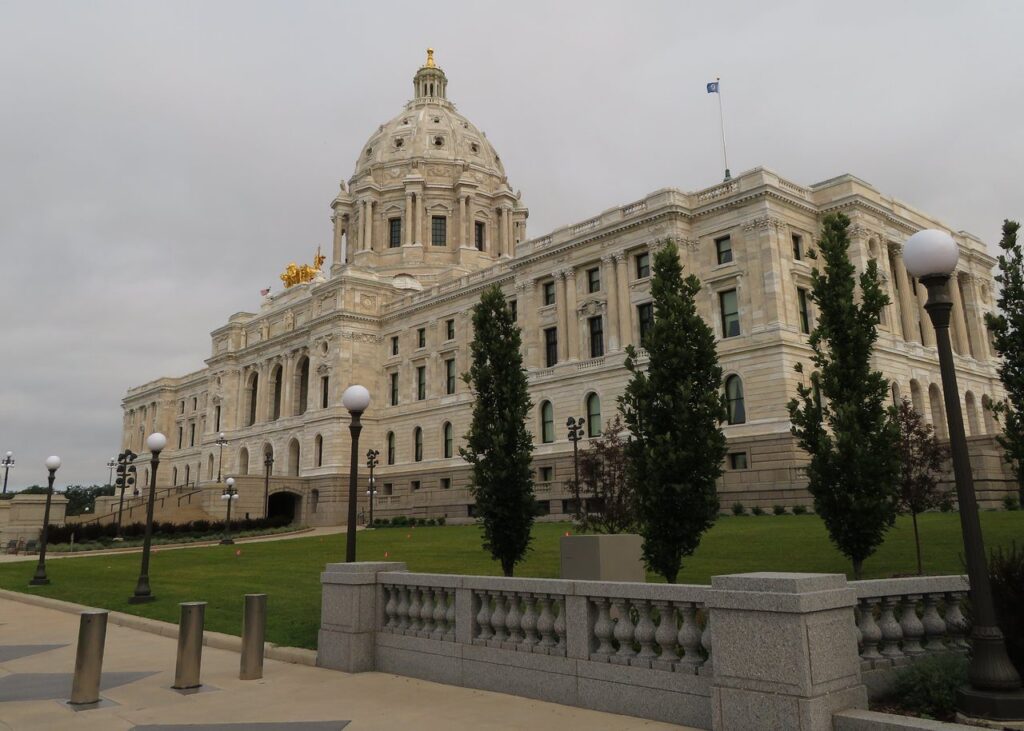
Archive photo: Minnesota State Capitol, August 2018. Ken Lund / CC BY-SA 2.0; cropped. Crop shared under the same license.
A Minnesota voter-outreach official’s explanation of how to vote without bringing a photo ID has drawn criticism over citizenship safeguards, putting the distinction between proof of residence and voter eligibility at the center of the dispute.
In an interview on Somali TV of Minnesota, Melanie Hazelip introduced herself as the voter-outreach director at the Secretary of State’s office and said her work involves making sure “all eligible Minnesotans know how to vote in Minnesota.”
“If you’re already registered to vote, you don’t need to bring anything with you,” she said while discussing early voting. For people who are not registered, she described using an updated Minnesota ID or other documents listed on the state’s website.
Criticism centers on citizenship safeguards
The Center of the American Experiment questioned that guidance in an October 27 commentary, arguing that the documents discussed do not prove U.S. citizenship. The organization also criticized Minnesota’s vouching process, which allows a registered voter to confirm another person’s residence.
The state’s official eligibility rules are explicit: only U.S. citizens may vote in Minnesota elections. Green card holders are not eligible. Voters must also be at least 18 on Election Day, have lived in Minnesota for 20 days, not be incarcerated for a felony conviction and not be under a court order revoking their voting rights.
What the identification rules require
According to the Secretary of State’s identification guidance, voters whose registration is current and active do not need to bring identification to the polls. People who need to register or update their registration must establish their residence before voting.
The state’s Election Day registration rules list a valid Minnesota driver’s license, learner’s permit or state ID with a current name and address as one way to prove residence. Another option is an approved photo ID paired with a qualifying document showing a current name and address, such as a utility bill.
The rules also allow a registered voter from the same precinct to accompany someone to the polling place and sign an oath confirming that person’s address. A registered voter can vouch for up to eight people and cannot vouch for others if someone vouched for them.
Hazelip made that limitation clear in the interview: the person vouching confirms that someone lives in the precinct, rather than establishing who that person is. The state describes the procedure as proof of residence, not an exemption from citizenship requirements.
For residents preparing to vote, the distinction matters: an accepted residency document or a neighbor’s oath does not make an otherwise ineligible person eligible. The interview and the criticism do not establish that an ineligible person registered or cast a ballot.
JBizNews Desk | St. Paul
© JBizNews.com. All rights reserved. Unauthorized reproduction or redistribution is strictly prohibited.