
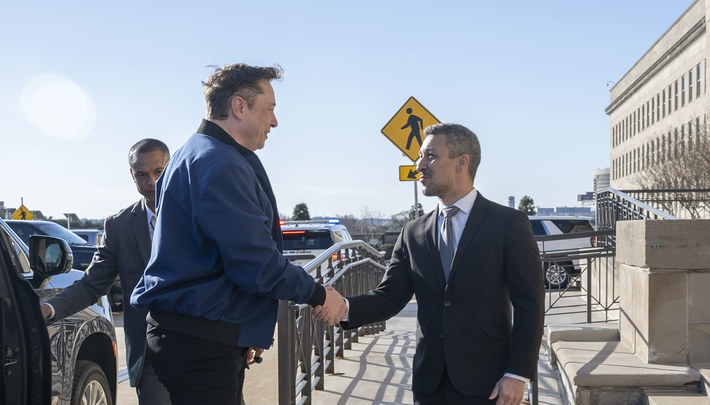
Photo: Madelyn Keech / DOD (2025 archive; cropped)
SpaceX is aiming to begin launching its Starmind space computers in the third quarter of 2027, Elon Musk said Friday, calling the timing a guess.
Musk spoke by video link at an investment conference in New York, in an hour-long conversation with Baron Capital CEO Ron Baron, according to a report on the event. The plan matters to anyone following SpaceX and Tesla.
What Musk said about Starmind
“We expect to start launching the first Starmind computers, which we’ve co-designed with NVIDIA, probably – I’m just guessing here – but in the 3rd quarter of next year,” Musk said. “And we’ll start off slow, but then it will ramp to significant volume probably in ’28, and then very, very large volume in ’29.”
Starmind is SpaceX’s project to capture solar energy in space and deliver computing power for artificial intelligence from a satellite constellation. Musk said going into space is needed to reach very large scales of computing power because “there just isn’t enough power on the ground.”
He said two test satellites are already up. “There’s a satellite with an NVIDIA GPU up there that we launched, and there’s a satellite we recently launched with a Google TPU,” he said. “And these are operating to the best of my knowledge – they’re working fine in space.” Google’s chips are part of a research effort called Project Suncatcher.
Opening the conversation, Musk quipped: “The pitchfork level for data centers is pretty high.”
Where the idea came from
Earlier this week, Elon Musk responded to the Democrats’ midterm election sweep with a pair of sarcastic posts on X early Wednesday, suggesting that putting data centers in space was suddenly looking attractive, a report said.
“Data centers in space looking pretty appealing right now,” Musk wrote. About a minute later, just before 1:15 a.m. Eastern, he added: “Guess my election-interfering space lasers didn’t work this time 🤷♂️.”
The posts nodded at a real political problem for the world’s richest man: the candidates he spent record sums supporting lost badly, and the winners in his adopted home state of Texas have promised to clamp down on the data-center industry his companies are betting on.
A bad night for Musk’s candidates
Democrats won control of both the House and the Senate on Tuesday. In Texas, Democrat Gina Hinojosa defeated three-term Republican Governor Greg Abbott, and Democrat James Talarico beat Republican Ken Paxton for a U.S. Senate seat. Musk was the biggest known donor of the 2026 midterms, but the totals depend on what you count. An analysis of campaign finance records put his overall election spending at at least $474 million, with $224 million – nearly half – going to Texas alone, where his favored candidates lost. A separate tally put roughly $250 million into congressional races specifically. His America PAC spent nearly $87 million across 44 federal races, and 93 percent of that money went to races Republicans lost, the analysis said. Talarico had accused him during the campaign of trying to buy “his own personal U.S. Senator.”
Texas turned data centers into an election issue
Hinojosa campaigned on reining in the state’s data-center boom, calling for a moratorium on new facilities until lawmakers pass stronger protections for electricity supplies, water resources and local communities. “We need a moratorium on data centers until the legislature can meet to put in place real protections,” she said in an August campaign statement. Talarico has also said data centers are driving up utility bills across Texas and has promised more regulation.
For families in Texas, the fight is about monthly utility bills and the power and water their communities rely on, and the state’s incoming leaders have promised tighter rules.
What happens next is limited by politics. Republicans kept control of the Texas Legislature, so Hinojosa cannot change state law on her own. But her administration will shape the state decisions Musk’s Texas operations depend on – electricity, water, environmental permits, infrastructure and tax incentives, according to that analysis. Hinojosa has called for an end to industry tax breaks and for data-center developers to cover their full electricity costs, and her team could slow expansion with a tougher line on permits and incentives.
Abbott had already halted new data-center permits in September, pending an audit of the state’s electricity grid. The North American Electric Reliability Corporation has warned that peak summer power demand could rise by 224 gigawatts over the next decade, largely because of AI data centers, and a report says Texas is reviewing proposed data-center connections representing more than 400 gigawatts of potential demand, though many projects remain speculative.
The stakes for Musk are direct. Tesla and SpaceX are both headquartered in Texas, SpaceX operates its Starship launch site in South Texas, and Musk has announced plans for Terafab, a semiconductor project involving the two companies.
The space idea is not entirely a joke
Musk has talked for years about moving computing off the planet. In January, SpaceX filed an application with the Federal Communications Commission to launch and operate an orbital data-center system of up to one million satellites, describing it as “the first step in becoming a Kardashev II level civilization” that could harness the Sun’s energy. The FCC accepted the application for filing in February and is seeking public comment.
Musk has predicted that monthly additions to orbital computing capacity could surpass additions on Earth by late 2028, citing electricity and regulatory constraints, and argued this week that cooling AI equipment is easier in space because radiators can release heat directly. A report in June said SpaceX aims to test orbital AI infrastructure by late 2027, though large-scale deployment depends on Starship’s launch capabilities and lower costs.
Skeptics point to major hurdles. An April assessment by the Government Accountability Office found that computing hardware does not cool down easily in space, that radiation can damage equipment, and that many more satellites would raise the risk of collisions. Launch, replacement and maintenance costs, and reliable data transfer between orbit and Earth, remain open problems.
JBizNews Desk | Washington
© JBizNews.com. All rights reserved. Unauthorized reproduction or redistribution is strictly prohibited.