NASA’s X-59 quiet supersonic jet has completed its first year of flight testing, logging 41 flights and reaching Mach 1.53 at more than 56,000 feet, the space agency said as the needle-nosed aircraft marked the anniversary with a cross-country trip to Florida’s Kennedy Space Center, the New York Post reported.
The experimental plane, built by Lockheed Martin and nicknamed the “Son of Concorde,” first flew on Oct. 28, 2025. That debut was low and slow, a basic systems check. In the year since, NASA said, the X-59 has steadily expanded its flight envelope to the altitudes and speeds the mission needs, reaching beyond its design cruising speed of Mach 1.4 – roughly 925 miles per hour, nearly twice as fast as a conventional airliner.
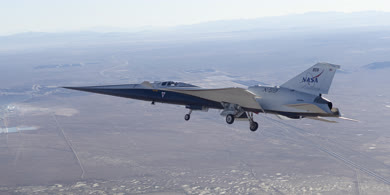
NASA’s X-59 in flight above the Mojave Desert (NASA / Lori Losey, public domain).
Speed is not the point of the exercise – quiet is. The X-59’s shape is designed so that at 55,000 feet and Mach 1.4, people on the ground hear no window-rattling sonic boom, only a thump NASA says should sound like a car door closing from about 20 feet away. Proving that is the next phase: the team is shifting from envelope expansion to acoustic validation, flying over instrumented ranges to record exactly how loud the “sonic thump” is.
The stakes reach far beyond one experimental jet. Supersonic flight over land has been banned in the United States for more than half a century because of the boom. NASA’s Quesst mission is gathering the data regulators would need to lift that ban and open a market for commercial supersonic travel that could cut long-haul flight times dramatically.
What it means: a London-to-New York trip in half the time is still years away, but the plane that could make it legal just finished its hardest first year intact. The tests that matter most – measuring whether the boom really has become a thump – come next.
JBizNews Desk | Mojave
© JBizNews.com. All rights reserved. Unauthorized reproduction or redistribution is strictly prohibited.