
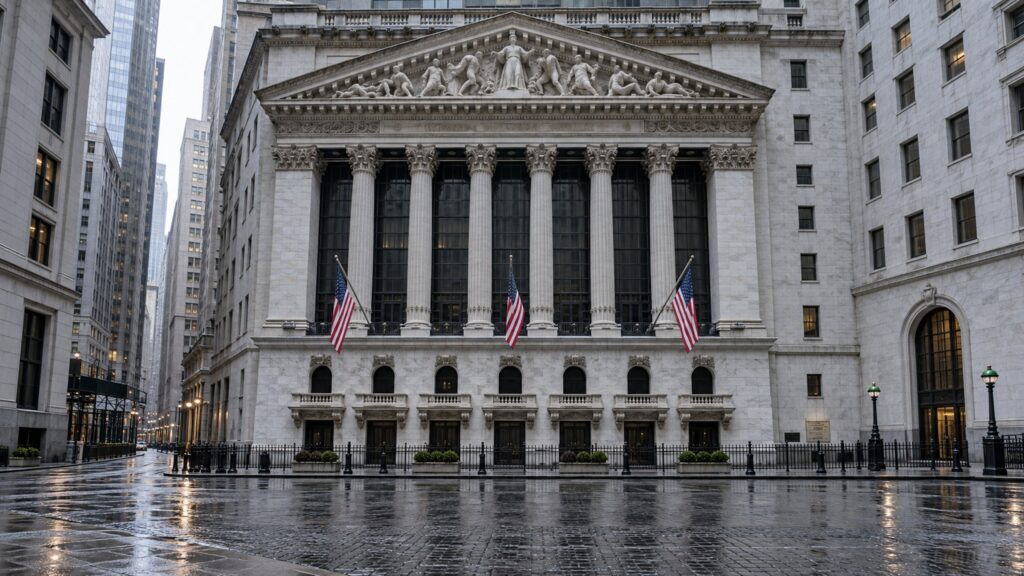
The Nasdaq Composite fell 5.52% Thursday in its worst session since April 2025, while the Dow Jones Industrial Average lost 1,833.06 points and the S&P 500 dropped 4.36% as a selloff in artificial-intelligence and semiconductor shares spread across Wall Street.
The Nasdaq closed at 24,315.00, down 1,421.52 points. The Dow closed at 51,523.06, down 3.44%, and the S&P 500 at 7,353.73. These are closing results, confirmed in the CNBC closing report and Fox Business’s closing market table.
Nasdaq’s own index page also displays the Composite’s 24,315.00 level and 5.52% decline. All three major indexes had their worst day since April 2025. The Dow’s decline more than erased its prior day’s post-election rally.
AI spending concerns drive the selling
CNBC and Reuters’ closing market review described investors reassessing the outlook for data-center construction and AI infrastructure after Democrats’ election victories.
Orion investment chief Tim Holland told CNBC investors were stepping back while assessing the implications for AI capital spending. Truist Wealth investment chief Keith Lerner said the size of the technology selloff was feeding into the broader market.
Nvidia falls as chip and data-center shares retreat
Nvidia, which supplies chips and networking technology used in AI computing, closed at $181.60, down 9.26%.
AMD fell 17.3% and Micron Technology dropped 17.5%. Qualcomm declined 9.5%. SpaceX fell 9.1%.
AppLovin moved the other way, climbing 31% to $356.10, a close shown by ETF.net and Investing.com. The marketing technology company reported record third-quarter revenue of $2.18 billion in its November 4 results release.
Both CNBC and Reuters described steep losses across semiconductor and data-center companies. Concerns about the cost and pace of AI infrastructure spending affected suppliers as well as companies building and operating computing capacity. The decline also spread beyond technology into other stock-market sectors.
Nasdaq ends in correction territory
The Nasdaq ended 11.9% below its October 6 record close of 27,599.79, confirming its second correction of the year.
Oil and gold rise as investors watch Iran and interest rates
Oil prices rose as investors assessed tanker attacks and the outlook for the Iran war. Brent crude also settled higher.
Gold futures settled higher as the dollar and Treasury yields weakened, with investors awaiting Friday’s U.S. employment report for clues about interest rates.
December gold futures settled at $4,113.50 an ounce and Brent crude settled at $98.29 a barrel. West Texas Intermediate settled at $90.52, while the 10-year Treasury yield was around 4.84%.
Initial unemployment claims fell to a seasonally adjusted 189,000 in the week ended October 31, down 6,000 from the revised prior week. The Bureau of Labor Statistics calendar schedules the October employment report for Friday, November 6, at 8:30 a.m. Eastern.
Individual investors turn net sellers
Individual investors sold a net $257 million of individual U.S. stocks Thursday, Vanda Research data showed. Vanda ranked it as the fifth-biggest single day of retail net selling since March 17, 2020.
Late-session buyers reduced the earlier net selling, Vanda said. “This is what we would call a total capitulation by retail investors,” Vanda global macro strategist Viraj Patel told Yahoo Finance in emailed comments.
What the reversal means for investors
The Dow, S&P 500 and Nasdaq Composite track different groups of shares and use different construction methods. For retirement savers, the effect depends on an account’s holdings across stocks, bonds and other assets.
Thursday’s close marks a sharp reversal in sentiment following Wednesday’s broad rally.
For the broader sector impact and retirement-account exposure, read why the selloff left investors with few places to hide inside the stock market.
Friday premarket: futures mixed in partial rebound
Futures pointed to a mixed, partial rebound on Friday: as of 6:48 a.m. ET, Nasdaq 100 futures were up 443 points, or 1.7%, S&P 500 futures were up 23 points, or 0.3%, while Dow futures were down 481 points, or 1.0%. Nvidia rose about 4% in premarket trading, AMD and Micron gained about 7% and 8% respectively, and data-center firm CoreWeave jumped more than 9%. These are futures and premarket snapshots as of 6:48 a.m. ET, a partial rebound rather than a broad recovery, and not a cash-session move. The October jobs report, due at 8:30 a.m. ET, could be the next catalyst for rate expectations.
JBizNews Desk | Wall Street
© JBizNews.com. All rights reserved. Unauthorized reproduction or redistribution is strictly prohibited.