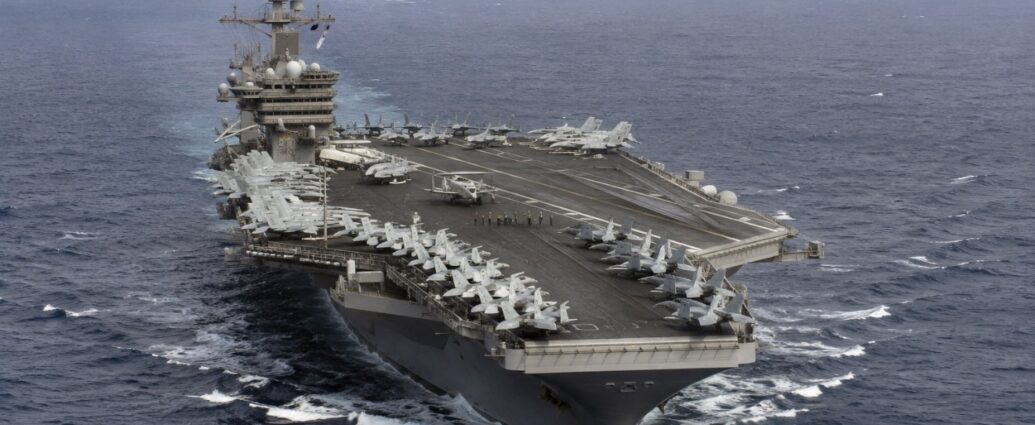
The U.S. Navy is preparing to send a replacement aircraft carrier into the Middle East, moving the USS George Washington in to take over the work the USS Abraham Lincoln has been doing since the winter. The handoff has not happened yet, and officials say it was scheduled before the current round of public complaints about life aboard the Lincoln. Swapping carriers takes several weeks on its own, because the incoming and outgoing ships operate side by side for a stretch before the older one pulls out.
The Lincoln’s numbers explain why a fresh ship is coming. It left on deployment in November and was rerouted to the Middle East in January, just ahead of the U.S. war with Iran. That has put it past 250 days deployed, including roughly 200 days without a single port call. A normal carrier deployment runs about six to seven months and includes regular port stops to resupply food and give crews a break. The Lincoln has run roughly a third longer than that, with none of the pauses.
What the ship has been doing is, at bottom, an economic mission. The Lincoln flew a central role in the U.S. bombing campaign against Iran and has since worked the naval blockade of Iranian ports. The USS George H.W. Bush is also in the Arabian Sea as part of the effort to pressure Tehran into reopening the Strait of Hormuz, where hundreds of ships sit stuck. That waterway is the only way in and out of the Persian Gulf, and it normally carries about a fifth of the world’s oil.
Traffic there is a fraction of what it was. Ship-tracking data showed between eight and 15 vessels crossing the strait on each of the first days of August, against roughly 130 transits a day before the war — closer to 1 in 10 than to anything like normal commerce. Every one of those missing transits is cargo that has to go somewhere else, at a longer distance and a higher insurance cost, which is why the war shows up on freight bills and fuel receipts far from the Gulf.
Oil is carrying the strain without panic. Crude slipped toward $82 a barrel Thursday after a five-day run, as traders weighed whether any deal to reopen the strait is close. The International Energy Agency’s latest monthly report put the global market short by 1.8 million barrels a day this quarter, even as U.S. crude inventories jumped 17.4 million barrels in a week, the biggest build since early 2023. Tight supply abroad, unusually full tanks at home.
On the other side of the ledger, the blockade is doing measurable damage to Iran’s revenue. The administration has put the cost to Tehran at roughly $500 million a day, and the Pentagon estimated Iran had lost about $4.8 billion in oil revenue by the start of May. Keeping that pressure on is exactly what requires a carrier parked in the region, which is why the Navy is replacing the Lincoln rather than simply bringing it home.
The replacement comes with a trade-off in Asia. The George Washington is permanently assigned to the Pacific as the Navy’s forward-deployed carrier with the 7th Fleet, and the service describes it as the symbol of the U.S. commitment to a free and open Indo-Pacific. The ship and its strike group were in the Strait of Malacca on Thursday. Moving it west shifts American naval weight out of the shipping lanes that carry most of Asia’s trade at a moment when Washington is trying to watch China, North Korea and Iran at once.
Congress has been pressing on the crew question for weeks. Rep. Marlin Stutzman, an Indiana Republican, said he intends to seek a Pentagon update, saying sailors need to know they are being properly cared for. Rep. Mike Levin, a California Democrat, said personnel in their ninth month of deployment have earned rest. Sailors and their families have described food shortages and the toll of months at sea without a break. Secretary of War Pete Hegseth said Thursday that conditions aboard the ship had been misrepresented, telling reporters in Panama that every crew is given everything the department can provide. The Navy said it takes personnel health seriously and has medical, mental health and religious staff aboard to address concerns.
The clock from here is measured in weeks, not days. Once the two carriers overlap and the swap is finished, the Lincoln faces a trip of at least two weeks back to its home base in San Diego — and then, almost certainly, a long stretch in the yard. Ships run this hard come back needing work, and every extra month at sea today turns into shipyard time and maintenance spending later. That bill lands well after the headlines about this rotation have passed.
JBizNews Desk | Washington
© JBizNews.com All Rights Reserved. Reproduction or distribution without written permission is prohibited.