
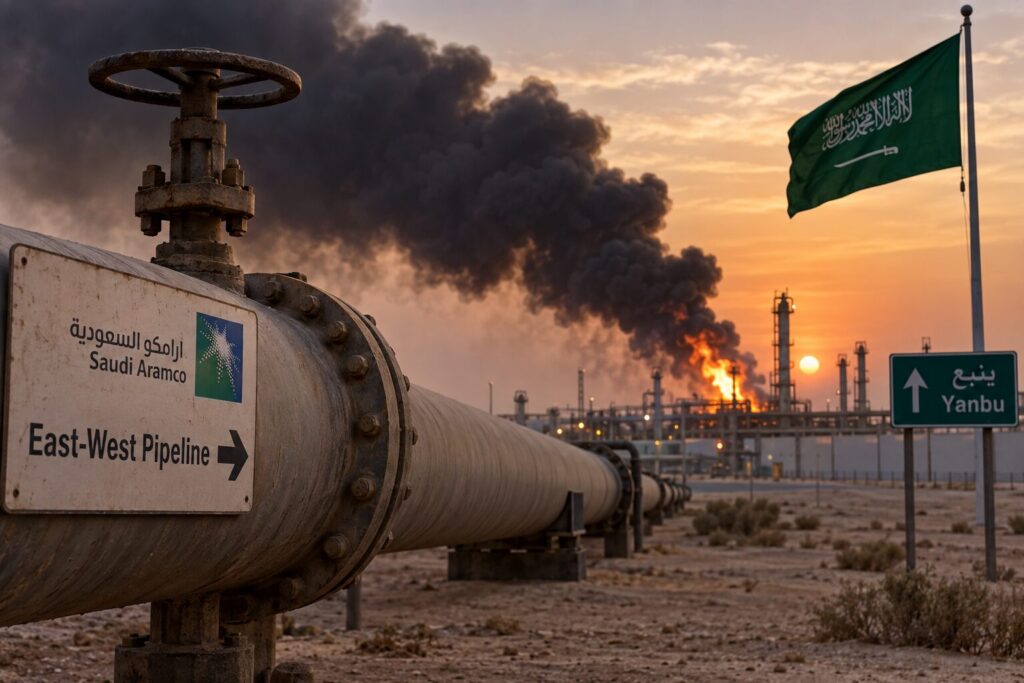
Oil prices surged above $107 a barrel Tuesday as the shutdown of Saudi Arabia’s critical East-West Pipeline intensified fears that a major portion of the world’s oil supply could be disrupted, potentially pushing fuel and transportation costs even higher.
Brent crude, the international oil benchmark, climbed as high as $108.43 a barrel during Tuesday’s trading, while U.S. West Texas Intermediate crude reached as high as $104.21. The sharp moves followed attacks that left Saudi Arabia’s East-West Pipeline offline, according to Reuters.
The pipeline is one of the most important pieces of energy infrastructure in the Middle East because it allows Saudi crude to travel from oil-producing regions in the east to the Red Sea port of Yanbu — avoiding the Strait of Hormuz.
That alternative route has become especially important as shipping through Hormuz has been severely disrupted.
Saudi Arabia could exhaust crude available for export within days if the East-West Pipeline does not resume operations, according to buyers and traders cited by Reuters. The disruption threatens as much as 4% of global oil supply.
Only Four Commodity Ships Cross Hormuz
The pressure on oil markets is being compounded by dramatically reduced shipping through the Strait of Hormuz.
Preliminary data from Kpler showed that only four commodity vessels traveled through the strait Monday, down from 10 the previous day.
The Strait of Hormuz has historically been one of the most important oil chokepoints in the world, with roughly one-fifth of global oil supplies previously passing through the narrow waterway.
That made Saudi Arabia’s East-West Pipeline a crucial backup route. Instead of sending crude through Hormuz, Saudi Arabia could move oil hundreds of miles across the kingdom and load it onto tankers at Yanbu on the Red Sea.
With that pipeline now offline, the ability to bypass the troubled shipping route has been sharply reduced.
Shutdown Could Last Weeks
One of the biggest uncertainties for energy markets is how long repairs will take.
Goldman Sachs said estimates for restoring the pipeline range from “very soon” to as long as eight weeks. The bank said the latest attacks could threaten approximately 2 million barrels per day of recent exports through Yanbu.
Goldman also described the attacks on Saudi oil infrastructure as a meaningful escalation and said they increased the probability of Brent crude moving above $120 a barrel under a scenario in which Gulf production remains substantially below pre-war levels.
Separately, Hamad Hussain, senior climate and commodities economist at Capital Economics, said several weeks of continued pipeline closure — without weaker demand or increased flows through Hormuz — could push Brent crude toward $130 a barrel.
That would represent another major jump from prices already above $100.
Why Americans Should Care
The impact of higher oil prices does not stop at the gasoline pump.
Oil is embedded throughout the modern economy. Trucks use diesel to move groceries and merchandise. Airlines depend on jet fuel. Farms use fuel to operate machinery and transport crops. Manufacturers rely on petroleum products both for energy and as raw materials.
When crude prices remain elevated, those costs can eventually work their way through supply chains.
Drivers are usually among the first to notice as gasoline and diesel prices respond to higher crude and refining costs. Trucking companies may also face higher fuel bills, which can increase the expense of moving everything from food to furniture.
Small businesses can be particularly exposed because they often have less ability than large corporations to absorb sudden increases in transportation, energy and financing expenses.
Inflation Risk Returns
The oil surge also arrives at a difficult moment for the broader U.S. economy.
Higher energy prices can contribute to inflation just as policymakers are deciding how aggressively interest rates need to remain elevated.
That creates a potentially difficult combination: households and businesses can face higher fuel costs at the same time that borrowing remains expensive.
The benchmark 10-year U.S. Treasury yield has already moved above 5%, reflecting heightened concern in financial markets over inflation, interest rates and the economic consequences of the latest energy shock.
If oil remains above $100 for an extended period, the effects could reach beyond gasoline into shipping, airfare, manufacturing, groceries and other everyday expenses.
A Critical Route for Saudi Oil
Saudi Arabia’s East-West Pipeline stretches roughly 1,200 kilometers, or about 750 miles, connecting the kingdom’s eastern oil-producing regions with Yanbu on the Red Sea.
Its strategic value comes from geography.
Normally, Saudi crude produced near the Persian Gulf can be shipped through the Strait of Hormuz. But when that route becomes dangerous or inaccessible, the East-West Pipeline allows Saudi Arabia to move crude across land and export it through the Red Sea instead.
That safety valve is now under pressure at precisely the moment it is most needed.
The shutdown therefore represents more than damage to a single pipeline. It removes one of the principal alternatives for getting Saudi oil to global buyers while another major export route is operating under severe constraints.
What Happens Next
Oil traders will now be watching three things closely: how quickly Saudi Arabia can restore the East-West Pipeline, whether vessel traffic through the Strait of Hormuz recovers, and whether additional attacks threaten energy infrastructure in the region.
Any improvement could ease fears of a prolonged supply shortage and take some pressure off crude prices.
But an extended pipeline outage combined with restricted Hormuz traffic could leave global markets scrambling for replacement barrels.
For American consumers and businesses, the stakes are straightforward.
The longer a meaningful share of Middle Eastern oil remains difficult to move, the greater the risk that $100-plus crude translates into higher costs for driving, shipping goods, operating businesses and ultimately buying everyday products.
JBizNews Desk | Trenton, N.J.
© JBizNews.com All Rights Reserved. Reproduction or distribution without written permission is prohibited.





