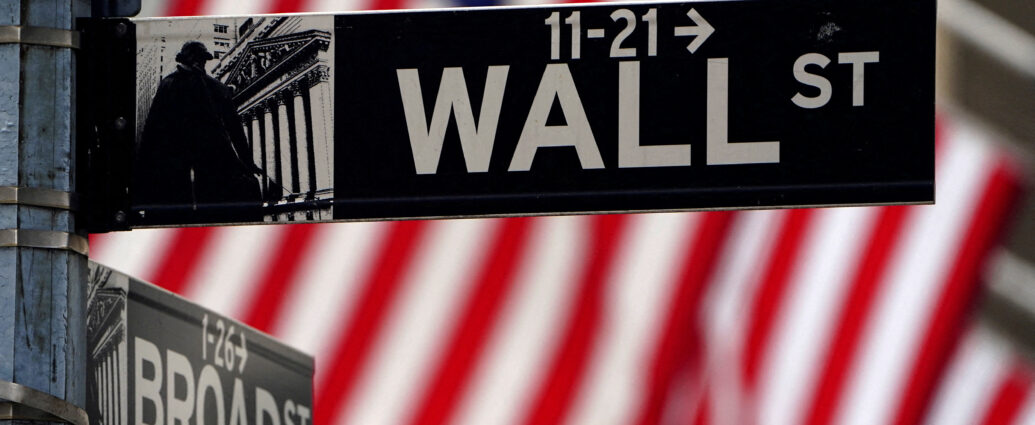
Wall Street gave back a sliver of last week’s record run on Monday after crude oil surged roughly 5%, driven by growing doubt that Washington and Tehran will reach a deal to reopen the Strait of Hormuz any time soon.
The mechanics are straightforward: higher oil means higher inflation, and higher inflation means the Federal Reserve is more likely to raise rates — the opposite of what stocks rallied on last week.
The S&P 500 finished just below the flatline, slipping 0.06% to 7,753.11. The Nasdaq Composite fell 0.32% to 26,605.36, and the Dow Jones Industrial Average dropped 60.95 points, or 0.11%, to close at 53,975.98. The Russell 2000 lagged the large-cap indexes, trading down about 0.6% near 3,015.
That leaves the S&P a whisker under Friday’s record close of 7,757.64 — a pause rather than a reversal.
The week that came before
Stocks posted a second straight winning week last week. The S&P 500 advanced 3.6%, closing above 7,700 for the first time in its history. The Nasdaq gained 5.2% on a rebound in chip stocks, with the iShares Semiconductor ETF up more than 7%. The Dow added nearly 3%.
Friday’s fuel was the July jobs report: nonfarm payrolls fell by 23,000 against expectations for a gain of about 82,000, and June was revised down to 20,000 from 57,000. The unemployment rate came in at 4.1%, below June’s 4.2%. Labor force participation slipped to 61.4% and average hourly earnings rose just 0.1% on the month.
Weak jobs plus soft wages equals a Fed that can sit still. Monday’s oil move put a question mark on that.
Market movers
Nvidia was the single heaviest drag on the tape, falling nearly 3% after a Financial Times report that the chipmaker is working with Apollo Global and Blackstone on a $500 billion AI infrastructure funding package. Bank of America kept its buy rating and called Nvidia a top sector pick, dismissing memory-cost and circular-financing concerns as overblown ahead of the company’s fourth-quarter report on Aug. 26.
Intel dropped 4% after announcing a $15 billion common stock offering. Equity offerings dilute existing shareholders, and the market priced that in immediately. Apple shed 1.5%.
The day’s biggest winners were both takeout targets. MarineMax soared 46% after agreeing to be sold to Blackstone Infrastructure’s Safe Harbor Marinas for $53 a share in cash, a $1.5 billion deal expected to close by year end. Varex Imaging climbed 48% after Teledyne Technologies agreed to buy it for $18.90 a share in cash, with closing expected in early 2027. Teledyne rose slightly.
AI infrastructure names sold off across the board. The Global X Data Center & Digital Infrastructure ETF lost 1%, Corning fell more than 3%, and photonics makers Coherent and Lumentum dropped 12% and more than 6%.
Exxon Mobil rose 3.4% as energy tracked crude higher, while Eli Lilly gained 2.3%, Microsoft 2.2%, Amazon 1.9% and Meta Platforms 1.3%. AbCellera surged 36% after a mid-stage trial showed its drug reduced hot flashes against placebo after a single dose.
Critical mineral stocks — MP Materials, 5E Advanced Materials, United States Antimony, Critical Metals, USA Rare Earth and Energy Fuels — moved on the White House announcement late Friday of more than $2 billion in new mining investments plus over $180 million for mining schools and workforce development.
Berkshire Hathaway reported second-quarter operating earnings of $12.98 billion against $11.16 billion a year earlier, on revenue of $101.81 billion versus $92.52 billion, and repurchased roughly $4.5 billion of its own shares in the quarter.
Commodities
West Texas Intermediate futures climbed about 5% to close at $82.13 a barrel, and Brent settled around 5% higher at $87.72. Both benchmarks had fallen more than 7% last week on expectations that Iran and Oman were closing in on an agreement. Before the war, the strait carried roughly one-fifth of global oil shipments. U.S. Strategic Petroleum Reserve stocks have fallen below 300 million barrels, the lowest since January 1983.
Gold futures rose 0.43% to $4,418.60 an ounce. The metal gained 7.4% last week, its best week since January, with silver up 10.2% to $65.34.
Rates, the dollar and the Fed
The 10-year Treasury yield held near 4.66%, still subdued after the payrolls miss, though it traded as high as 4.703% against Friday’s close of 4.658% — pressure from oil rather than from growth optimism. Futures now price roughly a 44% chance of a quarter-point hike in September, down from about 67% a week ago. The dollar hovered near a two-month low against major currencies.
What moved the world
Iran says it is nearing a deal with Oman to reopen Hormuz but continues to resist direct talks with the United States until conditions are met. Foreign Minister Abbas Araghchi said Sunday there is no possibility of restarting negotiations while those conditions stand. Tehran wants the naval blockade lifted and compensation for war damages.
President Trump told Axios on Sunday the U.S. is “only semi-negotiating” with Iran, and indicated he would lean on the blockade rather than new airstrikes. Iran’s supreme leader replaced the official who issued those demands with a veteran Revolutionary Guards commander skeptical of talks with Washington. Houthi militants claimed an attack on a Saudi refinery near the Red Sea, and an Abu Dhabi National Oil Co. tanker was attacked in Hormuz over the weekend.
Overseas, Australia’s S&P/ASX 200 closed down 0.3% at 9,232.60.
What’s next
The Consumer Price Index and initial jobless claims are due this week, along with earnings from Super Micro Computer, CoreWeave and Cisco Systems. Producer prices and the University of Michigan inflation survey follow.
A cool CPI keeps last week’s rally intact and September on hold. A hot one, with oil back above $80, puts the hike squarely back on the table.
JBizNews Desk | Wall Street
© JBizNews.com All Rights Reserved. Reproduction or distribution without written permission is prohibited.