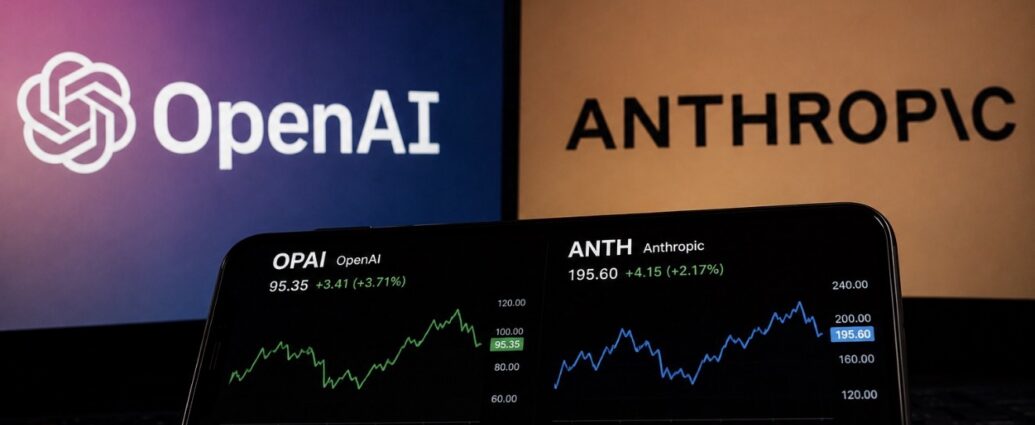
The two largest private AI companies both filed confidentially for public listings within days of each other in June. Two months later they are on completely different clocks, and the gap between them has become the market’s clearest read on how AI businesses are actually valued.
Anthropic filed a confidential S-1 with the SEC on June 1 and is still targeting an October listing on Nasdaq, potentially becoming the first company to debut at a $1 trillion valuation. The company is looking to raise roughly $30 billion at a $900 billion valuation, according to the Financial Times. OpenAI filed a week later and is now leaning toward 2027, per Bloomberg’s reporting, citing market volatility and CEO Sam Altman’s insistence on a $1 trillion floor. Prediction markets have moved with that: Polymarket priced the odds of a 2026 OpenAI listing near 18%, down sharply from 48% earlier in the year.
What changed both timelines was SpaceX. It priced at $135 on June 11, ran to $225 within days, then surrendered roughly 32% of those gains. The stock has since traded around $153, denting confidence in mega-cap technology listings, and the debut raised more than $85 billion. The lesson the market took was that enormous private valuations do not survive contact with daily price discovery unchanged.
The sequencing matters more than the calendar. Whatever multiple public investors assign Anthropic in October becomes the reference point for every OpenAI model built in 2027 — if Anthropic lists at, say, 20 times forward revenue, OpenAI must either match it with stronger financials or explain why it deserves a premium despite heavier cash burn. Going second means pricing against a year of a competitor’s public disclosures and settled analyst consensus.
The two businesses are less alike than the pairing suggests. Anthropic’s annualized revenue run rate expanded from $9 billion at the end of 2025 to more than $30 billion in April 2026, with roughly 134 million monthly active users against OpenAI’s 900 million weekly, and about 80% of revenue from enterprise customers compared with roughly 40% at OpenAI. CNBC reported Anthropic expected about $10.9 billion in second-quarter revenue and roughly $559 million in operating income — its first profitable quarter — while OpenAI was still loss-making in the first quarter. One is an enterprise software company by revenue mix; the other is a consumer platform.
OpenAI has raised approximately $180 billion to date, with Microsoft and SoftBank among its backers, and leads Stargate, a $500 billion joint venture targeting 10 gigawatts of AI data center capacity by 2029. Cracks appeared in April: ChatGPT stalled near 900 million weekly active users, short of internal targets, and monthly revenue milestones have been missed several times this year.
Anthropic’s valuation climbed fast — $380 billion in a February Series G, then roughly $965 billion after a $65 billion round in May, on cumulative fundraising above $129 billion since 2021 — a pace that makes fair IPO pricing genuinely difficult to set.
Both carry regulatory overhangs that public markets will have to price. The Department of War placed Anthropic on its supply chain risk list in February and barred federal contractors from using its services after the company declined to permit Claude’s use for mass surveillance and fully autonomous weaponry; oral arguments in the related lawsuit were heard May 19, with judges divided, while seven competitors including OpenAI were cleared to work with the Pentagon. A separate Commerce Department export control action took Anthropic’s Fable model offline on June 12. Those controls were lifted June 30 and access was restored July 1. OpenAI, meanwhile, still has to finalize its restructuring from nonprofit into a for-profit public benefit corporation.
The scale of what is queued is the systemic question. SpaceX, OpenAI and Anthropic together are expected to form three trillion-dollar listings in a single cycle — a combined demand for capital large enough that analysts have warned it could disrupt global capital markets. Estimates put their combined target market capitalization near $3.8 trillion.
For public investors, the read-through runs well past the two names: whichever lists first sets the first U.S. benchmark for pure-play AI model valuations, with direct implications for Nvidia, Oracle and CoreWeave, while Microsoft and SoftBank hold stakes that get marked to market on debut.
Neither company is currently accessible to retail investors, and a confidential filing guarantees neither a date nor a price. October will supply the number everyone is waiting for — or it won’t, and the wait extends into 2027.
JBizNews Desk | New York
© JBizNews.com All Rights Reserved. Reproduction or distribution without written permission is prohibited.