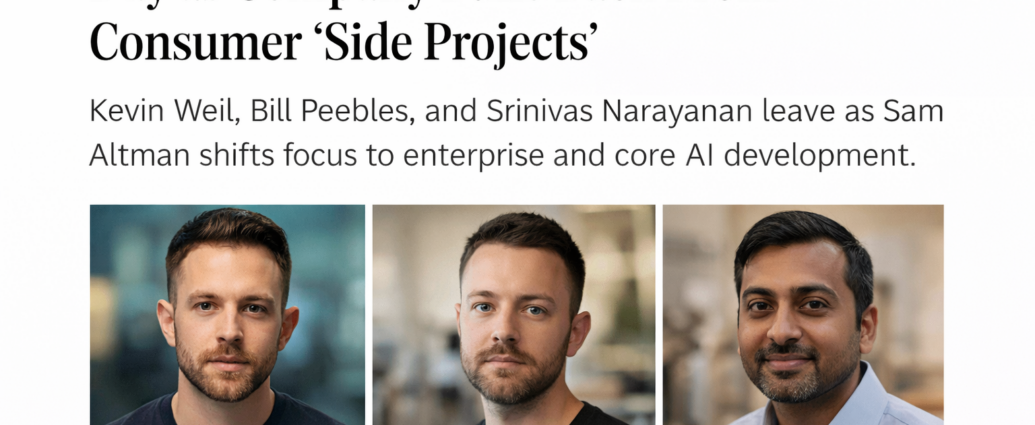
OpenAI saw three senior leaders depart in a single day Friday, as Chief Executive Sam Altman sharpens the company’s focus on enterprise artificial intelligence and scales back internal experimental initiatives. Kevin Weil, head of OpenAI for Science, Bill Peebles, creator of the AI video model Sora, and Srinivas Narayanan, a senior engineering leader focused on business products, each announced their exits, marking one of the most concentrated leadership shifts at the company to date.
The departures come as OpenAI restructures its internal priorities away from what executives have described as “side projects” and toward core infrastructure, enterprise deployment, and a broader integrated AI platform. Altman has increasingly emphasized building a unified ecosystem of AI tools for both consumers and businesses, often referred to internally as a “superapp,” as competition intensifies across the sector.
Weil’s exit underscores a shift in OpenAI’s scientific research strategy. “Today is my last day at OpenAI, as OpenAI for Science is being decentralized into other research teams,” Weil wrote in a public post on April 17, reflecting the company’s move to integrate specialized research efforts into its broader model development pipeline. The group had recently released GPT-Rosalind, a model aimed at accelerating life sciences research and drug discovery, positioning OpenAI within the growing intersection of AI and biotech.
At the same time, OpenAI is stepping back from resource-intensive consumer experiments. The company shut down Sora, its high-profile AI video generation tool, after internal costs reportedly reached roughly $1 million per day in compute usage. In announcing his departure, Peebles said Sora “sparked a huge amount of investment in video across the industry,” highlighting its influence despite its short lifecycle.
The exit of Narayanan, who led key business and engineering initiatives, comes as OpenAI deepens its push into enterprise partnerships, where demand for generative AI tools continues to accelerate. The company has expanded integrations with major corporate clients and cloud platforms, positioning itself against rivals including Microsoft-backed deployments and Google’s AI offerings under Chief Executive Sundar Pichai.
Industry analysts say the leadership changes reflect a broader maturation phase for leading AI firms. Daniel Newman, chief executive of The Futurum Group, has said that AI companies are now “moving from experimentation to monetization,” as infrastructure costs and competitive pressures force sharper prioritization. That shift is particularly acute at OpenAI, where scaling advanced models requires significant capital and computing resources.
The changes also come amid intensifying competition and scrutiny. OpenAI remains closely tied to Microsoft Chief Executive Satya Nadella, whose company has invested billions into the partnership and integrated OpenAI models across its enterprise software stack. Regulators and policymakers continue to examine the concentration of power in AI, even as demand from businesses surges.
For OpenAI, the simultaneous departure of three senior figures signals a decisive pivot: fewer experimental “moonshots” and a tighter focus on scalable, revenue-generating AI systems. As Altman reorients the company’s strategy, the key question is whether consolidation around core products can sustain OpenAI’s lead in an increasingly crowded and capital-intensive market.
JBizNews Desk