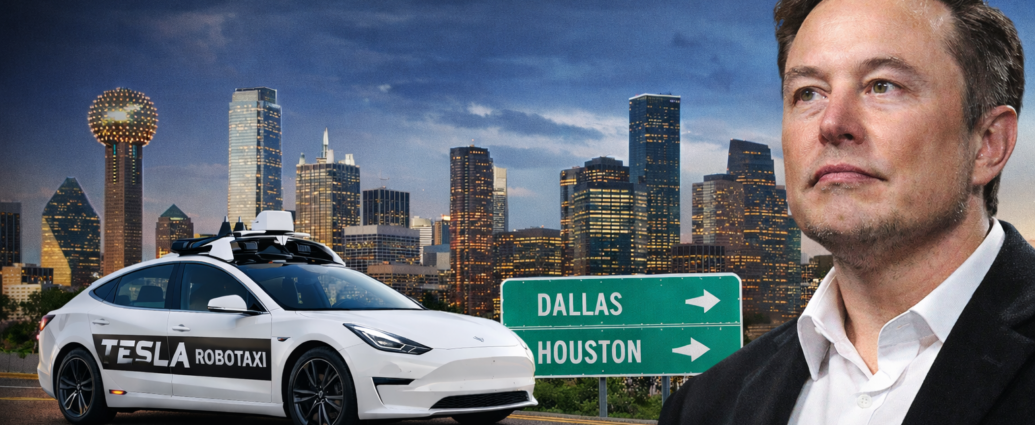
Tesla Inc. (NASDAQ: TSLA) said Saturday it is expanding its robotaxi service to Dallas and Houston, widening its autonomous ride-hailing footprint in Texas ahead of the company’s first-quarter results on April 22. The move follows Tesla’s launch in Austin in June 2025 and the start of driverless rides in January 2026, bringing the total number of Texas cities with Tesla robotaxi service to three.
The announcement gives investors a concrete operational update as Chief Executive Elon Musk pushes autonomy to the center of Tesla’s growth story. “The future of Tesla is fundamentally based on large-scale autonomy,” Musk told analysts on the company’s January 24, 2026 earnings call, framing robotaxis as a core revenue driver beyond electric vehicle sales.
Texas has become Tesla’s natural proving ground because the state allows autonomous vehicles to operate on public roads if they meet insurance and safety requirements. The Texas Department of Transportation, led by Executive Director Marc D. Williams, has maintained a relatively permissive framework for self-driving deployment, giving Tesla a faster route to commercial rollout than states with heavier regulatory restrictions.
The timing is significant. Tesla is set to report first-quarter earnings on April 22, and Wall Street analysts have been watching for visible autonomy milestones as pressure builds on the company’s core vehicle business. Dan Ives, managing director at Wedbush Securities, has said autonomous driving and artificial intelligence remain central to Tesla’s long-term valuation, while Gene Munster, managing partner at Deepwater Asset Management, has argued autonomy could eventually account for the majority of Tesla’s enterprise value.
Tesla is also trying to close the gap with competitors already operating at greater scale. Waymo, the Alphabet Inc. unit led by co-CEO Tekedra Mawakana, has said it is delivering more than 100,000 fully autonomous paid rides per week across Phoenix, San Francisco, and Los Angeles. Cruise, the General Motors-backed self-driving business previously led by Kyle Vogt, has also pursued urban robotaxi deployment, even as the sector faces heightened safety and regulatory scrutiny.
Tesla’s strategy remains distinct from rivals because it relies primarily on camera-based vision and neural networks rather than lidar. Musk has argued that approach can scale more efficiently, but critics remain unconvinced. Phil Koopman, an engineering professor at Carnegie Mellon University who focuses on autonomous vehicle safety, has repeatedly warned that safety-critical systems require strong redundancy and rigorous validation before broad deployment.
Federal regulators continue to watch the sector closely. The National Highway Traffic Safety Administration, which has overseen investigations into Tesla’s Autopilot and Full Self-Driving systems, remains a key factor in how quickly autonomous services can expand. Tesla has said in filings with the U.S. Securities and Exchange Commission that its driver-assistance systems require active supervision and are designed to improve through real-world fleet data.
For Tesla, the Dallas and Houston expansion is more than a technology story — it is an attempt to show that robotaxis are moving from promise to operations just as investors look for a fresh catalyst. With three Texas cities now in service, the focus heading into earnings will be whether Musk can convert early rollout momentum into a scalable business that starts to justify Tesla’s long-running autonomy bet.
—JBizNews Desk