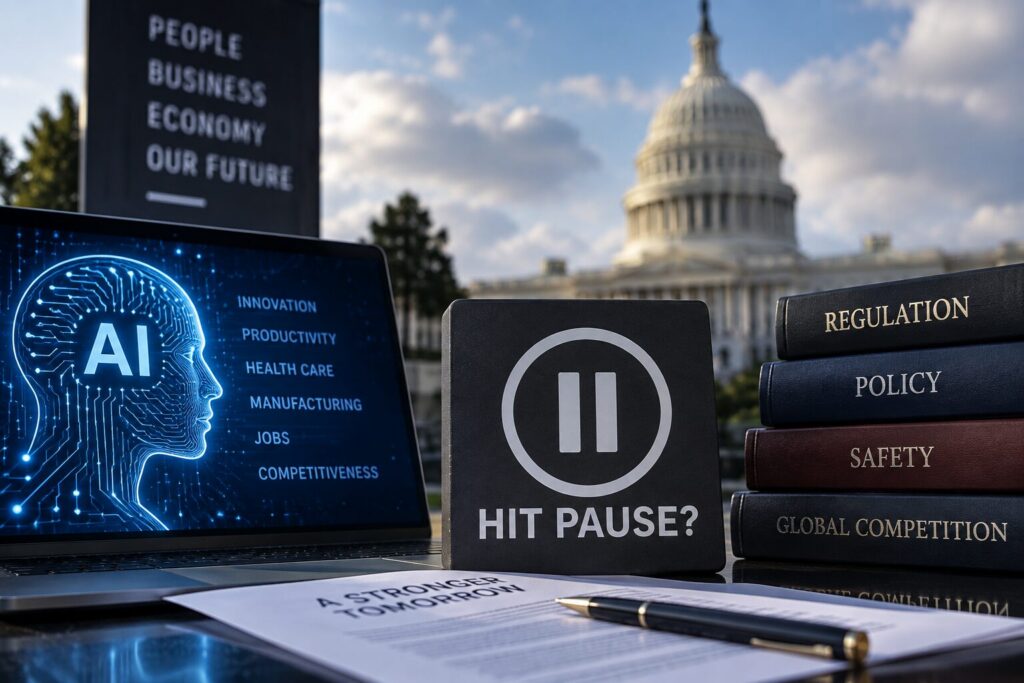
Every time a new wave of artificial intelligence hits the market, someone calls for a timeout. We heard it in 2023 when thousands of researchers and technology leaders signed a letter calling for a six-month pause in the training of AI systems more powerful than GPT-4. We’re hearing similar concerns today, dressed up in different language, as regulators, researchers and industry leaders debate whether the pace of AI progress has outrun our ability to manage it.
I understand the instinct. What I don’t accept is the price tag nobody wants to talk about.
Here’s the plain math. Every month that frontier AI development sits idle is a month that businesses don’t get the next generation of tools that could cut costs, increase productivity and improve services. Hospitals are exploring AI to help analyze medical images and streamline administrative work. Manufacturers are using machine vision and AI systems to identify defects. Accountants, lawyers and other professionals are using AI to summarize, search and analyze large volumes of information.
A broad pause on development could slow the improvements flowing into those tools.
And a pause doesn’t necessarily hit every company equally. That’s the part that gets lost in the debate.
Large, well-capitalized technology companies may be better positioned to absorb a slowdown. They have substantial resources, existing products and established customer bases. Smaller companies — startups building on top of frontier models and mid-sized businesses trying to use AI to compete with larger rivals — may have less room to wait.
A pause doesn’t automatically freeze the playing field. Depending on how it is structured, it could reinforce the position of companies that already have the deepest pockets, largest models and strongest market positions.
There’s also a harder truth underneath the pause debate: AI development isn’t happening in one country.
The United States is competing in a global technology race involving China, Europe and other governments and companies investing heavily in AI infrastructure, chips, models and research. If one country significantly restricts development while others continue, the technology itself doesn’t necessarily stop advancing.
The center of that advancement could simply move elsewhere.
That matters because leadership in AI isn’t only about who builds the most powerful model. It’s also about who influences the standards, business practices and rules surrounding the technology.
None of this means “no rules.”
I’m not arguing against safety testing, transparency, disclosure requirements or accountability when AI systems cause real harm. Those are legitimate issues, and businesses that want to earn public trust should take them seriously.
What I’m arguing against is the idea that the responsible move is to stop the clock entirely while we figure everything out.
Transformative technologies have historically created risks alongside enormous economic opportunities. Electricity, automobiles, aviation and the internet all forced governments, businesses and society to develop new rules as the technologies evolved.
We didn’t eliminate every risk before allowing those technologies to advance. We built regulatory systems alongside them, learning from failures and adjusting standards as new problems emerged.
AI should demand the same seriousness.
The businesses I talk to every week aren’t asking for a free-for-all. They’re asking for clarity so they can decide where to invest, what tools they can safely adopt and what rules they will be expected to follow.
Uncertainty is its own tax.
When companies don’t know whether today’s AI investment could become tomorrow’s regulatory problem, some will hesitate before signing the next contract, hiring employees around an AI product or rebuilding a workflow around new technology.
That hesitation carries an economic cost even if a formal pause never happens.
The real question isn’t whether AI carries risk.
It does.
The question is whether stopping development actually reduces those risks — or whether it slows the companies and researchers willing to operate under clear rules while development continues elsewhere.
I don’t believe a broad pause makes us safer.
I believe the better path is to keep moving while demanding stronger safeguards, clearer accountability and serious oversight along the way.
Because slower and safer are not necessarily the same thing.
JBizNews Desk | Dallas, Texas
© JBizNews.com All Rights Reserved. Reproduction or distribution without written permission is prohibited.