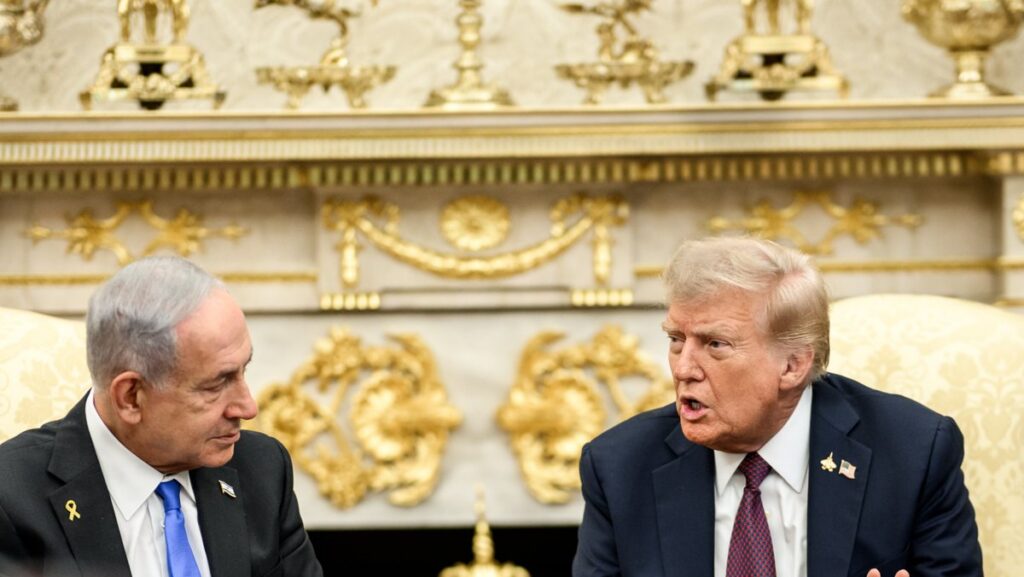
Photo: The White House (public domain). Donald Trump and Benjamin Netanyahu at the White House, September 2025.
President Donald Trump said on Election Day that he and Prime Minister Benjamin Netanyahu “made a deal months ago” to stop the roughly $4 billion a year the United States sends Israel, ending the payments by the end of this year. “They don’t need it,” Trump said on Fox News, adding that Netanyahu was the one who raised the idea and that the United States will still sell Israel weapons. “Now we’ll help Israel if they need it.”
Many pro-Israel readers heard that as bad news. Looked at as a business deal, it may be the opposite.
Start with what the aid actually is. Since 2016, a memorandum of understanding signed under President Obama has promised Israel $38 billion over ten years – $3.3 billion a year in military financing grants plus $500 million a year for joint missile defense, running through September 2028. It is a pledge, not a law: Congress must approve the money each year.
Now look at the strings. Under that deal, Israel has been steadily losing the right to spend any of the money at home. A historic allowance called offshore procurement, which let Israel convert about a quarter of the aid – roughly $815 million a year at its peak – into shekels for its own defense industry, is being phased down to zero by 2028. In plain terms: almost every aid dollar already has to be spent with American defense companies. The check is real, but it increasingly works like a gift card that can only be used in the giver’s store. For American workers in defense plants across dozens of states, that is money coming home. For Israel, it is $3.8 billion with rules attached – and, as Trump himself showed this week, a “talking point” used against both countries in American politics.
Now weigh that against what Israel gives. The relationship was never a one-way street, and the numbers show it. Israel spends a larger share of its economy on civilian research and development than any country in the world – 6.35 percent of GDP in 2023, nearly double the American rate of 3.45 percent. American companies do not treat Israeli technology as charity cases; they buy it. Intel paid $15.3 billion for Mobileye, an Israeli self-driving technology firm, in 2017 and put its global autonomous-driving division in Israel. Google paid $1.1 billion for Waze. Microsoft, Apple and Google all run research centers in Israel, and Israeli startups raised $10.6 billion in 2024 alone – nearly three times the annual aid package.
The giving runs through defense too. The U.S. Army bought Israel’s Trophy system, made by Rafael, to shield American Abrams tank crews, with deliveries completed in 2021. Israel’s missile-defense work, developed jointly with Washington, protects American interests as well as Israeli cities. And the aid dollars Israel does receive flow back into American factories, American engineers and American jobs.
That is the reframing Netanyahu himself has been making. He told The Economist in January that he wants to “taper off” American military aid to zero within a decade, saying “we’ve come of age, and we’ve developed incredible capacities.” In May he said he wanted to start the drawdown now, not wait for the next Congress. His vision, and one policy experts in Washington have also sketched, is to replace an aid relationship with a business one: Israeli firms and Israeli technology inside joint weapons programs, bought and sold on merit rather than granted and debated.
Seen that way, $3.8 billion a year is a small price for independence – and the bigger number points the other direction. Israel’s own defense industry sold a record $19.2 billion abroad in 2025, the fifth straight record year and nearly five times the annual American aid package, with more than half of the deals worth over $100 million each, according to Israel’s Defense Ministry. Buyers across Europe and Asia are paying full price for the same battlefield-tested technology the United States gets early access to.
Ending the aid also ends the strings that come with it. Today, the phase-out of offshore procurement means almost every aid dollar must be spent with American defense companies – money Israel cannot invest in its own industry. Researchers at Israel’s Institute for National Security Studies have warned that this shift hits Israel’s smaller defense firms hardest, and the Quincy Institute has noted that once the allowance reaches zero, the grant effectively becomes a subsidy for American primes rather than Israeli ones. Without the check, Israel keeps its own defense budget at home: it can buy from its own companies, set its own procurement rules, and move freely in markets where it now competes with the very American firms the aid required it to shop from. Netanyahu’s own words for this, from June, are that Israel must “break free from dependency and build our own independent armaments network.”
None of this means the transition is simple or painless. Ending the aid early would require Congress to act, and no one has explained how or whether that will happen before the current agreement expires in 2028. Israeli defense firms that relied on the offshore procurement allowance will feel the loss first. And if a real emergency comes, both countries will learn quickly what “we’ll help Israel if they need it” actually means.
But for readers who care about Israel, the headline is not that America is walking away. It is that the two countries are talking about replacing a handout with a partnership – because Israel, by its own prime minister’s account, no longer needs one.
By Duvi Honig
Publisher, JBizNews | Founder / CEO, Orthodox Jewish Chamber of Commerce
© JBizNews.com. All rights reserved. Unauthorized reproduction or redistribution is strictly prohibited.