Oracle and Nvidia announced plans Tuesday to expand Oracle Cloud Infrastructure’s Vera Rubin AI superclusters to multi-gigawatt scale, while making Nvidia’s Vera Rubin NVL72 systems and Vera processors generally available on the cloud platform.
The October 27 announcement at Oracle AI World in Las Vegas combines an immediate product-availability milestone with a much larger infrastructure plan. The companies did not disclose a purchase price, a firm completion date for the multi-gigawatt expansion or an exact number of gigawatts.
Available systems, planned expansion
The distinction matters for customers weighing where to train AI models and run them in production. General availability means the announced NVL72 and Vera CPU offerings have moved beyond an early-access description. It does not mean the entire planned multi-gigawatt buildout is already operating.
NVL72 connects 72 graphics processors within a rack through Nvidia’s NVLink networking. Oracle says its larger superclusters combine those systems with Oracle Acceleron networking, Nvidia Spectrum-X Ethernet equipment and power and cooling designed for very large AI deployments.
The planned expansion builds on Oracle’s existing Nvidia GB200 and GB300 infrastructure. It extends a partnership serving two related markets: training new AI models and inference, the computing that produces answers when users or applications make requests.
Oracle also plans to introduce HGX Rubin NVL8 systems, a smaller eight-GPU configuration built around x86 servers. The announced design includes two 64-core Intel Xeon 6 processors, four terabytes of DDR5 memory and high-speed networking. That remains a planned offering, distinct from Tuesday’s generally available systems.
Processors for the work between AI calls
The Vera CPU offering targets work that does not always run on a graphics processor. AI agents may retrieve information, execute code or call software tools between model responses. Those operations can leave costly GPUs waiting if the surrounding computing resources cannot keep up.
Oracle says customers can scale CPU and GPU resources independently to match those tasks. The companies describe that approach as a way to reduce idle capacity. Actual savings will depend on the workload and deployment; the announcement does not establish a uniform cost reduction for every customer.
OpenAI is among the customers cited in the release. Its executives described bringing Vera processors into production on OCI for agent workloads and using the new infrastructure to support demanding AI applications. Those statements are customer accounts supplied in the companies’ announcement, rather than independent performance tests.
For enterprise buyers, the immediate news is a wider set of available computing options on Oracle’s cloud. The larger headline is a planned expansion measured in gigawatts, underscoring the power and physical infrastructure needed to support advanced AI. Its ultimate scale, cost and deployment timetable remain details to watch.
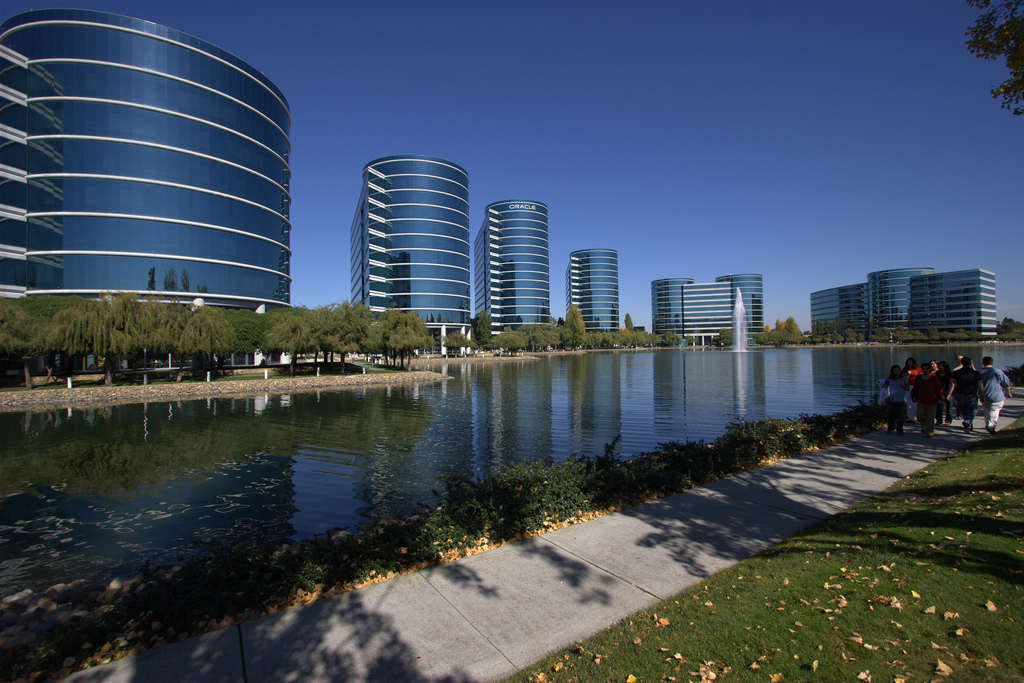
File photo: Oracle’s Redwood Shores campus, uploaded June 2007, not the new AI systems. Rayhe / Wikimedia Commons, CC BY 2.5. Unaltered.
JBizNews Desk | Las Vegas
© JBizNews.com. All rights reserved. Unauthorized reproduction or redistribution is strictly prohibited.