Photo: Coolcaesar / Wikimedia Commons (CC BY-SA 4.0)
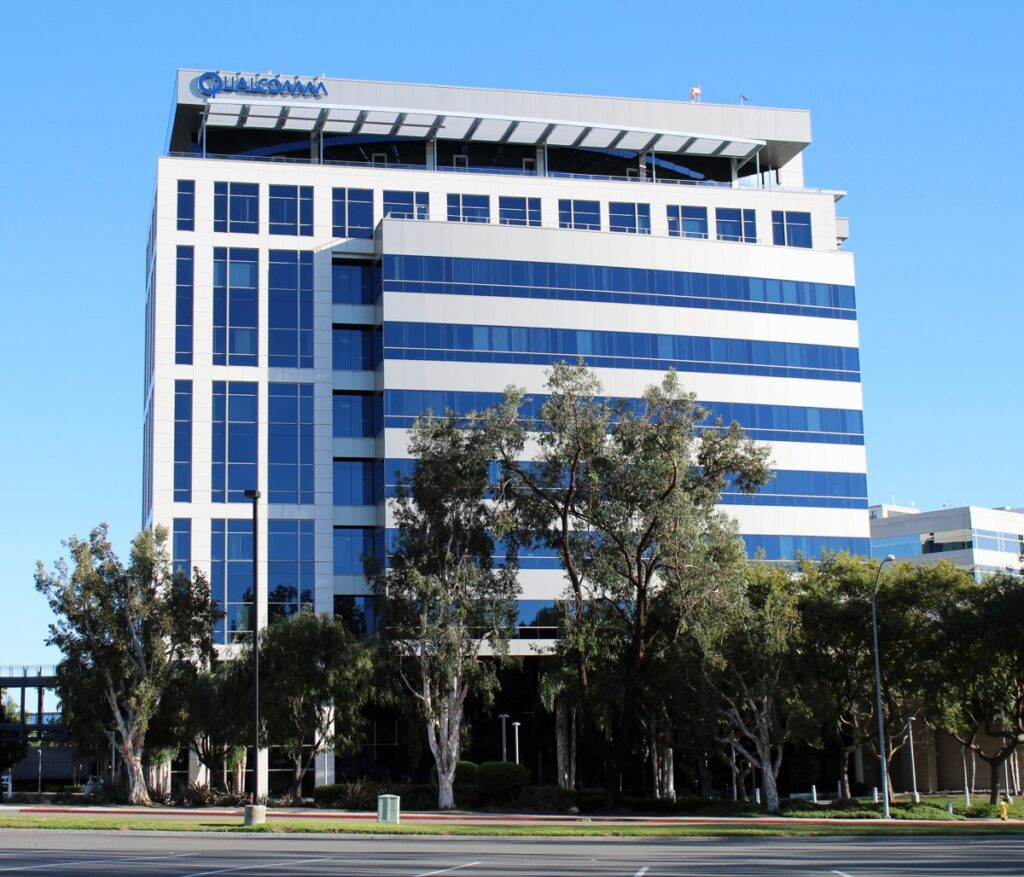
Qualcomm beat Wall Street’s quarterly expectations after the bell Wednesday as surging sales of chips for cars helped make up for a steep drop in its smartphone business.
The chipmaker reported adjusted earnings of $2.17 a share on revenue of $10.32 billion for its fiscal fourth quarter, ahead of the $2.16 a share and $10.12 billion analysts had projected, Yahoo Finance reported. A year earlier the company earned $3.00 a share on $11.27 billion in revenue.
Shares reversed lower and fell about 6% in extended trading, CNBC reported in an update shortly before 5 p.m. ET, as investors looked past the beat to the profit outlook.
The forecast was the real surprise. Qualcomm guided first-quarter revenue of $10.4 billion to $11.2 billion, with the midpoint above the roughly $10.6 billion analysts had expected.
The concern is on the profit line. Qualcomm projected first-quarter earnings of $2.15 to $2.35 a share, straddling the $2.27 analysts had expected, and warned that the industrywide memory shortage is forcing handset makers to raise prices and hurting demand for phones.
Cars carried the quarter. Automotive chip sales jumped 89% to $2 billion, the kind of growth that matters to drivers as Qualcomm silicon powers more dashboard screens and driver-assistance systems in new models. Handset revenue, still the company’s biggest business, plunged 26% to $5.1 billion, missing the $5.3 billion analysts expected. The broader QCT chip segment fell 8% to $9 billion but topped forecasts, and the licensing arm brought in $1.3 billion.
Qualcomm is pushing to rely less on phones. On Wednesday it announced a deal to supply technology for SpaceX’s Starlink mobile network, JBizNews reported earlier. In October it teamed up with defense tech firm Anduril on a laptop built around its Snapdragon X chips, and in September it signed an agreement to design custom chips for Amazon’s AWS AI infrastructure.
The handset slump reflects a wider memory and storage shortage that has forced electronics makers to raise prices on phones and laptops, dampening demand. Apple flagged the same margin pressure in its earnings this week, and Intel and AMD both warned of weaker PC sales ahead.
JBizNews Desk | San Diego
© JBizNews.com. All rights reserved. Unauthorized reproduction or redistribution is strictly prohibited.