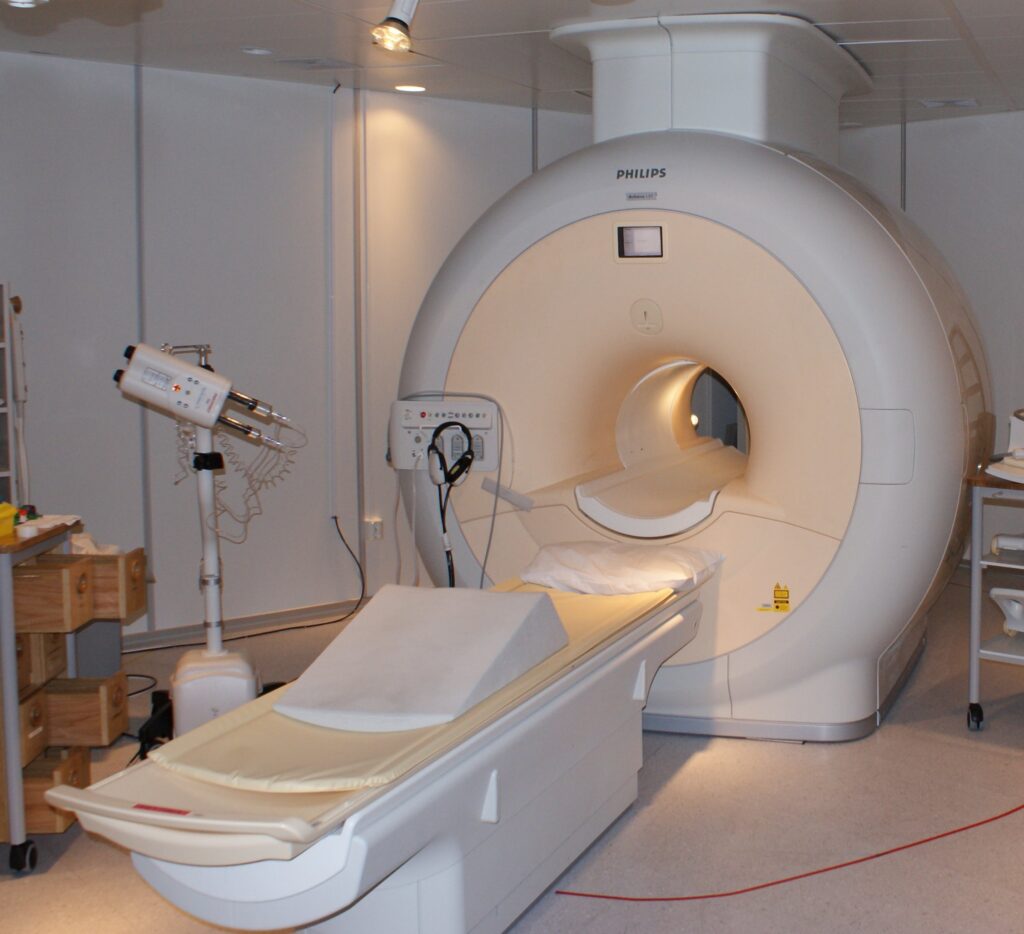
Jan Ainali / Wikimedia Commons / CC BY 3.0 / Archive MRI scanner in Gothenburg, Sweden, 2008; not a RadNet facility
RadNet raised its full-year outlook for its imaging-center business Sunday after reporting a 22.1% increase in third-quarter revenue, as more MRI, CT and PET/CT scans helped lift sales. But the company’s net income fell, showing that stronger demand did not translate into higher bottom-line profit.
In its November 8 earnings release, the outpatient diagnostic-imaging provider reported total revenue of $638.3 million for the quarter, up from $522.9 million a year earlier. Net income declined to $4.2 million, or 5 cents a diluted share, from $5.4 million, or 7 cents a share.
The company’s adjusted earnings told a different story. Adjusted diluted earnings per share rose to 30 cents from 24 cents, while adjusted EBITDA increased 23.8% to $105 million. Those are non-GAAP measures that exclude certain expenses and other items; they are not substitutes for the company’s reported net income.
For the full year, RadNet now expects its imaging-center segment to generate revenue of $2.385 billion to $2.435 billion, compared with its previous range of $2.370 billion to $2.420 billion. It raised that segment’s adjusted EBITDA forecast to $350 million to $363 million from $345 million to $358 million, and its free-cash-flow forecast to $120 million to $130 million from $115 million to $125 million.
That outlook also calls for higher spending on equipment and facilities. The imaging-center capital-expenditure range increased to $170 million to $180 million from $165 million to $175 million. The revenue, cash-flow and spending forecasts apply to that segment, not the entire company, and remain projections rather than guaranteed results.
Chief Executive Howard Berger attributed the quarter’s growth to filling capacity at existing centers, new locations, acquisitions, a shift toward advanced imaging, improved commercial-insurer reimbursement and health-system joint ventures. Advanced-imaging procedure volumes rose 19.9% overall and 8.9% at centers operating in both comparison periods.
The distinction matters because acquisitions and new centers can increase total volumes even without growth at existing locations. Across all imaging procedures, including routine exams such as X-rays and ultrasound, RadNet reported volume growth of 10.8% overall and 3.2% on a same-center basis.
The smaller digital-health business, which includes artificial-intelligence and radiology technology, reported revenue of $32.9 million, including intersegment revenue, up 32.6%. Its adjusted EBITDA fell 11.8% to $3 million. RadNet ended September with $750.6 million in cash.
RadNet’s imaging-center markets include New York and New Jersey.
JBizNews Desk | Los Angeles
© JBizNews.com. All rights reserved. Unauthorized reproduction or redistribution is strictly prohibited.