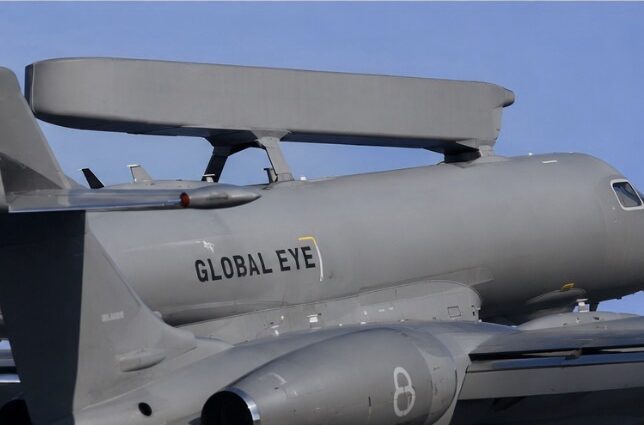
Saab has secured one of its largest surveillance-aircraft contracts in years, winning a 10 billion Swedish kronor (about $1.04 billion) order for two GlobalEye airborne early-warning aircraft from an unidentified Middle Eastern customer.
The award arrives as defense manufacturers worldwide struggle with a challenge few faced before the war in Ukraine: demand is growing faster than factories can produce sophisticated military equipment.
Unlike fighter jets or missiles, the GlobalEye is designed to serve as an airborne command center. Built on Bombardier’s Global 6000 business jet, it combines long-range radar, maritime surveillance and intelligence-gathering systems capable of tracking threats hundreds of miles away while coordinating military operations across air, land and sea.
For Saab, the contract strengthens one of its fastest-growing businesses at a time when governments are shifting procurement priorities from replacing aging equipment to expanding operational capabilities. Surveillance platforms, drones, electronic warfare systems and missile-defense networks are becoming just as important as traditional combat aircraft.
The ripple effects extend well beyond one manufacturer. Delivering aircraft like the GlobalEye requires thousands of specialized components supplied by aerospace companies across Europe and North America, supporting work in avionics, radar systems, precision electronics, composite materials and advanced manufacturing.
That industrial expansion is unfolding across much of the defense sector. Governments are signing larger, longer-term contracts to give manufacturers confidence to expand production capacity after years of operating with lean inventories and just-in-time supply chains. Companies are responding by investing in new factories, hiring skilled workers and rebuilding supplier networks that had shrunk following decades of lower defense spending.
For businesses outside the defense industry, the trend is creating opportunities for precision manufacturers, engineering firms, software developers and industrial suppliers that increasingly find themselves serving military programs alongside commercial customers.
The latest order reinforces a broader shift taking place across global manufacturing. Defense spending is no longer being driven solely by replacement cycles. Governments are investing to expand industrial capacity itself, creating demand that could support aerospace and advanced manufacturing companies well beyond the current geopolitical environment.
JBizNews Desk | Wall Street
© JBizNews.com All Rights Reserved. Reproduction or distribution without written permission is prohibited.