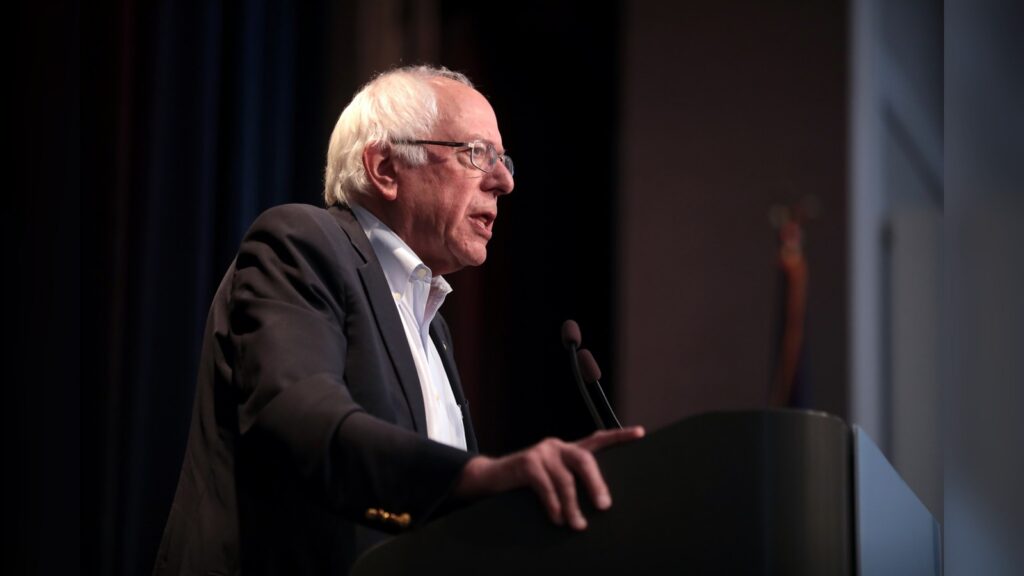
Gage Skidmore / Wikimedia Commons / CC BY-SA 2.0
WASHINGTON – Sen. Bernie Sanders is urging Democrats to put household costs and working families ahead of an agenda dominated by investigations of President Donald Trump, saying the party could jeopardize its affordability mandate if it spends the next two years focused on probes.
The Vermont independent made the argument in a Sunday, November 8 interview from Burlington, Vermont as Democrats prepare to take control of both chambers of Congress. He supported holding the administration accountable, but said oversight should not consume the time and attention needed to address health care, housing and wages.
Asked whether two years of investigations could undermine the promise to lower prices and make life more affordable, Sanders answered, “Yes, I do.” His central warning was that investigating the president cannot substitute for delivering changes that families can see in their daily lives.
“We cannot spend all of our time investigating Trump,” Sanders said in the original interview. “We’ve got to stand up for working-class families, make a real difference in their lives.”
That is a call to set priorities, not to abandon congressional oversight. Sanders explicitly backed accountability before arguing that lawmakers must also respond to the financial pressures on households. The difference matters because an investigation can examine government conduct without, on its own, changing what a family pays for housing or medical care.
Sanders described the election result as a demand for larger economic changes rather than small adjustments. He said people are working long hours, worrying about their children and struggling to afford health care and housing. Those were his explanation of the political mandate, not new economic data released during the interview.
Health care was at the center of the agenda he proposed. Sanders called for a Medicare for All system and described a first-year push to lower the Medicare eligibility age from 65 to 55, expand dental, hearing and vision coverage, and include children as part of a four-year transition. Those are proposals he wants Congress to pursue, not benefits that have been enacted.
He also advocated a federal minimum wage of at least $20 an hour, easier union organizing, a tax on billionaires, more housing, universal child care and tuition-free public colleges and universities. The interview did not establish that Democratic leaders have agreed to pass that full package or that it has the votes to become law.
Sanders said he expects to chair the Senate committee responsible for health, education, labor and pensions. He used that prospective role to explain why health care would lead his priorities, while acknowledging through the discussion that his preferred approach faces disagreement within the party.
He also left open the possibility of working with Trump on wages or health coverage. Sanders suggested the president might be receptive to raising low wages and interested in taking credit for expanded health care. That was Sanders’ assessment of a possible opening, not an announcement of negotiations or an agreement by the White House.
“Do I think we can work with Trump? Maybe,” he said. “I’m, by no means, guaranteeing it. But it is certainly worth the effort.”
The recent electoral record offers a caution about how quickly congressional control can change. The House’s official party-control record shows Democrats held both chambers in 2021-2023. They lost the House in the 2022 election, when Republicans won 222 seats to Democrats’ 213, but Democrats retained control of the Senate. They did not lose both chambers in that election.
Those results show that a majority is not permanent; they do not, by themselves, prove that a focus on Trump investigations caused the House loss. Looking toward the 2028 presidential and congressional elections, whether lawmakers deliver on living costs could become an important political test. The outcome cannot be known now. Sanders’ immediate argument is that the party should use its coming term to produce results for households rather than treat investigations as its entire program.
Watch interview – November 8, 2026.
The practical question for the incoming Congress is how much time it gives to oversight and how much to legislation, and whether any proposed economic changes can attract the support needed to become law. Sanders’ warning sets out his preferred balance. It does not settle the party’s agenda, guarantee cooperation with the president or make any of the proposed benefits available now.
JBizNews Desk | Washington
© JBizNews.com. All rights reserved. Unauthorized reproduction or redistribution is strictly prohibited.