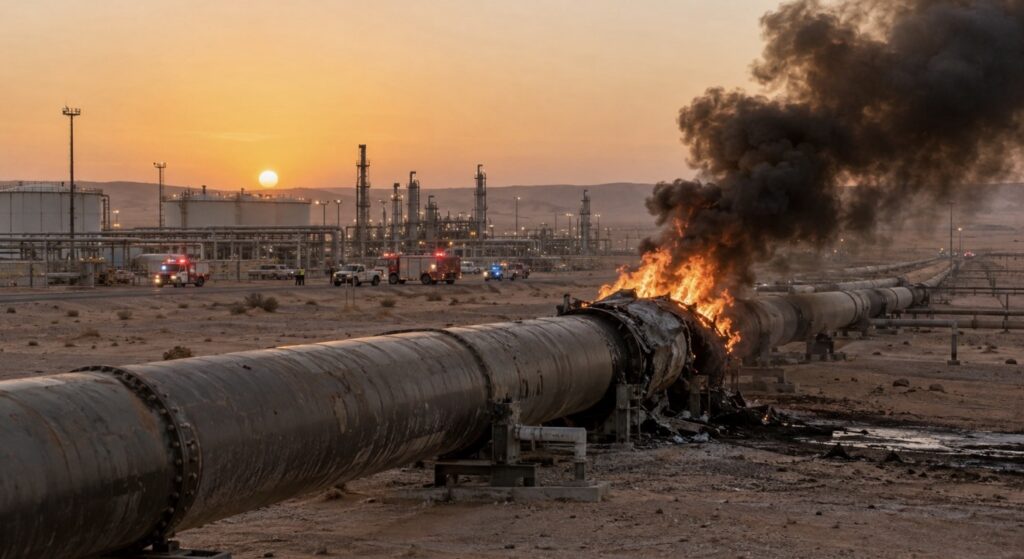
The world just lost one of its most important escape routes around the Strait of Hormuz — and oil jumped more than 3% Monday morning.
Brent crude surged above $108 a barrel, while U.S. West Texas Intermediate climbed above $102, after drone attacks forced Saudi Arabia to temporarily shut its East-West oil pipeline. (Reuters)
This is not simply another attack on an oil facility.
The 745-mile pipeline has become Saudi Arabia’s primary way of moving crude around the war-disrupted Strait of Hormuz. Earlier in the conflict, Saudi Arabia was pushing roughly 4 million to 5 million barrels a day through the line to its Red Sea export system — equal to approximately 4% to 5% of the entire world’s oil supply. (Reuters)
Now that route has been hit too.
That leaves Saudi Arabia relying on stored crude at the Red Sea port of Yanbu while repairs are made. Oil buyers told Reuters the kingdom has enough export inventory there for only about five to seven days if normal pipeline flows do not resume. (Reuters)
For businesses, the math becomes serious very quickly.
Every $10 increase in a barrel of oil adds enormous costs across an economy that moves almost everything by truck, ship or plane. Diesel fuels trucking and construction equipment. Jet fuel powers airlines. Marine fuel moves container ships. Oil and natural gas feed into plastics, chemicals, packaging and manufacturing.
And diesel has already crossed $6 a gallon in the United States during this latest energy shock. (Reuters)
A trucking operation burning 10,000 gallons a week at $6 is spending $60,000 every seven days just on fuel.
Raise that cost by another 50 cents a gallon and the company needs another $5,000 every week — $260,000 a year — before paying one additional driver, buying one additional truck or moving one additional package.
Those costs do not disappear.
They eventually show up in freight rates, groceries, construction materials, airline tickets and the price businesses charge customers.
The Saudi pipeline had been one of the biggest reasons the global oil market remained functional even after traffic through the Strait of Hormuz collapsed.
Before the Iran war, Hormuz handled roughly 20% of global crude oil and LNG supply, with about 125 commercial vessel transits a day. Over the weekend, commodity-vessel traffic remained dramatically below normal as security risks continued around the strait. (Reuters)
Saudi Arabia responded to those disruptions by moving more oil west across its territory through the East-West pipeline and loading it onto tankers from the Red Sea.
But that backup system was already under pressure.
Saudi west-coast exports fell sharply in August as Houthi activity threatened shipping near the Bab el-Mandeb Strait at the southern entrance to the Red Sea. Saudi output fell to roughly 6 million barrels a day in August, its lowest level in more than three decades, according to the International Energy Agency. (Reuters)
Now the pipeline feeding that route has itself been attacked.
Asian refiners are already preparing for tighter supplies. Saudi Aramco had not provided customers with updated shipment schedules early Monday, leaving buyers uncertain about how much crude would arrive and when. Refiners are beginning to look toward alternative barrels from producers including Iraq and the United Arab Emirates. (Reuters)
The danger is not simply today’s oil price.
Global petroleum inventories have already fallen by approximately 507 million barrels since the Iran war began, according to International Energy Agency figures cited by Reuters. Refined-fuel exports from the Middle East — including diesel, gasoline and jet fuel — remain nearly 60% below prewar levels. (Reuters)
That means the world is entering this new disruption with a much smaller cushion than it had when the conflict began.
The pipeline shutdown also comes just two days before the Federal Reserve announces its next interest-rate decision.
Markets are already overwhelmingly expecting another rate increase Wednesday as inflation accelerates. A fresh jump in oil, diesel and transportation costs gives the Fed another reason to worry that inflation will remain elevated.
That is why Monday’s pipeline attack matters far beyond Saudi Arabia.
For months, the Strait of Hormuz was the vulnerability and Saudi Arabia’s East-West pipeline was part of the solution.
Now the solution has become another vulnerability.
And if Saudi Arabia cannot restore that pipeline quickly, businesses around the world may discover that $108 oil was not the peak — it was the warning.
JBizNews Desk | New York
© JBizNews.com. All rights reserved. This article is original reporting by JBizNews Desk. Unauthorized reproduction or redistribution is strictly prohibited.