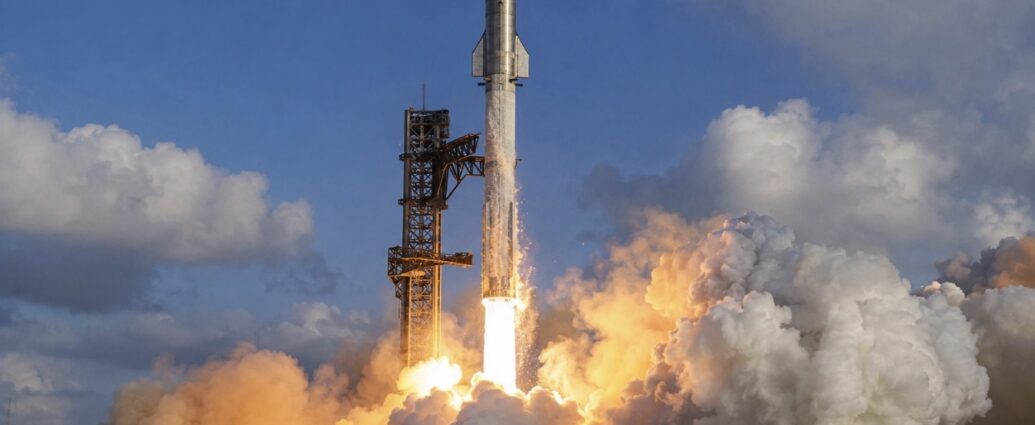
SpaceX successfully launched its upgraded Starship V3 rocket on Friday, May 22, 2026, from its Starbase facility in South Texas, deploying 20 mock Starlink satellites in space and executing a controlled splashdown in the Indian Ocean — a critical milestone for Elon Musk’s company just two days after SpaceX filed its prospectus with regulators to take the company public in what is expected to be the largest initial public offering in history. The test, the 12th major flight of the Starship program and the debut of the redesigned V3 version, lifted off at 5:30 p.m. local time from the southern tip of Texas and stretched halfway around the world during its hour-long flight.
The flight achieved most of its major objectives despite minor anomalies. One of the six engines on the Starship upper stage shut down early during ascent, and the Super Heavy booster spun out of control and broke apart over the Gulf of Mexico after the booster’s controlled re-entry burn failed. SpaceX lost communications with the booster moments before splashdown, indicating it likely disintegrated. But the Starship upper stage itself reached space, deployed its entire payload, scanned its own heat shield with two specialized companion satellites, and made a controlled re-entry through the atmosphere before splashing down upright in the Indian Ocean under what appeared to be full control. The vehicle then toppled over and ignited, as expected.
“It’s pretty incredible to see this happening live from space now,” SpaceX employee Kate Tice told viewers on the company’s livestream as applause and chants of “USA, USA” erupted from employees in the Starbase control room. Musk later called the launch and landing “an epic” event on his X social media platform.
The successful payload deployment is a critical commercial validation. The 20 mock satellites were designed to mimic the size, weight, and release mechanics of next-generation Starlink satellites — the larger, more powerful units that SpaceX plans to deploy at a much higher cadence once Starship enters operational service. Two additional modified satellites that Starship deployed scanned the spacecraft’s heat shield and transmitted data back to ground operators during the vehicle’s descent, providing real-time engineering data that will inform future flights. All of the satellites are expected to fall back to Earth and burn up in the atmosphere.
For SpaceX and its investors, the timing could not have been better. Musk announced earlier in the week that the company had filed its S-1 registration statement with the U.S. Securities and Exchange Commission, setting the stage for an IPO expected next month. Industry analysts estimate SpaceX could be valued at between $400 billion and $500 billion at the time of the offering, which would make it the largest U.S. IPO in history, eclipsing Saudi Aramco’s $25.6 billion offering in 2019 and Alibaba’s $25 billion raise in 2014. Investors are already getting exposure to the rocket company through exchange-traded funds, with shares of publicly traded space sector ETFs including ARKX rallying sharply this week on the IPO news and Friday’s successful test.
The financial stakes of Friday’s test were enormous. A spectacular failure, especially of the highly publicized V3 debut, would have raised hard questions for IPO underwriters about whether the Starship program is ready for the commercial cadence SpaceX has been promising. Back-to-back Starship test failures in January and March 2025 ended in midair explosions that rained debris into the Atlantic. The ninth test in May 2025 also failed. The tenth test in August 2025 became the first to successfully deploy mock satellites and execute a controlled splashdown. Friday’s flight took that progress and built on it with the larger, more powerful V3 design.
The new Starship V3 is significantly bigger and more capable than earlier versions. The fully stacked vehicle stands roughly 400 feet tall — taller than the Statue of Liberty including its pedestal. The Super Heavy booster generates more thrust at liftoff than any rocket ever built, surpassing NASA’s legendary Saturn V that sent astronauts to the moon in the 1960s and 1970s. V3 features upgraded engines, larger and stronger booster fins for stability, and a refined heat shield that SpaceX has been iteratively rebuilding flight after flight. The company’s stated goal is to ultimately catch the booster mid-air with the launch tower’s robotic “chopsticks” arms, fully reusing the rocket within hours of landing.
The commercial logic behind Starship is staggering. SpaceX intends to use the rocket to deploy thousands of next-generation Starlink satellites, which deliver internet service to consumers and enterprises in places where terrestrial broadband cannot reach. Starlink currently serves more than 5 million subscribers in over 100 countries, and the V3 Starlink satellites that Starship will eventually carry are designed to provide direct-to-cell service to standard smartphones — eliminating dead zones for T-Mobile, Verizon Communications, AT&T, and other partner carriers. The satellite communications market is projected to grow to more than $100 billion annually by 2030, and SpaceX is positioned to capture a dominant share.
NASA is equally invested. The U.S. space agency has ordered two Starships to serve as the lunar lander for its Artemis program, which intends to return American astronauts to the moon later this decade. NASA Administrator Sean Duffy has publicly emphasized Starship’s importance to U.S. space leadership, particularly as China accelerates its own crewed lunar program with the goal of landing Chinese astronauts on the moon by 2030. Every successful Starship test moves the Artemis timeline closer to reality.
Musk’s ultimate ambition extends much further. The Starship program is explicitly designed to enable human missions to Mars. SpaceX has been transparent about its intention to use the rocket to land cargo and eventually crew on the Red Planet within the next decade. Friday’s successful payload deployment is one small step in that long-term technology development, but every successful flight reduces the technical risk and validates the underlying engineering.
For investors, the story is even bigger than rockets. Musk has been openly framing SpaceX as an integrated artificial intelligence and satellite communications company, not just a launch provider. The Starlink subscriber base generates recurring revenue. The launch business generates contracted revenue from NASA, the U.S. Department of Defense, commercial satellite operators, and international space agencies. The data and connectivity layer Starlink provides enables a new generation of AI applications, autonomous vehicles, Internet of Things deployments, and global enterprise communications. Investors buying into the SpaceX IPO are buying exposure to all of those revenue streams at once.
The competition is intensifying. Jeff Bezos’s Blue Origin is developing its own large-class New Glenn rocket, which has flown several successful missions and is now positioning to compete for both NASA and commercial contracts. Boeing, Lockheed Martin, and the United Launch Alliance continue to dominate certain national security launches but face cost disadvantages against SpaceX. Rocket Lab, Relativity Space, Stoke Space, and other smaller competitors are pursuing niche segments. China’s State-Owned Long March rockets and the privately backed LandSpace are accelerating launch cadence at lower price points. The competitive pressure is real, but SpaceX’s lead in reusable rocketry — the technology that fundamentally lowers per-launch costs — remains substantial.
For everyday Americans, the SpaceX IPO will be one of the most-watched financial events of the year. Investment advisors at Charles Schwab, Fidelity Investments, Vanguard Group, Morgan Stanley, Edward Jones, and Merrill Lynch are already fielding client questions about how to get access. The IPO is expected to be heavily oversubscribed, with institutional allocations dominating early share distributions. Retail investors will likely need to wait for the secondary market for meaningful access, though some brokers including Robinhood Markets and SoFi Technologies have built IPO access tools that have democratized retail participation in earlier high-profile offerings.
The political backdrop is also significant. Musk’s complicated relationship with President Donald Trump — including Musk’s brief role leading the Department of Government Efficiency before his very public falling-out with the administration earlier this year — has not slowed SpaceX’s federal contracting. Starship’s central role in the Artemis program and SpaceX’s dominant share of U.S. national security launches make the company effectively too important to U.S. space and defense capabilities to be politically sidelined. Musk has also drawn renewed criticism for his political activities and X platform statements, but SpaceX the company has continued executing through the noise.
For the broader space economy, Friday’s test is a clear signal that the next phase of orbital commerce is real and arriving on a faster timeline than skeptics expected. Satellite internet, lunar logistics, in-space manufacturing, asteroid mining, space tourism, and eventually interplanetary cargo and crew transportation all depend on a working heavy-lift reusable rocket. Starship V3 is now closer than ever to delivering that capability.
The SpaceX IPO timeline appears intact. The Starship program is back on track. The Starlink business continues to grow. NASA’s moon program is moving forward. Musk’s Mars ambitions remain wildly aspirational, but each successful test brings them incrementally closer to credible.
For Wall Street, the practical message is straightforward. SpaceX just demonstrated that its next-generation rocket can fly, deploy payload, and return controlled — three weeks before its public offering. Investors will price that in.
— JBizNews Desk
© 2026 JBizNews. All Rights Reserved. Reproduction or distribution without written permission is prohibited.