Even as our heads spin from a dizzying array of consecutive holidays, the parade of crises focusing on the IDF marches on and on.
The latest (at least of this writing) is the fallout from the dastardly film, NAZA (a title loved by global Jew-haters because it sounds so much like the monsters they think we are).
Wanna get your movie in an avant-garde film festival, be hailed as a hero, and snatch a ton of moola to boot? Just trash Israel and catalogue/concoct our atrocities, while studiously avoiding any mention of the other side’s abhorrent sins.
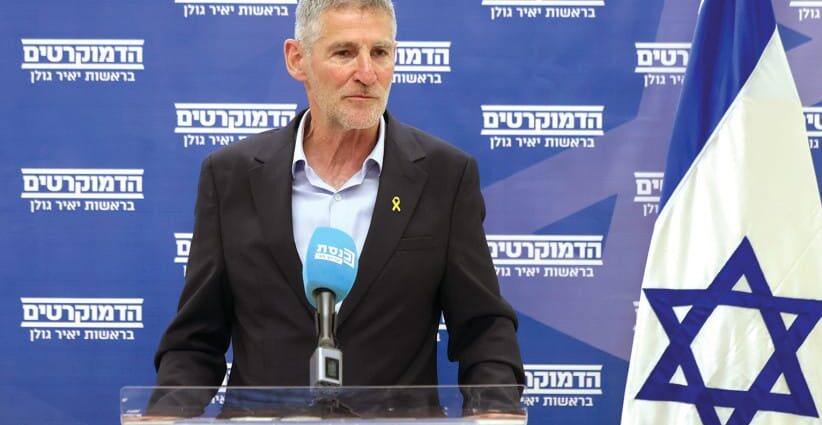
Before this story broke, there was the hullabaloo over who knew what, and when did they know it, on Oct. 7. Did the prime minister oversleep, or was he purposely not woken up when the fighting began? Did Yair Golan really rush to Gaza and slay several of the terrorists, and if so, how did he get there so fast? And will there ever be – now three years and counting – an independent investigation into what actually happened on that dark day?
The balagan that is known as Israeli elections
Not to mention the balagan that is known as Israeli elections, where the central issue this year – once again – is who must serve in the armed forces, and for how long.
And the deepest point of turmoil, from my religious perspective, is the ongoing debate as to who is the guardian of Israel and its citizens. Whom do we depend on for our safety: our military, or our Maker?
Sources abound on both sides. King David’s 121st Psalm flatly proclaims that “God is our guardian,” yet David himself was a brilliant military strategist who finally overcame the Jebusites and conquered Jerusalem. Our recent Torah portion of Ha’azinu portrays God as “an eagle hovering above, carrying us, His young, to safety,” and our daily prayers proclaim that “God is a Man of War, God is His name.”
But at the same time, the Torah includes extensive censuses specifically of those who were eligible for military service, starting at age 20. And while Deuteronomy 20 lists those who are exempt from military service, Torah study is pointedly not one of those exemptions.
And this is just for optional wars, such as wars of expansion. For obligatory wars, the well-known source in Sotah 44b rules that even a groom is taken from his wedding to fight; and according to Maimonides (Melachim 5:1), a defensive war is in the category of an obligatory war.
As we all know, the religious-Zionist community subscribes to both opinions, representing the best of both worlds. These young men (and an increasing number of young women) combine Torah study with military service through a multitude of programs for both Israelis and foreign lone soldiers. They have served with amazing distinction, suffering an inordinate, even excessive number of deaths and injuries in defense of this country.
IT SEEMS to me that Sukkot sends a clear message on this very same subject.
The Talmud in tractate Sukkah discusses a difference of opinion as to why we build a sukkah and dwell in it for a week.
Rabbi Eliezer says the sukkot mimic the real booths, or huts, in which the Israelites lived in the desert during their 40-year journey to Israel. The desert can be a brutal environment, with burning heat and intense cold, sandstorms, and dangerous snakes and scorpions as daily threats. And so each family had to build their own sukkah to protect themselves from the elements.
Rabbi Akiva – though himself one of the principal leaders of the ill-fated armed rebellion against the Romans – has a very different viewpoint. He maintains that the “booths” described in the Torah were actually miraculous, Heaven-sent clouds that enveloped us and shielded us from harm as we traveled. We build the sukkah merely to represent the impenetrable safety that God provided then and always.
Sukkot accentuates the metaphysical and the spiritual
One sage emphasizes the Heavens and Divine protection. The other stresses Earth and the need to use our resources to secure our safety.
This same dichotomy accompanies the ritual acts of Sukkot.
On the one hand, this festival requires us to touch the physical. With our own hands, we build a sukkah, one that must be walled and may not be open to the sky. We grasp the Four Species, waving the lulav (palm branch) and smelling the etrog (citron). We acknowledge our dependence on water in the Simchat Beit Hashoeva ceremony, even as we thank God for this life-giving necessity.
Yet Sukkot also accentuates the metaphysical, when we sing the Hallel’s praises of God, when we nightly “invite” invisible biblical heroes into our sukkot, and when we daily march in the synagogue around a Torah scroll as we chant, “Hoshana; Save us, our Creator; save us, our Redeemer.”
Both sides get equal representation, as they should.
Living in two worlds
IN OUR history, we have been blessed with unique individuals who were able to live, and live beautifully, in two distinct worlds.
David Ben-Gurion, our first prime minister, often quoted the Tanach, which he studied extensively. Yigal Yadin, Israel’s second IDF chief of staff, who excavated Masada, was a brilliant biblical scholar.
At the same time, MK Avraham Verdiger, who studied at the Mir Yeshiva and served as general secretary of Poalei Agudat Yisrael, fought in the 1948 War of Independence and actively worked to promote haredi integration into both the workforce and the military.
MK Avraham Ravitz, longtime chairman of Degel HaTorah, joined the Lehi (Stern Group) pre-state underground movement in 1947 at just 13, enlisted in the newly formed IDF in 1948, and fought throughout the war. His wife, Avigail, once told me how proud he was of his military service.
These are the kind of heroes – lovers of Heaven and Earth – that I will be thinking of both on Sukkot and when I cast my ballot in the coming election. They are the best – and we deserve the best.
Chag Sameach to all.■
The writer is the director of the Jewish Outreach Center of Ra’anana. rabbistewart@gmail.com