“Mouaz, what do you think, should I go?”
The day after Henry Hamra learned that Islamist rebels had ousted Bashar Assad from power, ending more than six decades of Ba’athist rule over Syria, he was on the phone with his friend Mouaz Moustafa, the executive director of the Syrian Emergency Task Force.
The unlikely alliance, a Syrian-American son of Palestinian refugees and a Syrian Jewish cantor whose father was Syria’s chief rabbi, would drive a yearlong campaign to lift punishing sanctions that Moustafa had helped bring about.
It would also place prominent Syrian American Jews opposite Israel’s government, which remains intensely wary of the new regime in Syria.
Hamra fled Syria with his family in 1992, after the Ba’athist government lifted the ban on Jews traveling abroad. Ba’athist restrictions on one of the largest and oldest Jewish communities in the Middle East forced the displacement of more than 30,000 Jews.
Hamra, speaking in a thick Brooklyn accent, recounted how he had watched his country fall apart. There was little he or his family could do from their exile. Henry’s father, Yosef Hamra, was a rabbi and leader of the Damascus Jewish community, and his uncle, Rabbi Avraham Hamra, who settled in Holon, Israel, after leaving Syria, served as the country’s last chief rabbi until 1994.
Moustafa, the son of a Palestinian refugee father and a Syrian mother, had wasted little time before heading back to Syria. By the time Hamra called, he was already there. Moustafa’s reply was immediate, he recalled: “Absolutely, I was just there, and I’m going back. You need to come with me.”
Moustafa founded the Syrian Emergency Task Force in March 2011 in response to the Assad government’s war on civilians in the wake of Arab Spring protests. Over the 14 years of civil war, the SETF became a mainstay of the Syrian opposition in exile, and Moustafa became a well-regarded political operative working on behalf of the Syrian people in Washington.
In 2014, Moustafa was put in touch with a Syrian military police photographer who fled the country with a flash drive containing evidence of systematic torture and mass executions in Assad’s prisons. The whistleblower, known publicly as “Caesar,” was First Lieutenant Farid al-Madhhan, a name he kept hidden for years to protect himself and his family, and only revealed after Assad’s fall in December 2024.
“The pictures were reminiscent of the worst moments of history,” Moustafa said. “Emaciated, tortured bodies, eyes gouged out, men, women, children, elderly, on a massive scale.”
A return to Syria after decades in exile
The images set off a five-year lobbying campaign led by Moustafa, culminating in the Caesar Syria Civilian Protection Act, signed by President Trump in December 2019, which sanctioned Assad regime officials and cut Syria off from the international financial system.
“When we drafted the Caesar Act,” Moustafa said, “we took all of that to pass a law that very specifically addressed the machinery of death of the Assad regime and how it needed to stop.”
After Assad’s ouster in December 2024, the Caesar sanctions, so effective at strangling his regime, threatened to do the same to Syria’s new government. So Moustafa enlisted Hamra’s help.
Moustafa had known Hamra since 2013 through his friendship with Abraham Hamra, Henry’s uncle. They had connected through Moustafa’s efforts to save Judaica from the Jobar Synagogue after it was bombed by forces loyal to Assad.
The friendship would result in Hamra, who still resists describing himself as a political person, running for parliament in Syria’s first open elections since the Ba’ath party seized power in 1963. It would bring his father to recite a blessing over Ahmad al-Sharaa, the Islamist rebel commander who now serves as Syria’s president. And their relationship, and the efforts that followed, would help pave the way for the lifting of the US sanctions regime that had cut Syria off from the global economy.
“Would Caesar have been lifted without the Syrian Jewish community? I don’t believe it would have been,” Moustafa said.
President Donald Trump officially lifted the Caesar sanctions on December 19, 2025, when he signed the FY 2026 NDAA into law, a year after Assad’s ouster. By May 2025, the Treasury had already issued a 180-day waiver on the other sanctions, but the Caesar sanctions remained in place, only to be repealed by an act of Congress.
This was Moustafa’s target, and the first step, as Moustafa recalled, was to help get the Hamras back to Syria. But there was much work to be done between that initial phone call and the moment Hamra set foot in Syria for the first time in more than 30 years.
As Moustafa recalled, he and Hamra spoke by phone every day in the weeks leading up to the trip. Hamra had a list of demands they had to work through, including an official letter from the Syrian Ministry of Foreign Affairs welcoming the group, meant to ease fears after decades of persecution under Assad.
“They just liberated it. There’s no staff, there’s nothing set up yet. How can I get you a paper?” Moustafa recalled telling him.
Also on Hamra’s list: He wanted at least 10 Jews on the first trip, so his father Yosef could pray with a quorum at the Faranj Synagogue in the heart of Damascus’s Jewish Quarter, the same synagogue where Yosef had prayed as a child and where he last led services before the family left Syria in 1992.
Syrian Jews in America had for years sought to maintain civil relations with a regime that still housed remnants of their family and their properties. A delegation visited the regime in 2004 as Syria sought to head off a sanctions regime, and some in the community marked the death in 2000 of Hafez Assad with a black sash mourning.
That demand proved impossible to meet. As Moustafa and Hamra sought to fill the spots, security concerns led most prospective travelers to back out in the days before departure. The question of whether the trip would happen at all remained unresolved until the day before, when Hamed Khanatri (then the head of Syria’s foreign ministry) called Henry to say: “We’re waiting for you,” he recounted.
“The Syrian Jewish community has suffered enormously, both before the 2011 conflict and throughout it,” Moustafa said. “Like so many Syrians, they suffered under the regime.”
Having seen firsthand what the Assad government had done to Syrian Jews, including property confiscations and travel bans, Moustafa wanted them to see for themselves whether the transitional government meant what it was telling the international community about leaving behind its jihadist past and severing ties with designated terror groups.
In the year between Assad’s fall and the repeal of the Caesar sanctions in December 2025, the SETF organized three trips to Syria, bringing members of both the Syrian and American Jewish communities to meet with high-level Syrian officials and visit Jewish historic sites in the country.
Lawrence Schiffman, professor of Hebrew and Judaic studies at New York University, who joined the first trip in February 2025, said the engagement felt real, even if the motivations behind it were pragmatic.
“I think it was genuine,” he said. “Let’s be realistic. They were setting up an attempt to get into good relations with Syrian Jews, and they needed American help.”
For Schiffman, the motivations of the transitional government mattered less than what it was actually doing, including efforts to document lost Jewish property and begin a process of restitution and restoration for the Syrian Jewish community, according to Hamra.
“Syrian Jews here are partly intentionally serving the same role that certain Jewish organizations served in visiting the UAE and Saudi Arabia, softening the ground before official [state] visits,” Schiffman said. “We did not negotiate with them. We were there to learn what their views are. It was a goodwill mission.”
Rabbi Mendy Chitrik, head of the Ashkenazi community in Istanbul and a key contact for Syria’s Jewish community during the civil war who helped facilitate kosher product deliveries to Damascus, joined another trip. He recalled walking through the lanes of Damascus’ souk wearing his kippah without incident.
“I walked through Damascus freely,” he said. “We did not feel or experience any hostility.”
Syrian Jews push Congress to lift sanctions
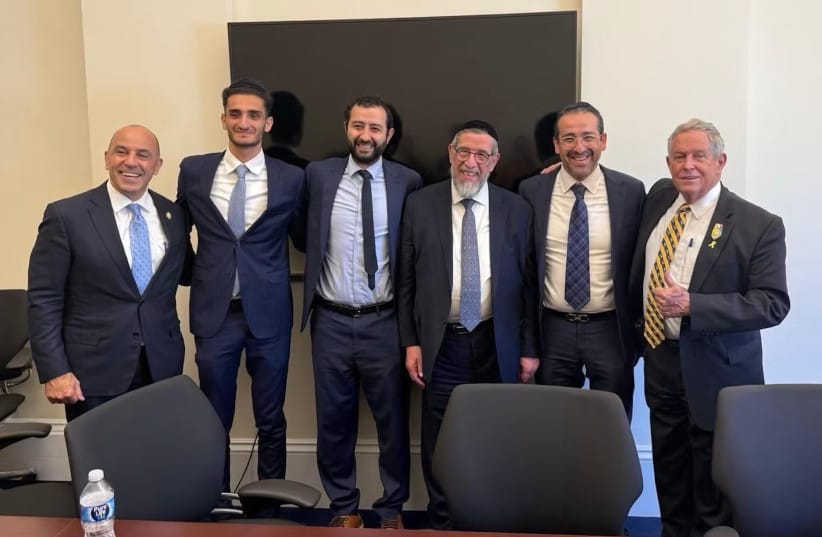
The culmination of their efforts, as both Moustafa and Hamra described it, was their visit to Washington in November 2025, the final push before passage of the defense authorization bill, into which they sought to insert a provision repealing the Caesar sanctions.
In a one-on-one meeting with South Carolina Republican Rep. Joe Wilson, Henry recounted that it was his father’s words that Wilson later said had changed his mind. When Wilson asked whether the new Syrian leadership would be good for Syria, Rabbi Hamra’s answer was simple: “I think everybody deserves another chance.”
A spokesperson for Wilson confirmed the meetings: “Wilson met with Rabbi Yosef and Henry Hamra on multiple occasions in the lead-up to the vote. Their perspective did give the Congressman encouragement,” the spokesperson wrote to JTA. “He mentioned the Rabbi’s stance on multiple occasions when advocating to colleagues.” Wilson has become an outspoken critic of Israel’s post-Assad regime incursions into the country, saying it is inhibiting the country’s rehabilitation.
Henry Hamra said Wilson carried that message throughout the sanctions fight. Moustafa also said it was the Hamra family’s testimony and meetings that helped bring around Rep. Gregory Meeks, the New Yorker who is the senior Democrat on the Foreign Relations Committee, and Rep. French Hill, an Arkansas Republican, two other figures who had stood in the way of sanctions relief.
Hill did not comment on the role of the Syrian Jewish expats in relieving the sanctions but said in a statement to JTA that the relief was necessary.
“The Trump administration is doing the right thing by re-engaging diplomatically and taking steps to help Syria rejoin the community of nations,” he said. “I will continue to work with my colleagues and stakeholders to ensure that American support advances responsible governance and lasting stability for the Syrian people.”
Meeks did not respond to multiple requests for comment.
Al-Sharaa was also in Washington during that period, working to build goodwill with the Trump administration. It was not al-Sharaa’s first meeting with Trump. In May 2025, al-Sharaa met with the president in Riyadh on the sidelines of a Gulf Cooperation Council summit.
Al-Sharaa had himself been designated a terrorist by the United States – a designation that was unwound only after Assad’s fall, with the bounty on his head lifted in December 2024 and the full designation removed in July 2025.
Ahmad Sharawi of the Foundation for Defense of Democracy said that meeting may have been the turning point for Trump’s decision to lift sanctions, which he did by executive order, though only those he could repeal unilaterally.
“What I think happened is that during President Trump’s visit to Riyadh, Mohammed bin Salman spoke with him, and convinced him in what I believe was a single conversation,” Sharawi said. “That’s when al-Sharaa met with Trump as well.”
He added, “I do think they [Syrian Jews] played a role with Congress when it came to the Caesar Act specifically, because it required congressional approval.”
Even with Saudi Arabia lobbying for sanctions relief, and, according to The New York Times, an intensive push by Syrian expatriates in the Gulf with stakes in development contracts and real estate in the rebuilding country, Congress still had to sign off on the repeal. Trump is a fan of al-Sharaa, calling him “attractive” and a “tough guy” when they met in Riyadh in May. Reports have already emerged of a Trump Tower planned for Damascus.
Israel remains wary of Syria’s new leadership
Moustafa knew that one of Syria’s other central challenges would be its relationship with Israel, a conflict that had never been formally resolved since Israel seized the Golan Heights in 1967. In the days after Assad’s fall, Israeli airstrikes destroyed up to 80% of Syria’s strategic military capabilities.
Moustafa vividly recalled the moment a missile struck outside the building where he had just finished a four-hour meeting with President al-Sharaa.
“About an hour after I left that meeting, Israel struck the front door of the presidential palace,” he said. “I heard it and watched it happen.” He added: “The Syrian president said to me, ‘I don’t want to go back to war for 7,000 more years.’”
Israel has maintained a harsh posture toward the new Syrian government since Assad’s fall. Netanyahu declared that Israel would not allow forces loyal to Syria’s new rulers to operate in southern Syria, and demanded full demilitarization of the provinces of Quneitra, Daraa, and Sweida.
An Israeli official told the Times of Israel that Netanyahu personally asked Trump not to lift sanctions on Syria during a visit to Washington, citing fears of a cross-border attack similar to Hamas’s Oct. 7 assault. Ron Dermer, Netanyahu’s close aide and minister of strategic affairs, was widely reported to have lobbied Congress to keep the sanctions in place, or at a minimum, to preserve conditions that would allow them to be reimposed.
Others in the Israeli security establishment are similarly skeptical. Sarit Zehavi, the founder and president of the Alma Research and Education Center in Israel, sees the new Syrian government as Islamist in all but name.
Zehavi’s family is originally from Damascus. As she recounted to JTA, her family of jewelers, among the wealthiest in the city, lived in the historic Beit Lisbona in the Harat al-Yahud, the old Jewish quarter.
When Bashar Assad was finally ousted in December 2024, Zehavi was eager to return and see her family’s home for the first time. Her own staff had to talk her out of it.
“My research staff had to convince me that there is no chance that I am going to Damascus in the near future to see my father’s house because things are not going to get better,” she said.
She was hopeful at first, but reports of massacres committed against Alawites on the coast, and then against the Druze in Sweida, soured her faith in the new government.
“It took a while until I understood that what is happening in Syria is far from liberation,” she said.
Zehavi said she was surprised by the lobbying undertaken by her fellow Jewish expats. “It seems counterintuitive that Syrian Jews living in Brooklyn would try to get the sanctions lifted on someone who was in Al-Qaeda. He’s a jihadist,” she said, while reserving her sharpest criticism for the Trump administration’s decision to lift the Caesar sanctions without conditions.
“You need timed demands and benchmarks that would indicate that Ahmed al-Sharaa is truly what we all hoped he would be,” she said. “They lifted it without any conditions. That’s the main problem.”
Zehavi is skeptical that the Syrian Jewish community’s goals will be served by the move.
“If what they said is true, that this way they can reestablish Jewish institutions in Damascus, that’s a very nice goal, and maybe they’re right,” she said. “But in the bigger picture, I’m not sure it will lead in a positive direction.”
Yosef Hamra had been scheduled to testify before the Helsinki Commission, the US branch of the multiparliamentary human rights monitor, during his visit to Congress in November 2025, but the hearing was canceled. In a copy of his prepared remarks obtained by JTA, he wrote: “It is a shame that today the Caesar Act punishes the Syrian people, Muslims, Christians and Jews, Arabs and Kurds, for the crimes of a regime that has been deposed.”
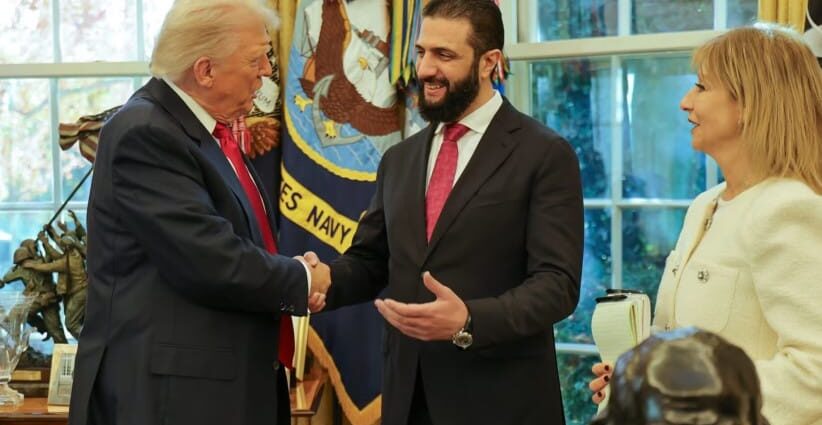
Before he met with Trump, Yosef Hamra, wearing a kippah, recited a blessing over Ahmad al-Sharaa.
It was an ending fit for such an improbable alliance: a Palestinian-Syrian activist and a Syrian Jewish cantor working together to reopen a country ripped apart by 14 years of civil war. For the Hamras, the blessing was more than a public declaration of faith in the new government – it was proof that something had shifted. But whether Syria’s future would bring democracy and equality for its multi-ethnic population was a question neither Hamra nor Moustafa could answer.