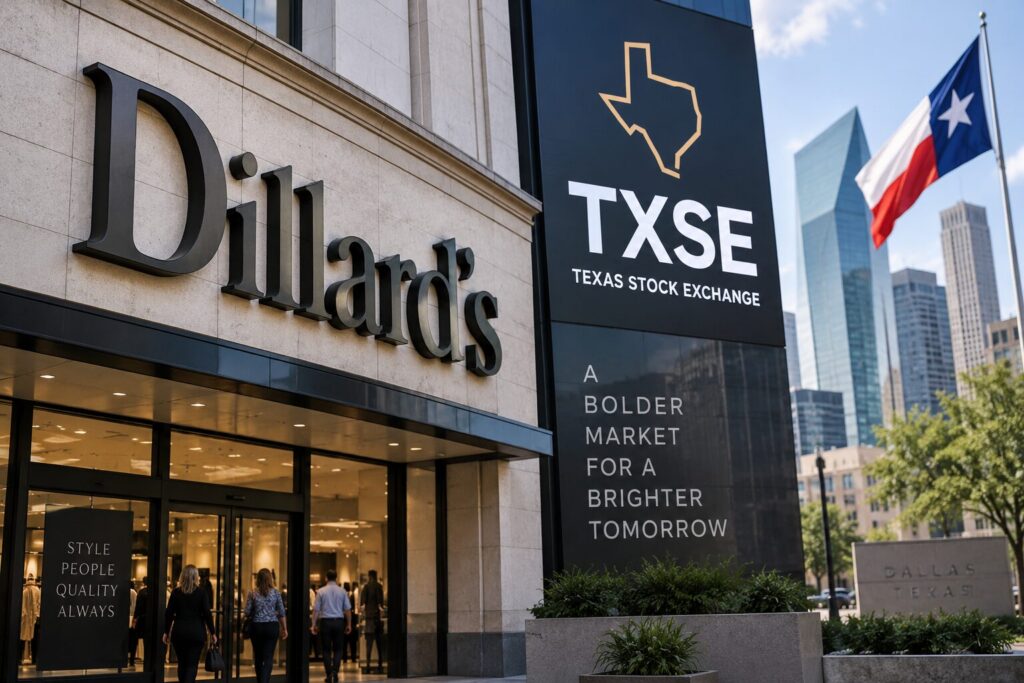
Dillard’s is leaving the New York Stock Exchange for the new Texas Stock Exchange, giving the Dallas-based marketplace a major retail name as it works to establish itself as an alternative to the country’s traditional exchanges.
The department-store chain announced Friday that it will voluntarily transfer the primary listings of its Class A common stock and its 7.50% Dillard’s Capital Trust I securities from the NYSE to the Texas Stock Exchange, or TXSE.
The switch is expected to happen quickly.
Dillard’s securities are scheduled to stop trading as primary listings on the NYSE after the market closes Friday, Oct. 2, and begin trading on TXSE when markets open Monday, Oct. 5.
The ticker symbols will remain the same: DDS for Dillard’s Class A shares and DDT for the capital securities.
Investors do not need to take any action because of the transfer, according to the company.
What Changing Exchanges Actually Means
For ordinary investors, the move is largely happening behind the scenes.
Publicly traded companies list their shares on exchanges that provide the infrastructure and rules governing how those securities trade. For decades, the New York Stock Exchange and Nasdaq have dominated U.S. stock listings.
Dillard’s is essentially changing the primary marketplace on which its securities are listed.
Someone who already owns Dillard’s shares does not need to sell them, exchange them or open a new brokerage account simply because of the move.
The company’s business also does not suddenly change because its shares are listed in Texas rather than New York.
What makes the decision significant is where Dillard’s has chosen to move: a new Texas-based exchange trying to establish itself in a market long dominated by New York.
Dillard’s Points to Deep Texas Roots
Dillard’s said the decision aligns its listing with its longstanding presence in Texas.
Founder William T. Dillard acquired a store in downtown Tyler, Texas, in 1956. Texas has since become Dillard’s largest market, with 54 locations across the state.
The company made another major move toward Texas last year when it reincorporated from Delaware to Texas in August 2025.
Dillard’s itself dates to 1938, when William T. Dillard invested $8,000 in a hometown department store in Nashville, Arkansas.
Today, the company operates 272 Dillard’s stores, including 28 clearance centers, across 30 states, along with its online retail business.
Its corporate headquarters remain in Little Rock, Arkansas.
Texas Builds Its Financial Footprint
The Dillard’s announcement carries significance beyond the retailer itself because Texas is attempting to expand its role in America’s financial markets.
The Texas Stock Exchange is headquartered in Dallas and is positioning itself as a new venue for companies seeking to list and trade securities.
For TXSE, attracting recognizable companies is an important part of establishing the exchange as a credible alternative in a business historically concentrated around the NYSE and Nasdaq.
Dillard’s brings a familiar consumer brand to that effort.
The move also comes as Texas continues attracting corporate investment and financial-sector activity, strengthening Dallas’ position as one of the country’s major business centers.
What It Means for Dillard’s Shoppers
For customers, practically nothing changes.
Dillard’s stores will continue operating normally, and the exchange transfer does not itself affect merchandise prices, online shopping, customer service or store operations.
The immediate impact is primarily financial and administrative.
For investors, Dillard’s shares will retain the DDS ticker they already know, while the company’s DDT securities will also retain their existing symbol.
The difference is that beginning Oct. 5, their primary exchange is expected to be TXSE rather than the NYSE.
For Texas, however, the symbolism is considerably larger.
A major American department-store chain is choosing a Texas-based exchange as the primary home for its publicly traded securities — another step in the state’s push to build financial-market infrastructure alongside the corporations, banks and investment firms already expanding their presence there.
Whether other major companies follow Dillard’s with primary-listing transfers will help determine how significant that shift ultimately becomes.
For now, Dillard’s investors keep the same securities and ticker symbols.
JBizNews Desk | Dallas, Texas
© JBizNews.com All Rights Reserved. Reproduction or distribution without written permission is prohibited.